MAPLEMONEYHUB.COM | CANADIAN FEDERAL BUDGET
Canada Federal Budget 2026: November 5 Release, Relief Measures and What to Expect
Published November 2, 2026 | Pre-budget guide
Quick Answer: What Relief Is Coming in Canada’s November 5 Budget?
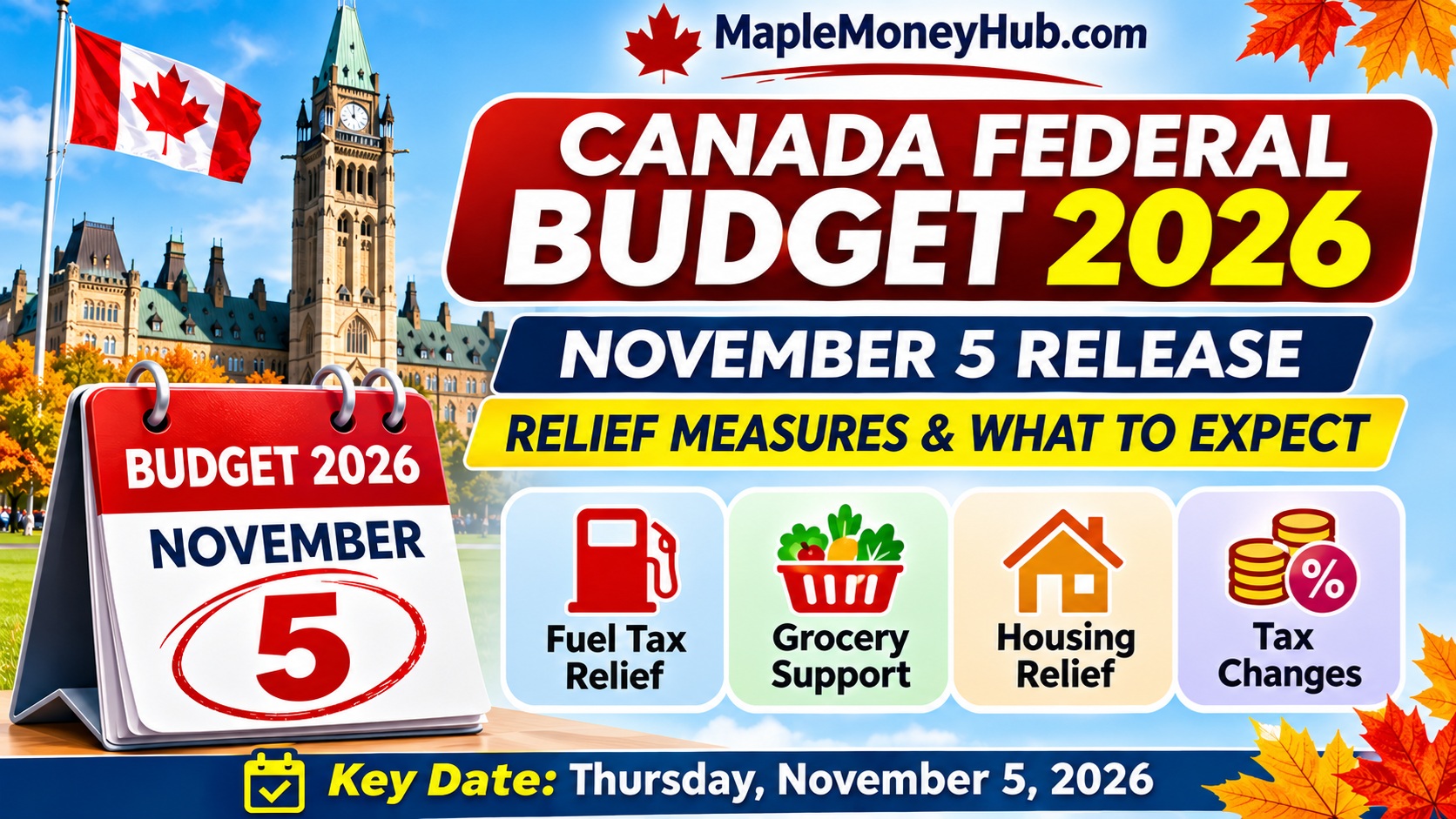
Canada’s 2026 federal budget will be released on Thursday, November 5, 2026. Finance Minister François-Philippe Champagne will present the government’s fiscal plan, which is expected to address affordability, housing, jobs, investment and economic security.
Existing federal measures include temporary fuel excise tax relief, grocery-related benefits, and a first-time home buyers’ GST/HST rebate. Whether Budget 2026 will extend, expand or introduce additional measures will only be confirmed when the official budget is published.
Important: As of November 2, no universal new November 2026 cash payment, special CRA bonus or automatic budget relief deposit has been confirmed by the budget announcement.
Canadians facing high grocery bills, rent, mortgage payments, transportation costs and other living expenses are watching the upcoming federal budget closely.
The November 5 announcement is particularly relevant to low- and middle-income households, seniors, families with children, renters, first-time homebuyers and people receiving federal benefits.
However, the difference between an existing program and a newly proposed measure matters. A federal budget can announce new spending, tax changes or benefits without making them immediately available.
This guide explains the confirmed budget date, relief programs already in place, areas to watch on November 5, and how Canadians can determine whether they qualify for assistance.
1. When Is Canada’s Federal Budget 2026 Being Released?
The Department of Finance Canada confirmed on October 20, 2026, that the federal budget will be tabled on Thursday, November 5, 2026.
Official budget date: November 5, 2026
Finance Minister: François-Philippe Champagne
Budget: Federal Budget 2026
Government priorities: Affordability, economic growth, investment, jobs and economic security
Status: Scheduled for release; final measures not yet published as of November 2.
The government’s official announcement describes plans to support investment, infrastructure and a more resilient economy while making life more affordable for Canadians.
Read the official Department of Finance announcement.
2. Which Relief Measures Are Confirmed and Which Are Still Possible?
Before budget day, Canadians should separate established federal policies from potential announcements.
| Measure | Current Status | What to Watch |
|---|---|---|
| Fuel excise tax relief | Existing temporary measure | Possible extension or modification |
| Canada Groceries and Essentials Benefit | Existing benefit | Any changes to eligibility or amounts |
| First-time homebuyer GST/HST rebate | Existing housing measure | Additional housing affordability policies |
| New renters’ tax credit | Discussed in pre-budget recommendations | Whether government formally proposes it |
| Home renovation tax relief | Potential policy area | Eligible renovations and tax-credit rules |
| New universal CRA cash payment | Not confirmed | Official announcement, if any |
Reminder: A proposal, recommendation or media discussion is not the same as an approved government benefit.
3. Fuel Tax Relief: Will Gasoline and Diesel Stay Cheaper?
Fuel prices are an important concern for commuters, rural households, delivery drivers and businesses.
The federal government introduced a temporary suspension of federal fuel excise taxes in April 2026, providing relief equivalent to 10 cents per litre on gasoline and 4 cents per litre on diesel.
The suspension was subsequently extended, with the current published schedule calling for full relief through January 31, 2027, followed by a partial restoration during February and March and a return to full rates in April 2027.
Budget 2026 could address this schedule, but any further extension must be confirmed in the official budget documents.
Example: How much could the gasoline tax suspension save?
Example fuel purchase: 50 litres
Suspended federal gasoline excise tax: 10 cents per litre
50 × $0.10 = $5.00
This is a simplified illustration of the suspended federal excise tax, not a guarantee of the exact change in pump prices. Retail pricing, other taxes and market conditions also matter.
Households should watch for any changes to the expiry date, tax rates and effective dates announced on November 5.
4. Grocery Relief: Will Canadians Receive More Support?
Food affordability remains a significant household concern. The Canada Groceries and Essentials Benefit (CGEB) is an existing federal benefit intended to support eligible low- and modest-income Canadians.
It should not be confused with an unconfirmed new grocery bonus supposedly arriving immediately after the budget.
For grocery-related relief, the main questions to watch on November 5 are whether the government proposes:
- Changes to existing benefit amounts.
- Different income thresholds.
- Additional assistance for families or seniors.
- Measures affecting food prices or supply chains.
- New implementation dates for any announced programs.
None of these potential changes should be treated as a confirmed Budget 2026 entitlement until the government publishes the details.
Readers can also use our Low Income Grocery Support Calculator to estimate benefits under the calculator’s stated assumptions. Actual entitlement is determined by the relevant government agency.
5. Housing Relief: First-Time Buyers, Renters and Homeowners
Housing affordability is another area to monitor when Budget 2026 is released.
An existing federal measure provides GST/HST relief for eligible first-time buyers purchasing certain newly built or substantially renovated homes.
The rebate can reach $50,000 on qualifying purchases, subject to the program’s detailed rules and price thresholds.
Because this measure predates the November budget, readers should not interpret it as a newly announced November 5 benefit.
Could renters receive new tax relief?
A refundable, income-tested renters’ tax credit has been discussed in pre-budget policy recommendations.
However, a recommendation does not establish that the federal government will include it in Budget 2026.
If a new renters’ credit is announced, important details will include eligible rent, household income limits, whether it is refundable, provincial interactions and the first tax year for claims.
Could homeowners receive renovation assistance?
Pre-budget discussions have also included potential tax incentives for home improvements related to energy efficiency, accessibility and housing quality.
Homeowners should wait for an official program description before beginning renovations based solely on speculation about a future tax credit.
6. Will Budget 2026 Change CRA Benefits?
Many Canadians are particularly interested in whether the federal budget will increase payments from the Canada Revenue Agency.
Programs that readers may want to monitor include the Canada Child Benefit, Canada Workers Benefit and Canada Groceries and Essentials Benefit.
Other federal programs, such as CPP, OAS and the Canada Disability Benefit, are administered through Service Canada rather than the CRA.
Any announced benefit increase would need to specify who qualifies, how much is payable, when the change begins and whether recipients must apply.
A budget announcement on November 5 does not automatically mean a new CRA deposit will arrive in November. New programs can require legislation, regulations, administrative setup or a future payment schedule.
For the already scheduled deposits, see our CRA November 2026 Benefit Payments guide.
7. Will Seniors Receive Additional CPP, OAS or GIS Relief?
Seniors may be watching for policies affecting retirement income, taxes, housing costs and essential expenses.
CPP retirement pensions are primarily determined by contribution history and the age at which a person begins receiving benefits.
OAS and GIS follow their own eligibility and adjustment rules.
Budget 2026 may discuss broader affordability policies affecting seniors, but a special pension increase or one-time payment should not be reported as confirmed without an official announcement.
Recipients should continue to use the published Service Canada payment schedule and account information for their existing benefits.
Related reading: OAS Payment Dates 2026.
8. Could Budget 2026 Change TFSA, RRSP or FHSA Rules?
Canadians saving for retirement or a first home may also be interested in possible tax-policy changes.
The three major registered savings arrangements have different rules:
- TFSA: Contribution room is determined under annual federal rules, with unused room generally carried forward.
- RRSP: Deduction room generally depends on prior earned income, applicable limits and pension adjustments.
- FHSA: Eligible first-time homebuyers can use the account under specific annual and lifetime contribution limits.
Pre-budget speculation about changes to registered accounts should not be treated as an announcement.
Before making a contribution, check your actual room and eligibility through CRA records and your financial institution.
9. Why Are Canadians Watching This Budget Closely?
Federal budget decisions affect both government finances and household costs.
Budget 2026 arrives amid concerns about economic growth, international trade, borrowing costs and affordability.
Government priorities include investment, infrastructure, employment and economic security. The budget will explain how the government proposes to fund and implement those priorities.
From a household perspective, the most useful questions are practical:
- Does a measure reduce a cost you currently pay?
- Does it create a tax credit or cash benefit?
- Are you eligible based on your income or family circumstances?
- When would the measure actually begin?
- Does it require an application or tax filing?
- Is the proposal subject to parliamentary approval?
These details often matter more than the headline amount of a proposed spending package.
10. How to Check the Official Federal Budget on November 5
The most reliable way to verify new measures is through the Government of Canada’s official publications.
- Visit the Department of Finance Canada website on November 5.
- Find the official Budget 2026 documents.
- Read the affordability and tax-measures sections.
- Identify the exact eligibility rules for each proposed benefit.
- Check effective dates and whether legislation is required.
- Use CRA or Service Canada pages for subsequent application and payment instructions.
Visit Department of Finance Canada
11. Federal Budget 2026: Questions and Answers
What date is Canada’s 2026 federal budget?
The federal budget is scheduled for Thursday, November 5, 2026.
Who will present the federal budget?
Finance Minister François-Philippe Champagne is scheduled to table Budget 2026.
Will Canadians receive a new relief payment in November?
No universal new November payment has been confirmed by the budget-date announcement. Any new benefit must be verified against the actual budget and subsequent program guidance.
Will the grocery benefit increase?
Any Budget 2026 change to the Canada Groceries and Essentials Benefit remains unconfirmed until the government releases the budget details.
Will the federal fuel tax suspension continue?
The existing temporary relief has a published phase-out schedule extending into 2027. Whether the government changes that schedule is an issue to watch on November 5.
Will renters get a new federal tax credit?
A renters’ tax credit has appeared in pre-budget policy discussions, but it has not been confirmed as an enacted new Budget 2026 measure.
Will CPP and OAS payments increase immediately?
There is no basis to assume an immediate special increase solely because a budget is being presented. Existing pension adjustment rules continue unless official changes are announced and implemented.
Where can I find official budget information?
Use the Department of Finance Canada website and the official Budget 2026 publications released on November 5.
12. What MapleMoneyHub Will Check After November 5
Once Budget 2026 is published, the most important updates to this guide will be:
| Budget Item | Information to Confirm |
|---|---|
| New cash benefits | Amounts, eligibility and payment dates |
| Grocery assistance | Changes to CGEB and related programs |
| Fuel tax relief | Extension, expiry or revised rates |
| Housing measures | Rebates, credits and qualifying conditions |
| Income tax changes | Tax years, thresholds and effective dates |
| Seniors and disability support | Any officially announced program changes |
Publication note: This article was prepared before the November 5 budget release. It should be updated with the official Budget 2026 measures, exact amounts and implementation dates after publication.
13. TL;DR: Federal Budget November 5 Relief Measures
- Budget release: Thursday, November 5, 2026.
- Finance Minister: François-Philippe Champagne.
- Confirmed priorities: Affordability, housing, jobs, investment and economic security.
- Existing relief: Temporary fuel tax suspension, grocery-related benefits and housing rebates.
- Measures to watch: Fuel relief changes, housing tax credits and any additional targeted assistance.
- Not confirmed: A universal new November CRA cash bonus or immediate payment for every Canadian.
- Next step: Review the official November 5 budget for eligibility, amounts and start dates.
Official Sources and Further Reading
- Department of Finance Canada — Budget 2026 Release Announcement
- Department of Finance Canada — Official Website
- Canada Revenue Agency — Benefits and Taxes
- Government of Canada — Benefits
Editorial disclaimer: MapleMoneyHub.com is an independent information website and is not affiliated with the Government of Canada. This article describes confirmed announcements and possible policy areas as of November 2, 2026. Budget proposals may require legislation or additional implementation steps before taking effect.