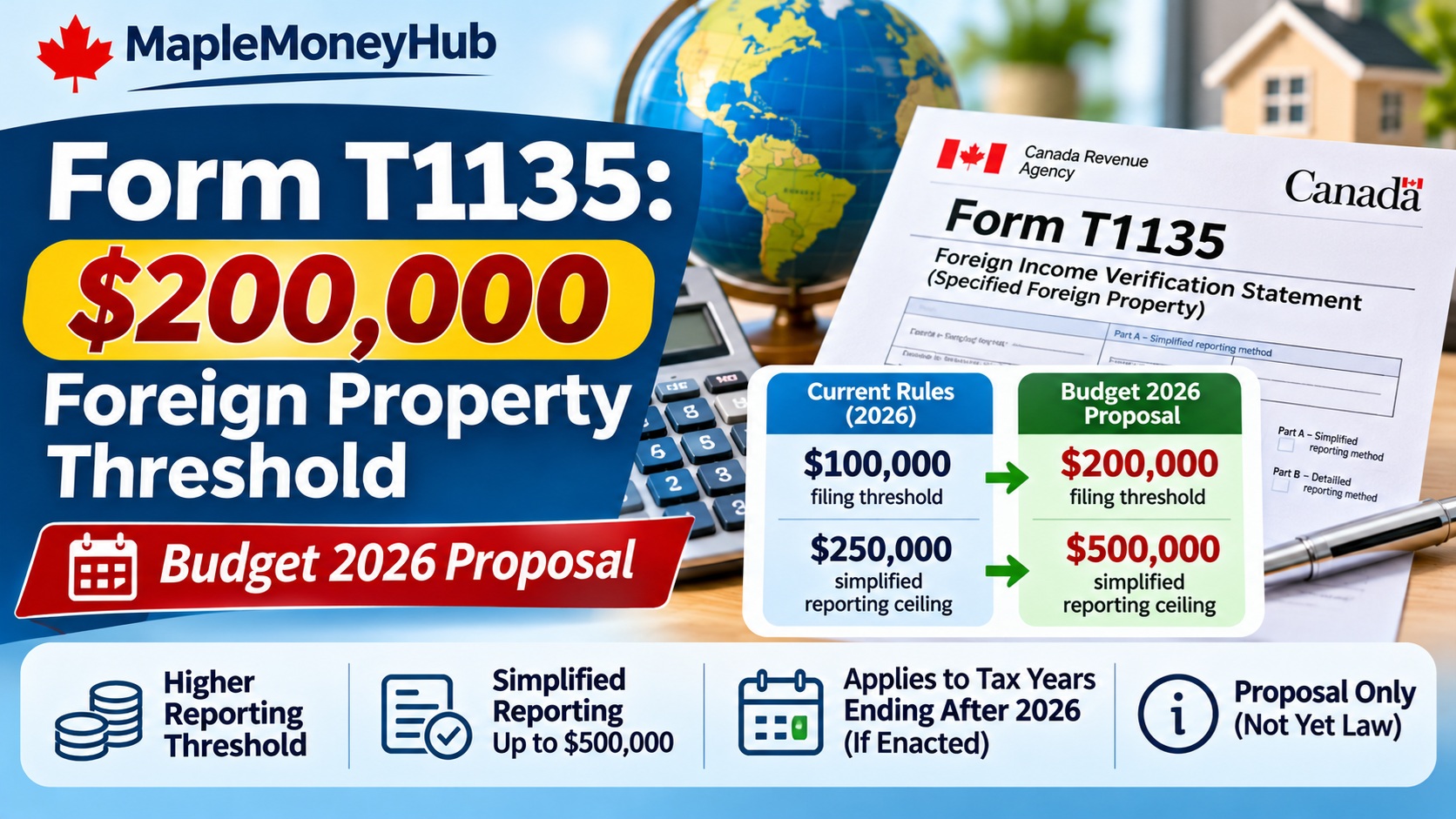
Form T1135 Foreign Property Reporting: New $200,000 Threshold Explained
Canada’s 2026 federal budget proposes a major change to Form T1135, the Foreign Income Verification Statement used to report certain foreign assets to the Canada Revenue Agency (CRA).
The proposal would double the reporting threshold from $100,000 to $200,000 and increase the simplified reporting threshold from $250,000 to $500,000.
What Is Form T1135?
Form T1135 is a CRA information return used by certain Canadian residents to disclose specified foreign property. It helps the CRA verify compliance with Canadian tax laws involving foreign investments and income.
It is not a tax payment form. Filing T1135 does not automatically mean that you owe additional tax.
However, income and taxable gains from foreign investments may still need to be reported on your Canadian income tax return.
What Is Changing Under Budget 2026?
| Requirement | Current rules | Budget 2026 proposal |
|---|---|---|
| Foreign property filing threshold | More than $100,000 | More than $200,000 |
| Simplified reporting | More than $100,000 but below $250,000 | More than $200,000 but below $500,000 |
| Detailed reporting threshold | $250,000 or more | $500,000 or more |
| Effective period | Existing requirements | Tax years or fiscal periods ending after 2026 |
| Legislative status | Current rules | Proposed; subject to enactment |
The government estimates that approximately one-third of current Form T1135 filers would no longer need to file under the proposed higher threshold.
Who Must File Form T1135?
Under the current rules, Form T1135 generally applies to Canadian-resident individuals, corporations, certain trusts and qualifying partnerships that hold specified foreign property with a combined cost amount exceeding $100,000 at any time during the relevant reporting period.
If the proposed changes become law, the filing threshold would increase to more than $200,000 for applicable periods ending after 2026.
What Foreign Property Counts Toward the Threshold?
The reporting test generally considers specified foreign property rather than every asset physically located outside Canada.
| Asset | Generally reportable? | Explanation |
|---|---|---|
| Foreign bank account | Yes | Foreign deposits generally count. |
| Shares of foreign corporations | Yes | May count even when held through a Canadian broker. |
| Foreign rental property | Yes | Income-producing foreign real estate generally counts. |
| Foreign mutual fund | Generally yes | Interests in non-resident funds may be specified foreign property. |
| Personal-use vacation home | Generally no | Property primarily held for personal use is excluded. |
| Foreign investments inside an RRSP or TFSA | Generally no | Specified property held inside these registered plans is excluded. |
| Canadian mutual fund holding foreign stocks | Generally no | The investment is generally in a Canadian fund, not directly in its foreign holdings. |
Property used or held exclusively in carrying on an active business is also generally excluded.
Complex holdings, trusts and partnership interests may require professional review.
Does the $200,000 Threshold Mean Market Value?
No. Form T1135 generally uses the cost amount of specified foreign property, not its current market value.
For many investments, this is broadly related to adjusted cost base. Foreign currency conversions and certain transactions can affect the amount reported.
Example: Foreign Investments Worth $240,000
Suppose a Canadian resident purchased foreign shares for CAD $180,000. Those shares later increased in market value to $240,000.
Assuming the adjusted cost base remains $180,000 and the taxpayer has no other specified foreign property, the filing threshold test generally uses $180,000, not $240,000.
Under the current $100,000 threshold, Form T1135 would generally be required. Under the proposed $200,000 threshold, the taxpayer would generally fall below the filing threshold.
What Happens If You Own $150,000 in Foreign Assets?
This is one of the most important situations affected by the proposal.
| Tax year | Specified foreign property cost | General filing result |
|---|---|---|
| 2026 | $150,000 | T1135 required under current rules |
| 2027, if proposal enacted | $150,000 | T1135 generally not required |
| 2027, if proposal enacted | $300,000 | T1135 required; simplified reporting generally available |
| 2027, if proposal enacted | $550,000 | T1135 required; detailed reporting generally applies |
Examples assume a calendar-year taxpayer, no relevant exclusions and the proposed legislation taking effect as announced.
What If Your Foreign Assets Exceed the Limit for Only One Day?
The filing test considers whether the combined cost amount of specified foreign property exceeded the applicable threshold at any time during the year.
Selling an investment before December 31 does not automatically eliminate a filing requirement that arose earlier in the year.
For example, under current rules, a taxpayer whose specified foreign property cost amount reached $125,000 during 2026 may need to file T1135 even if the year-end amount fell to $70,000.
What Is Simplified Reporting on Form T1135?
Form T1135 currently has two reporting methods:
- Part A: Simplified reporting for eligible taxpayers whose specified foreign property cost exceeds $100,000 but remains below $250,000 throughout the year.
- Part B: Detailed reporting for taxpayers whose specified foreign property reaches $250,000 or more at any time during the year.
Budget 2026 proposes increasing the simplified reporting ceiling to less than $500,000.
That means many taxpayers with foreign property costing between $250,000 and $500,000 could use a less detailed reporting method if the changes become law.
Do You Still Need to Report Foreign Income?
Yes. The proposed higher T1135 filing threshold does not eliminate the requirement to report taxable foreign-source income.
For example, a Canadian resident earning interest from a foreign bank account may still need to include that interest on their Canadian income tax return, even when no T1135 is required.
Similarly, foreign dividends, rental income and taxable capital gains may have Canadian tax reporting consequences.
When Is Form T1135 Due?
The Form T1135 filing deadline generally follows the taxpayer’s income tax return filing deadline, or the partnership information return deadline where applicable.
Individuals should check their applicable CRA filing deadline, especially when they or their spouse or common-law partner have self-employment income.
The CRA permits electronic filing of Form T1135 for eligible tax years through supported filing methods.
What Are the Penalties for Not Filing T1135?
The CRA may assess penalties for failing to file a required Form T1135 on time or for providing inaccurate information.
The ordinary late-filing penalty under the relevant information-return provisions is generally $25 per day, subject to a minimum of $100 and a maximum of $2,500. Additional penalties can apply in more serious circumstances.
Taxpayers who discover an omission should review the CRA’s amendment, taxpayer relief and voluntary disclosure procedures.
Because foreign property reporting can involve significant penalties, seek advice from a qualified Canadian tax professional when the filing position is uncertain.
What Should Canadians Do Before Filing Their 2026 Taxes?
- List your foreign assets. Identify foreign accounts, investments, real estate and other potentially reportable property.
- Exclude qualifying property. Separate personal-use property, registered-plan holdings and other excluded assets.
- Calculate cost amounts. Use Canadian-dollar cost amounts and appropriate foreign exchange records.
- Check the highest amount during 2026. Do not rely only on December 31 balances.
- Apply current rules. Use the $100,000 threshold for 2026 unless the law is changed to apply differently.
- Monitor the proposed changes. Confirm whether the $200,000 threshold is enacted before relying on it for later tax years.
- Report foreign income separately. Do not assume that an exemption from T1135 filing eliminates income tax reporting obligations.
Frequently Asked Questions
Has the T1135 threshold increased to $200,000?
Budget 2026 proposes the increase. As of November 7, 2026, it should not be treated as an enacted change. The government proposes application to tax years or fiscal periods ending after 2026.
Will I need to file T1135 for $175,000 in foreign investments?
Under current rules, generally yes, assuming the investments are specified foreign property and the cost amount exceeded $100,000 during the year. Under the proposed rules for applicable later years, that amount would generally fall below the new filing threshold.
Does the threshold apply to each investment separately?
No. The test generally uses the combined cost amount of all specified foreign property.
Are U.S. stocks held in a Canadian brokerage account included?
Generally yes. Holding shares of a non-resident corporation through a Canadian broker does not by itself exclude those shares from T1135 reporting.
Is foreign property inside a TFSA reportable?
Specified foreign property held inside a TFSA or RRSP is generally excluded from Form T1135 reporting. Other tax rules may still apply.
Do newcomers to Canada file T1135 immediately?
An individual generally does not have to file Form T1135 for the tax year in which they first became resident in Canada. Different requirements may apply in later years.
Does the $200,000 threshold eliminate tax on foreign income?
No. It concerns the filing of an information return, not whether foreign-source income is taxable in Canada.
Official Sources
This article uses primary information from the Department of Finance Canada and the Canada Revenue Agency.
TL;DR: Form T1135 $200,000 Threshold
- Budget 2026 proposes raising the foreign property filing threshold from $100,000 to $200,000.
- The simplified reporting ceiling would rise from $250,000 to $500,000.
- The proposed changes would apply to tax years or fiscal periods ending after 2026.
- The proposal is not the same as an enacted tax-law change.
- The test generally uses cost amount, not market value.
- Foreign income may remain taxable even if no T1135 is required.
Published by: MapleMoneyHub Editorial Team. Information reviewed: November 7, 2026. This article is based on the Budget 2026 proposal and current CRA guidance. Legislative details may change. MapleMoneyHub is an independent educational website and is not affiliated with the CRA. This information is not personalized tax or legal advice.