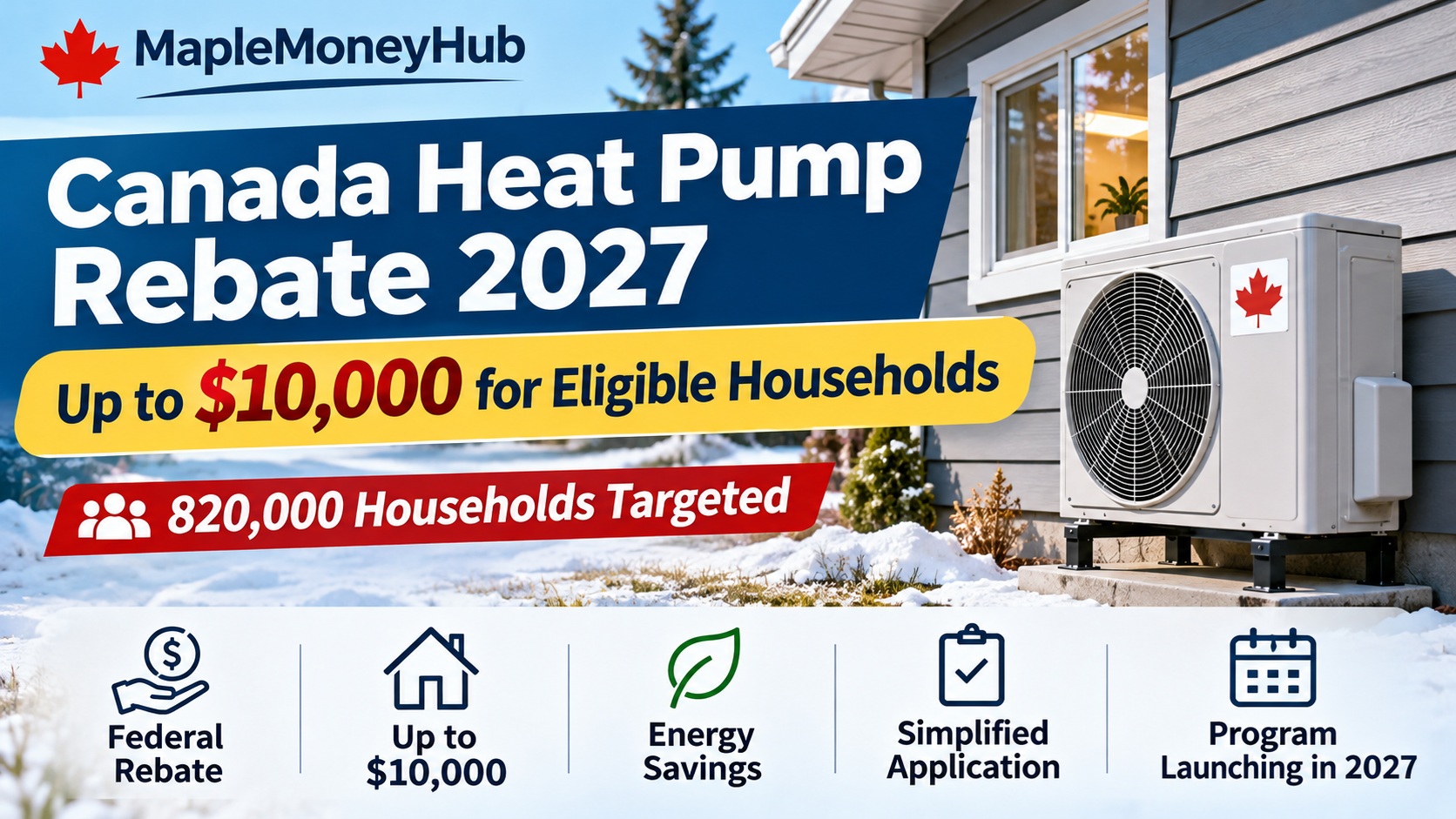
Canada’s new National Heat Pump Rebate Program is intended to make efficient home heating and cooling more affordable. The federal initiative aims to help up to 820,000 households switch to eligible electric cold-climate heat pumps.
Announced on October 8, 2026, the program forms part of a broader federal commitment of more than $2 billion over eight years to support home energy retrofits.
What Is the National Heat Pump Rebate Program?
The National Heat Pump Rebate Program is a federal financial incentive intended to reduce the upfront cost of replacing older heating systems with more efficient electric heat pumps.
Unlike a conventional furnace, a heat pump transfers heat between indoor and outdoor air. Many modern cold-climate systems can heat a home during Canadian winters while also providing cooling during summer.
The initiative is intended to address a common problem: homeowners often need to replace a failed furnace or heating system quickly and may not have time to complete lengthy rebate procedures.
The government’s proposed process is designed to make the rebate easier to access when a heating system breaks down or approaches the end of its useful life.
How Much Is the Heat Pump Rebate?
The federal announcement identifies two main rebate levels.
| Household category | Announced federal rebate | Important condition |
|---|---|---|
| Households below the median income | Up to $10,000 | Must meet applicable income, homeowner and equipment requirements. |
| Other eligible homeowners | $2,000 | Must install an eligible heat pump and satisfy program rules. |
The announced rebates may be combined with existing provincial incentives, subject to the rules of the programs involved.
However, a homeowner should not assume that every heat pump installation automatically qualifies for the maximum federal rebate.
Who Is Eligible for the National Heat Pump Rebate?
The federal backgrounder identifies homeowners installing eligible electric cold-climate air-source heat pumps as the intended recipients.
Key announced requirements include:
- The applicant must satisfy the program’s homeowner eligibility rules.
- The heat pump must appear on the official Eligible Products List.
- The applicant must meet the applicable income requirements for the higher rebate, if claiming that amount.
- Only one rebate per person is permitted.
- The installation and purchase must satisfy the program’s final rules.
The government says its eligible equipment list contains more than 100,000 heat pump options suitable for Canadian conditions.
The one-rebate-per-person restriction is important for property owners with multiple homes.
For example, the federal backgrounder explains that a landlord receiving a rebate for a rental property cannot also claim another rebate for a heat pump in their own residence.
When Will Applications Open?
The National Heat Pump Rebate was announced in October 2026, with implementation expected in 2027.
The government has described a streamlined online application system. However, the official federal backgrounder does not establish a confirmed public application-opening date or provide a live application link for homeowners.
Homeowners should monitor official Government of Canada announcements for the application portal, opening date and complete program rules.
How Will the Application Process Work?
According to the federal announcement, the planned process is intended to be simpler than some previous home retrofit programs.
- Check eligibility: Confirm the household and property meet the published program conditions.
- Choose approved equipment: Select a heat pump included on the government’s eligible product list.
- Submit an online application: Provide basic homeowner information and details of the proposed equipment.
- Receive approval: The government intends to provide application approvals within 24 hours.
- Install the system: Arrange installation according to the program’s requirements.
- Upload receipts: Submit the required purchase and installation documentation online.
- Receive the rebate: The announced process aims to approve payments within five days after eligible receipts are submitted.
These are announced service targets, not guaranteed processing times for every application.
Applicants should not begin work based solely on an assumed approval or reimbursement.
Do You Need an Energy Audit?
The federal government says the National Heat Pump Rebate will not require energy audits before or after installation.
This is a notable difference from some earlier Canadian home energy retrofit programs.
Removing the audit requirement may make the program easier to use when an existing furnace fails unexpectedly.
Homeowners may still need documentation showing that their selected equipment and installation satisfy the program rules.
How Much Could a Heat Pump Save on Energy Bills?
The federal government estimates average annual energy bill savings of more than $1,400 for households switching from oil, propane or electric resistance heating.
This is a government estimate, not a guaranteed saving for every Canadian household.
Actual savings depend on:
- The current heating fuel.
- Local electricity prices.
- Existing furnace efficiency.
- Home insulation and air sealing.
- Climate and winter temperatures.
- Heat pump size and performance.
- Whether backup heating is required.
- Household heating and cooling habits.
Example: Comparing Installation Costs
Consider a hypothetical homeowner who receives a heat pump quote of $12,000, including installation.
| Example | Calculation | Remaining cost |
|---|---|---|
| No rebate | $12,000 – $0 | $12,000 |
| $2,000 federal rebate | $12,000 – $2,000 | $10,000 |
| $10,000 federal rebate | $12,000 – $10,000 | $2,000 |
These are illustrative calculations, not actual installation quotes or approved rebate amounts. Taxes, electrical upgrades, backup heating and other expenses may affect the final cost.
For a more realistic comparison, request itemized quotes from qualified local HVAC installers and ask which costs are included.
Can You Combine Federal and Provincial Rebates?
The federal announcement says National Heat Pump Rebates may be combined with existing provincial incentives.
This could make the upfront cost more manageable for some homeowners.
However, provincial programs may have separate conditions involving:
- Home location and ownership.
- Existing heating equipment.
- Household income.
- Approved installers and products.
- Maximum combined incentives.
- Required pre-approval.
Is the New Rebate the Same as the Oil to Heat Pump Program?
No. The National Heat Pump Rebate is a newly announced initiative. It should not be confused with the existing Oil to Heat Pump Affordability Program or the Canada Greener Homes Affordability Program.
These initiatives may differ in their funding arrangements, eligible households, equipment requirements and application procedures.
For information on existing federal energy programs, consult Natural Resources Canada .
What Should Homeowners Do Before Applying?
Because replacing a heating system can involve a substantial expense, homeowners should prepare before committing to an installation.
- Identify your existing heating system. Record whether you currently use oil, propane, electric baseboards, natural gas or another system.
- Check your household income. Keep relevant tax and income records available for future eligibility checks.
- Request detailed quotes. Compare equipment, installation, warranty, electrical work and backup heating requirements.
- Ask about cold-climate performance. Choose equipment appropriately sized for your home’s heating needs.
- Verify approved products. Confirm the model appears on the official list when it becomes available.
- Check provincial incentives. Review whether another program can be combined with the federal rebate.
- Wait for official application instructions. Do not assume a purchase made before program opening will qualify.
How to Avoid Heat Pump Rebate Scams
New government rebate announcements can attract misleading advertising and fraudulent application websites.
Be cautious of companies or websites that promise guaranteed approval, demand an application fee through an unofficial portal or request sensitive information without explaining why it is needed.
- Use official Government of Canada websites to verify program information.
- Check contractor credentials and business details.
- Request written quotes and warranties.
- Do not share online banking passwords.
- Avoid offers claiming that every household automatically qualifies for $10,000.
Frequently Asked Questions
Is Canada giving $10,000 for heat pumps?
The government has announced rebates of up to $10,000 for eligible households below the median income. Other qualifying homeowners may receive $2,000.
Will 820,000 households automatically receive a rebate?
No. The 820,000 figure represents the intended scale of the program, not an automatic payment to that many households. Applicants must satisfy the program’s eligibility rules.
Can renters apply?
The announced program is directed at homeowners installing eligible heat pumps. Renters should not assume they can apply independently without confirmation in the official program rules.
Can landlords qualify?
The federal backgrounder includes an example involving landlords, but also specifies a one-rebate-per-person limit. Landlords should review the final eligibility conditions before proceeding.
Do I need to replace a broken furnace?
Not necessarily. The government says homeowners may apply when their existing heating system approaches the end of its useful life, as well as when it fails.
Is the $1,400 annual saving guaranteed?
No. It is an average estimate for certain heating system conversions. Individual savings depend on energy prices, equipment and household conditions.
Can I apply through the CRA?
The announced process describes a dedicated online rebate portal. It should not be assumed to be a CRA tax credit or a payment available through CRA My Account.
Official Government Sources
The information in this article is based primarily on the Government of Canada’s October 8, 2026 announcement and Budget 2026.
TL;DR: National Heat Pump Rebate Canada
- Canada has announced a new National Heat Pump Rebate.
- The initiative aims to support up to 820,000 households.
- Eligible below-median-income households may receive up to $10,000.
- Other eligible homeowners may receive $2,000.
- The announced process does not require pre- or post-installation energy audits.
- Federal and provincial incentives may be combined where permitted.
- Homeowners should verify the official application-opening date and full eligibility rules.
Editorial information: Published by MapleMoneyHub Editorial Team. Information reviewed November 6, 2026, using official federal government sources. MapleMoneyHub is an independent educational website and is not affiliated with the Government of Canada. Rebate availability and eligibility may change as the program is implemented.