MAPLEMONEYHUB.COM | CANADIAN SAVINGS & TAXES
2027 TFSA Contribution Limit Canada: Will It Increase to $7,500?
Updated November 4, 2026 | Canada Revenue Agency
Quick Answer: What Is the 2027 TFSA Contribution Limit?
The 2027 TFSA contribution limit has not yet been officially announced by the Canada Revenue Agency as of November 4, 2026.
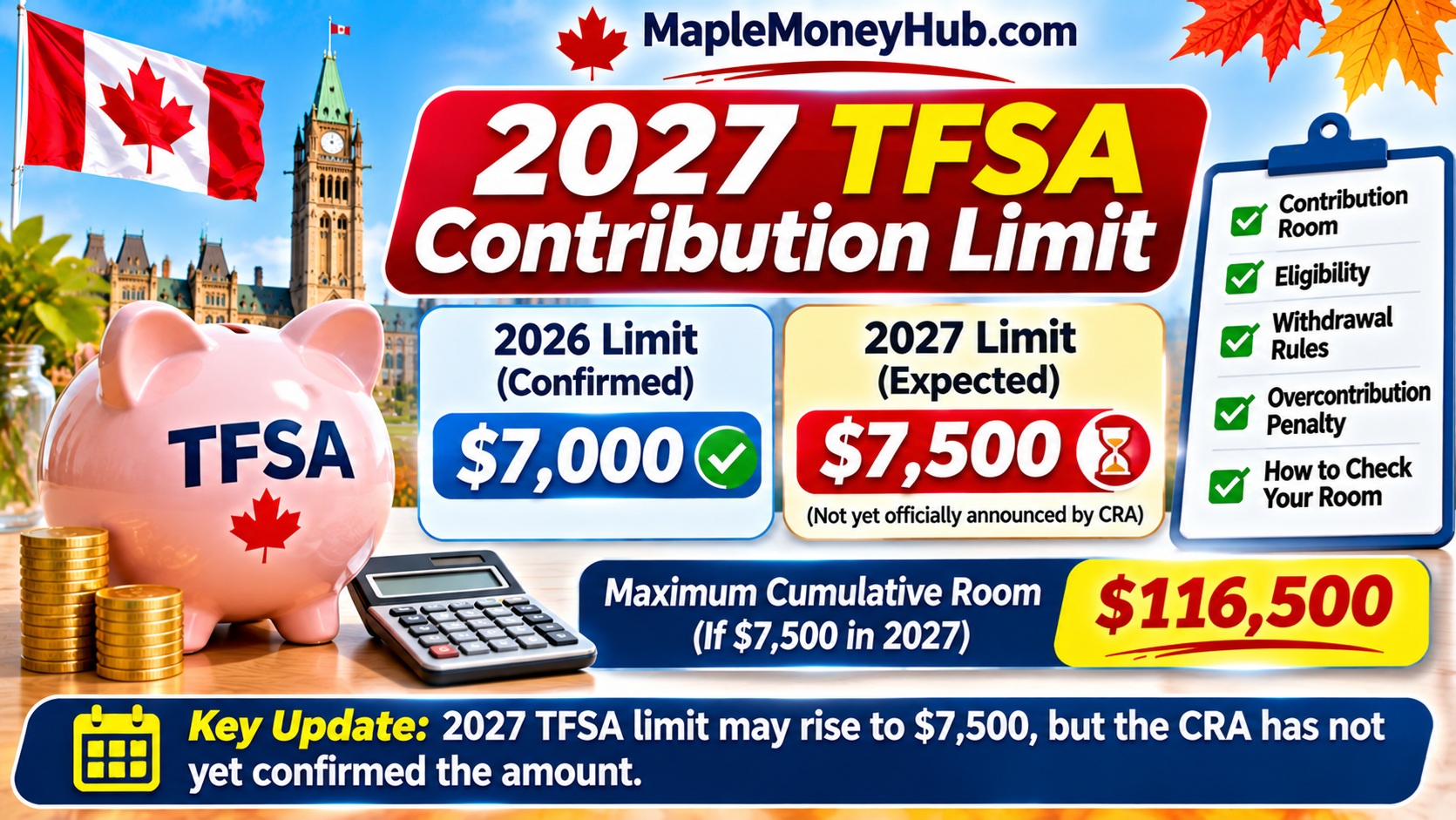
The confirmed annual TFSA limit for 2026 is $7,000. Financial commentators have suggested that the 2027 limit could increase to $7,500, depending on the inflation-indexation calculation.
TFSA contribution limits are indexed to inflation and rounded to the nearest $500.
If the 2027 limit becomes $7,500, the maximum cumulative TFSA room for someone eligible every year since 2009, with no previous contributions, would be $116,500.
Important: The $7,500 figure and $116,500 cumulative total are projections, not confirmed CRA limits.
Canadians planning their savings for 2027 are watching for the next Tax-Free Savings Account contribution limit announcement.
A TFSA allows eligible Canadians to save and invest without paying Canadian income tax on most investment earnings and withdrawals.
Unlike a Registered Retirement Savings Plan (RRSP), TFSA contributions do not provide an income tax deduction. However, eligible investment growth and withdrawals are generally tax-free.
Understanding your contribution room is essential because contributing more than your available room can result in a CRA penalty.
1. Has the CRA Announced the 2027 TFSA Limit?
As of November 4, 2026, the CRA has not published a confirmed 2027 TFSA dollar limit in its official annual limit table.
The most recent confirmed limit is $7,000 for 2026.
Canada’s TFSA dollar limit is adjusted annually using inflation-indexation rules. Because the limit is rounded to the nearest $500, it does not necessarily increase every year.
The CRA announced the 2026 TFSA limit on December 1, 2025. The announcement date for 2027 has not yet been confirmed.
Check the CRA’s official TFSA dollar limit table for the final figure.
2. 2027 TFSA Limit Compared With Previous Years
| Year | Annual TFSA Limit | Status |
|---|---|---|
| 2027 | $7,500 possible | Not confirmed |
| 2026 | $7,000 | Confirmed |
| 2025 | $7,000 | Confirmed |
| 2024 | $7,000 | Confirmed |
| 2023 | $6,500 | Confirmed |
| 2019–2022 | $6,000 each year | Confirmed |
| 2016–2018 | $5,500 each year | Confirmed |
| 2015 | $10,000 | Confirmed |
| 2013–2014 | $5,500 each year | Confirmed |
| 2009–2012 | $5,000 each year | Confirmed |
The 2027 amount shown above is an illustrative projection. It should not be treated as an official contribution limit until confirmed by the CRA.
3. Maximum Lifetime TFSA Contribution Room in 2027
The cumulative TFSA dollar limits from 2009 through 2026 total $109,000.
This amount represents the maximum available room for a person who was eligible in every year since the TFSA began in 2009, remained eligible throughout that period and never contributed.
Projected Maximum TFSA Room
Cumulative room through 2026: $109,000
Possible 2027 annual limit: $7,500
$109,000 + $7,500 = $116,500
Projected cumulative room for an eligible person who has never contributed: $116,500.
If the 2027 limit instead remains $7,000, the corresponding cumulative total would be $116,000.
These totals are not universal lifetime caps. Personal TFSA room can also be affected by previous contributions, withdrawals, residency and eligibility history.
4. How Does TFSA Contribution Room Work?
Every eligible Canadian resident accumulates TFSA contribution room beginning in the year they turn 18.
You do not need to open a TFSA immediately to begin accumulating room.
Unused room carries forward to future years.
The basic calculation is:
Available TFSA room at the beginning of a year =
Unused room from previous year
+ New annual TFSA dollar limit
+ Withdrawals made during the previous calendar year
Your available room is reduced by contributions you make during the current year.
For example, suppose you have $4,000 of unused contribution room at the end of 2026 and make no withdrawals that year.
If the 2027 limit is confirmed at $7,500, your available room on January 1, 2027 would be:
$4,000 + $7,500 = $11,500.
However, if the new annual limit is $7,000, your room would be $11,000 instead.
5. When Does New TFSA Contribution Room Become Available?
New annual TFSA contribution room becomes available on January 1 of the applicable calendar year.
For 2027, that means the new annual dollar limit will become available on January 1, 2027 to eligible individuals.
You do not need to wait until you file your 2026 income tax return to receive the new annual room.
However, you should calculate your actual available room carefully before contributing.
6. What Happens if You Withdraw Money From Your TFSA?
TFSA withdrawals generally do not permanently eliminate contribution room.
Instead, the amount withdrawn becomes available as new contribution room on January 1 of the following calendar year.
Example: Withdrawal in 2026
Suppose you withdraw $10,000 from your TFSA on September 15, 2026.
That withdrawal does not automatically create $10,000 of additional contribution room in September 2026.
Instead, the $10,000 is added back to your available contribution room on January 1, 2027.
If the 2027 annual limit is $7,500, you could receive $17,500 of additional room from the annual limit and the withdrawal combined, before considering other unused room or contributions.
Do not withdraw money from a TFSA and immediately recontribute it in the same calendar year unless you already have sufficient unused contribution room. Otherwise, you may trigger a CRA overcontribution tax.
7. What Is the CRA Penalty for Exceeding Your TFSA Limit?
The CRA generally charges a tax of 1% per month on the highest excess TFSA amount in that month.
For example, suppose you exceed your available contribution room by $5,000 and the excess remains throughout three calendar months.
Excess contribution: $5,000
Monthly tax: 1%
Monthly penalty: $50
Three-month tax = $150
This is a simplified example. The actual tax depends on the highest excess amount in each month and when the excess is corrected.
Additional tax rules can apply to non-resident contributions, prohibited investments and other situations.
If you discover an excess contribution, review the CRA’s instructions and take prompt corrective action.
8. How to Check Your TFSA Contribution Room Through CRA My Account
You can review the TFSA information available in your CRA account.
- Visit the official CRA account sign-in page.
- Sign in using your CRA credentials or an available Sign-In Partner.
- Complete multi-factor authentication.
- Find the TFSA section in your account.
- Review your reported contribution room and transaction history.
- Compare CRA records against statements from every financial institution where you hold a TFSA.
- Account for recent contributions and withdrawals that may not yet appear in CRA records.
Financial institutions report TFSA transactions to the CRA after the calendar year ends. Therefore, the amount displayed in CRA My Account may not reflect recent transactions.
The CRA states that TFSA records for 2025 were processed by April 2026. The timing of 2026 transaction updates will depend on the CRA’s subsequent reporting cycle.
9. Who Can Open and Contribute to a TFSA in 2027?
Generally, you must be at least 18 years old and have a valid Social Insurance Number to open a TFSA.
Canadian residents begin accumulating contribution room in the year they turn 18.
Some provinces and territories have a higher legal age for entering into certain financial contracts. In those jurisdictions, individuals may need to wait until age 19 to open an account, even though contribution room begins accumulating at age 18.
Non-residents should exercise particular caution. Contributions made while a person is a non-resident of Canada can be subject to a separate 1% monthly tax, even when unused contribution room exists.
10. TFSA vs RRSP vs FHSA in 2027
Canadians may use several registered accounts to meet different savings goals.
| Feature | TFSA | RRSP | FHSA |
|---|---|---|---|
| Primary use | Flexible savings | Retirement | First home |
| Contribution deduction | No | Generally yes | Generally yes |
| Qualifying withdrawals | Generally tax-free | Generally taxable | Tax-free for qualifying home purchase |
| 2027 annual dollar limit | Not yet confirmed | $35,390 dollar ceiling; personal room varies | $8,000, subject to eligibility and available room |
For RRSPs, your personal deduction limit depends on factors including earned income, pension adjustments and unused room. The published RRSP dollar ceiling is not automatically available to every taxpayer.
The FHSA also has a $40,000 lifetime contribution limit, with additional rules governing room accumulation and account eligibility.
11. How Much Should You Save Each Month to Maximize a 2027 TFSA?
If the annual limit increases to $7,500, saving approximately $625 per month would allow you to contribute that amount over 12 months.
| Savings Frequency | Amount for $7,500 |
|---|---|
| Monthly | $625.00 |
| Twice per month | $312.50 |
| Biweekly (26 deposits) | About $288.46 |
| Weekly (52 deposits) | About $144.23 |
These amounts assume a $7,500 annual limit and sufficient contribution room. They are savings targets, not required deposits.
You do not need to maximize a TFSA to benefit from it. Smaller regular contributions can still support long-term savings goals.
12. Frequently Asked Questions
What is the 2027 TFSA contribution limit?
The CRA has not yet officially announced the 2027 limit as of November 4, 2026. A $7,500 limit is possible but remains unconfirmed.
Will the TFSA limit increase to $7,500 in 2027?
It may increase to $7,500 depending on the applicable inflation-indexation calculation. Wait for the CRA’s official announcement before treating that figure as final.
What is the confirmed TFSA limit for 2026?
The confirmed 2026 annual TFSA dollar limit is $7,000.
What could the maximum cumulative TFSA room be in 2027?
If the new annual limit is $7,500, cumulative room since 2009 would total $116,500 for a person eligible every year who has never contributed.
Does unused TFSA contribution room expire?
No. Unused contribution room generally carries forward while you remain eligible under the applicable rules.
Can I contribute to multiple TFSAs?
Yes. However, the combined contributions to all your TFSAs must remain within your available contribution room.
Do TFSA withdrawals create new room immediately?
No. Withdrawals are generally added back to available room on January 1 of the following calendar year.
What happens if I exceed my TFSA limit?
The CRA generally imposes a 1% monthly tax on the highest excess amount in each month.
Can a TFSA hold stocks and ETFs?
Yes. TFSAs can hold various qualified investments, including many stocks, exchange-traded funds, mutual funds and guaranteed investment certificates. Special rules apply to prohibited and non-qualified investments.
Is TFSA investment income taxable?
Investment income and gains earned inside a TFSA are generally exempt from Canadian income tax. Certain exceptions and foreign withholding taxes may apply.
Do I need to open a TFSA to accumulate room?
No. Eligible Canadian residents generally accumulate room starting in the year they turn 18, even if they do not open an account.
When will the 2027 TFSA limit take effect?
The annual dollar limit for 2027 will take effect January 1, 2027, once the amount is established.
13. Related MapleMoneyHub Guides
- CRA My Account Secure Login Verification Guide
- CRA Notice of Assessment 2026
- CRA Home Office Expense Deduction 2026
- Canada Federal Budget 2026: Relief Measures
14. TL;DR: 2027 TFSA Contribution Limit
- The 2027 TFSA annual dollar limit is not yet officially confirmed.
- The confirmed 2026 limit is $7,000.
- A possible 2027 increase to $7,500 has been discussed.
- The maximum cumulative room through 2026 is $109,000 for a continuously eligible person who never contributed.
- If the 2027 limit becomes $7,500, cumulative room would reach $116,500.
- Unused TFSA contribution room carries forward.
- Withdrawals generally restore room the following January 1.
- Excess contributions can trigger a 1% monthly CRA tax.
- Check your personal room using CRA records and financial institution statements.
Bottom line: Plan for a possible $7,500 TFSA contribution limit in 2027, but wait for official CRA confirmation before relying on the figure.
Official Sources and Editorial Information
- CRA — Annual TFSA and Registered Plan Limits
- CRA — Before You Contribute to a TFSA
- CRA — Registered Plans Announcements
- CRA — Tax-Free Savings Account Information
Last reviewed November 4, 2026. MapleMoneyHub.com is an independent informational website and is not affiliated with the Canada Revenue Agency. The projected 2027 limit is not an official CRA announcement. This article is general financial information, not personalized investment or tax advice.