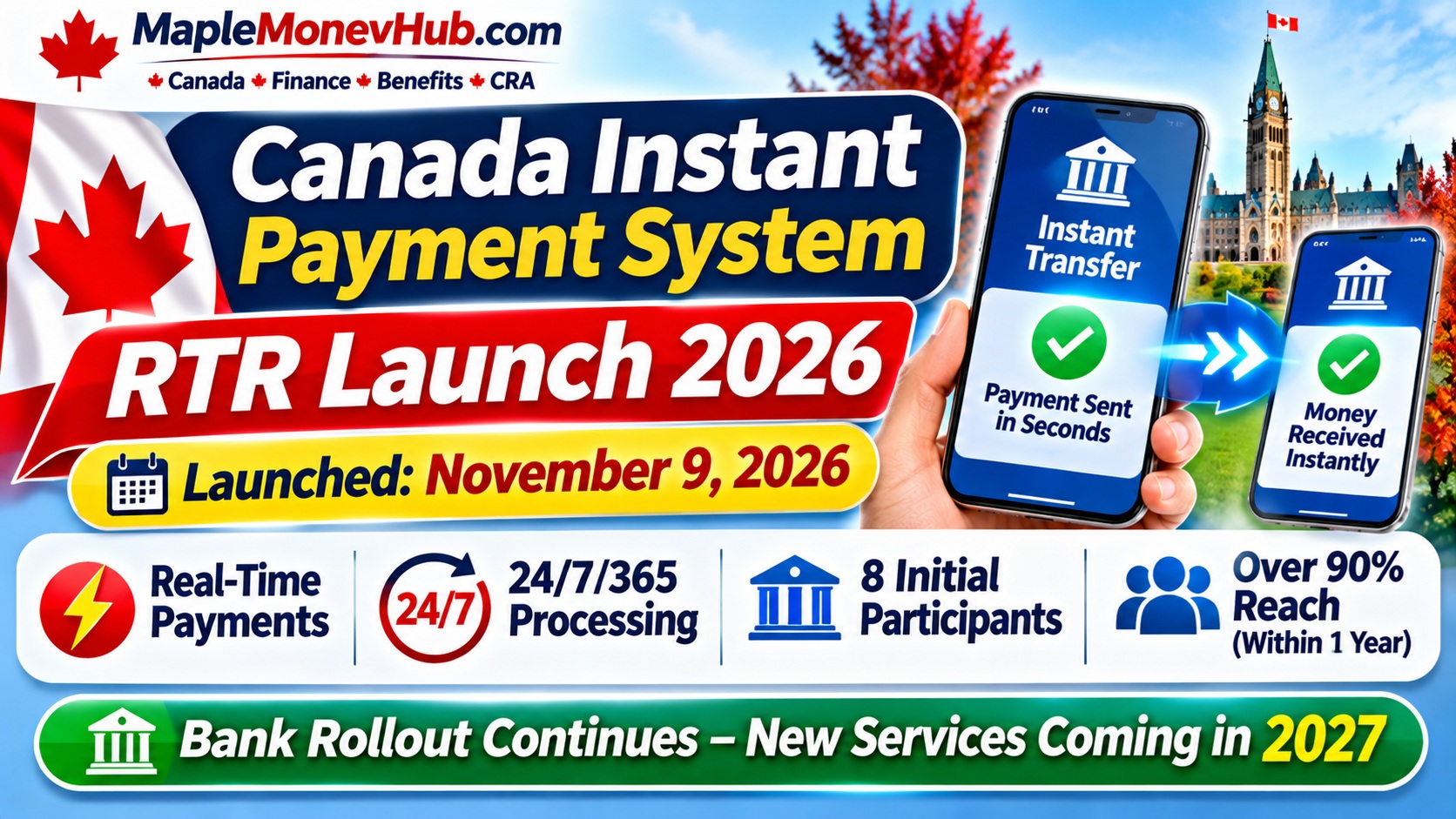
Updated November 10, 2026. Canada has officially launched its long-awaited instant payment system, the Real-Time Rail (RTR). The November 9 announcement from Payments Canada marks an important change in how financial institutions can transfer money across the country.
For Canadian consumers and businesses, the new infrastructure promises faster payments, around-the-clock processing and improved visibility into money moving between accounts. But does that mean every Canadian can now transfer money instantly between banks? Not yet.
What Is Canada’s Real-Time Rail?
The Real-Time Rail, commonly called RTR, is a national payment system owned and operated by Payments Canada.
It allows participating financial institutions and payment service providers to move money using infrastructure designed for immediate clearing and settlement.
Clearing involves exchanging and validating payment information. Settlement is the process of completing the financial obligation between participating institutions.
Traditionally, some Canadian electronic payments have relied on batch-processing systems and banking-day schedules. The RTR introduces an always-on alternative for eligible payments.
The system also supports ISO 20022 financial messaging, allowing more structured information to accompany payments. This can be useful for business reconciliation and accounting.
When Did Canada’s Instant Payment System Launch?
Payments Canada announced the official launch on Monday, November 9, 2026.
The launch followed years of development, industry collaboration and testing. It establishes the national infrastructure needed for participating institutions to introduce new real-time payment services.
| Milestone | Status |
|---|---|
| National RTR infrastructure | Launched November 9, 2026 |
| Initial participants | Eight organizations announced |
| Real-time clearing and settlement | Available to participating institutions |
| Major Canadian bank onboarding | Phased rollout expected |
| Universal customer availability | Not yet established |
| Wealthsimple customer features | Testing underway; rollout planned for 2027 |
Which Banks and Companies Joined at Launch?
Payments Canada identified eight initial active participants.
| Initial participant | What to know |
|---|---|
| Wealthsimple | Plans new customer-facing instant payment capabilities |
| KOHO | Included in the initial RTR participant group |
| Questbank | Part of the Questrade financial group |
| Peoples Trust Company | Participates in the financial infrastructure and settlement ecosystem |
| Paramount Commerce | Payment service provider serving merchants and partners |
| DoBusiness.com | Business payment services participant |
| Digital Commerce Bank | Financial institution supporting payment services |
| Bank of America | Participant with Canadian payment operations |
Participation in the national system does not necessarily mean every customer of these organizations has an RTR payment option immediately available.
Customers should check their institution’s official product announcements for supported transfers, transaction limits, fees and rollout dates.
When Will RBC, TD, Scotiabank, BMO and CIBC Join?
Payments Canada says additional participants will continue onboarding, including major Canadian financial institutions.
The organization projects that RTR services will become available to more than nine in ten Canadians within the first year after launch.
That is a forward-looking target, not confirmation that all major banks will activate identical consumer features on a single date.
As of November 10, 2026, the official launch announcement does not provide individual consumer activation dates for RBC, TD, Scotiabank, BMO or CIBC.
For now, avoid assuming that your existing banking app has gained a new instant-transfer feature unless your bank confirms it.
How Will Instant Payments Work in Canada?
A real-time payment generally begins when a sender initiates a supported transfer through a participating bank or payment service.
- The sender enters the required payment information.
- The provider validates the transaction and applies fraud-prevention checks.
- Payment instructions are processed through RTR.
- Participating institutions clear and settle the payment in real time.
- The receiving provider makes the funds available according to the supported service.
The exact steps visible to customers will depend on how banks and payment providers implement their products.
Real-Time Rail vs Interac e-Transfer
Many Canadians already use Interac e-Transfer to send money quickly. That raises an important question: why does Canada need RTR?
Interac e-Transfer is a customer-facing payment service. RTR is national infrastructure that financial institutions and providers can use to clear and settle payments.
| Feature | Interac e-Transfer | Real-Time Rail |
|---|---|---|
| Primary role | Money-transfer service | National clearing and settlement infrastructure |
| Customer interaction | Available through participating banks and apps | Generally accessed through services built by participating providers |
| Operating hours | Transfers can be initiated around the clock | Designed for real-time processing 24/7/365 |
| Transaction limits | Depend on financial institution and service | Customer limits depend on provider and payment product |
| Settlement infrastructure | Existing arrangements, with RTR integration planned | Real-time clearing and settlement |
| Customer rollout | Already widely available | New services rolling out progressively |
Interac is also a technical partner in the RTR project. Payments Canada says Interac e-Transfer payments will begin clearing and settling on RTR as integration progresses.
For an existing payment problem, read our Interac e-Transfer Pending in Canada guide .
Will Canadian Bank Transfers Become Instant?
RTR makes real-time inter-institution payments possible for participating providers, but it does not automatically convert every bank transfer into an instant payment.
For example, an ordinary electronic funds transfer between two banks may still follow its existing processing schedule until the institutions introduce a supported RTR-based service.
Similarly, moving money between accounts at the same bank may already happen quickly without RTR.
Example: Moving $1,500 Between Banks
Suppose a customer wants to move $1,500 from an account at one financial institution to an account at another.
With a conventional transfer, the customer may need to wait for processing and availability.
With a future supported RTR-based service, the payment could clear and settle within seconds, including outside normal banking hours.
This is an illustrative scenario. It does not confirm that a particular bank currently offers this service, that the transfer is free, or that a $1,500 limit applies.
What Could RTR Mean for Small Businesses?
Small businesses may eventually be among the largest beneficiaries of real-time payments.
Consider a business that receives customer payments on Friday evening but cannot access certain funds until the following business day.
An eligible RTR-based payment could reduce the time between receiving payment instructions and completed settlement.
Potential business advantages
- Faster access to eligible incoming payments.
- Improved cash-flow visibility.
- Payment processing during weekends and holidays.
- Faster supplier and contractor payments.
- More structured remittance information.
- Reduced reliance on slower payment methods.
These advantages depend on the products that financial institutions and payment providers actually offer.
Will Payroll and Government Benefits Be Paid Instantly?
RTR creates opportunities for new payroll, insurance, refund and government payment services. However, no general rule requires employers or government agencies to switch existing payments to RTR immediately.
For example, Canada Child Benefit, CPP and other government deposits continue to follow their official payment schedules unless the responsible agency announces a change.
A national instant payment system does not itself create an early benefit payment or change a recipient’s eligibility.
How Secure Is Canada’s Real-Time Rail?
Payments Canada says RTR launched with mandatory centralized fraud-prevention services.
These safeguards include:
- Confirmation of payee for consumer accounts.
- A transaction safety score.
- A repository of fraud risks and indicators.
- Fraud reporting and intelligence capabilities.
Confirmation of payee can help verify recipient information before a payment is completed.
However, no payment system eliminates fraud entirely. Consumers should continue checking recipient details, avoiding suspicious payment requests and reporting unauthorized transactions promptly.
Will Instant Payments Be Free?
Payments Canada has not announced a universal consumer fee for every RTR-based transaction.
The price a customer pays will depend on the bank, payment provider and specific service.
Some providers may offer certain transfers without a separate transaction fee. Others may apply business pricing, account charges or transaction limits.
Consumers should review the applicable account agreement rather than assuming all instant payments will be free.
Will RTR Replace Interac e-Transfer?
No immediate replacement has been announced.
Interac e-Transfer remains an established Canadian money-transfer service.
RTR is designed to provide modern underlying payment infrastructure, and Interac is involved in its operation and future integration.
Canadians may eventually benefit from RTR without seeing the name “Real-Time Rail” inside their banking app.
What Should Canadians Do Now?
Most consumers do not need to register for RTR or download a new app.
- Check your bank’s official website for real-time payment announcements.
- Review supported transfer types and transaction limits.
- Confirm any applicable fees before transferring.
- Keep your banking app and security settings updated.
- Verify recipient information carefully before sending funds.
- Avoid third-party websites claiming to activate RTR for a fee.
Frequently Asked Questions
Has Canada’s instant payment system launched?
Yes. Payments Canada officially launched the Real-Time Rail on November 9, 2026.
Can I send instant payments between any two Canadian banks?
Not necessarily. Both the participating institutions and the customer-facing payment service must support the relevant transfer.
Which financial institutions joined RTR first?
The initial eight participants are Wealthsimple, KOHO, Questbank, Peoples Trust Company, Paramount Commerce, DoBusiness.com, Digital Commerce Bank and Bank of America.
When will Wealthsimple introduce RTR features?
Wealthsimple says it is testing capabilities and plans to roll out new instant payment features in 2027.
Will RTR work on weekends?
Yes. The infrastructure supports real-time clearing and settlement around the clock, including weekends and holidays.
Does RTR increase Interac e-Transfer limits?
The national infrastructure launch does not automatically change the transfer limits shown in an individual’s banking account.
Will RTR replace traditional bank transfers?
RTR provides an additional payment infrastructure option. Existing payment methods may continue operating alongside new services.
Is RTR safe?
The system includes mandatory centralized fraud controls, but consumers must still protect their accounts and verify recipients.
Can businesses use RTR?
Participating providers can build business payment services using the system. Availability and functionality depend on the provider.
Do I need to apply for Real-Time Rail?
Generally, consumers access payment services through their existing financial institutions rather than registering directly with Payments Canada.
Related MapleMoneyHub Guides
Official Sources
TL;DR: Canada Instant Payment System Launch
- Canada’s Real-Time Rail launched November 9, 2026.
- It supports 24/7 real-time clearing and settlement.
- Eight financial and payment organizations joined initially.
- Major Canadian banks are expected to join progressively.
- Wealthsimple plans new customer features in 2027.
- RTR does not automatically make every existing bank transfer instant.
- Fees, limits and availability depend on individual providers.
Editorial note: Prepared for MapleMoneyHub.com and reviewed November 10, 2026. Information is based primarily on Payments Canada’s official launch announcement and participant disclosures. MapleMoneyHub is an independent educational website and is not affiliated with Payments Canada or any financial institution. Payment features and rollout schedules may change.