MAPLEMONEYHUB | SAVINGS & CREDIT
How Credit Scores Work in Canada: Equifax, TransUnion & Ways to Improve
Updated October 27, 2026 | Canadian Credit Guide
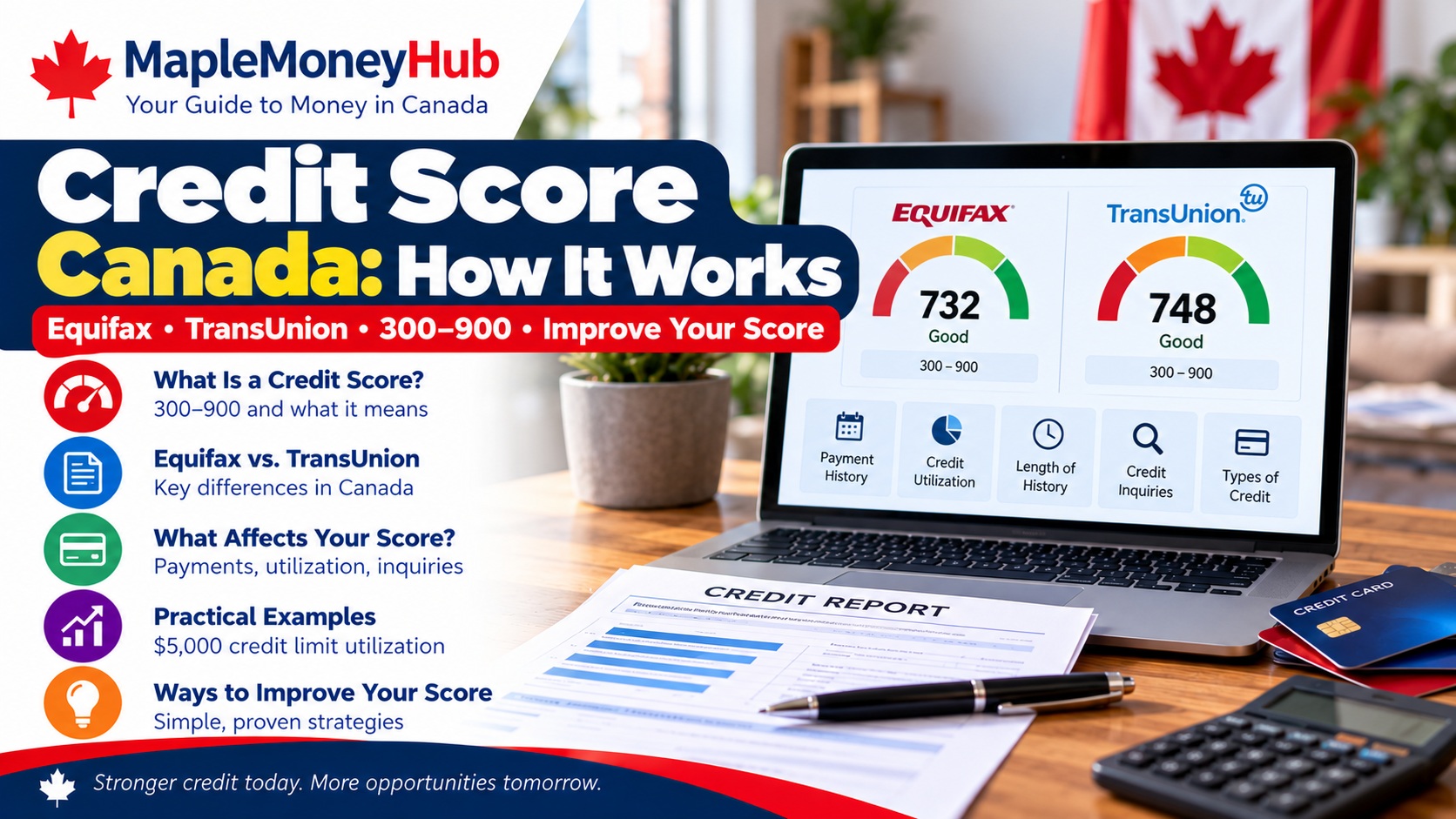
A Canadian credit score is a three-digit number, usually between 300 and 900, calculated from information in your credit report. Higher scores generally indicate lower credit risk, but lenders also assess income, debts and other factors.
Your score can be influenced by payment history, credit utilization, length of credit history, credit applications and the types of credit you manage.
To improve your credit: Pay bills on time, aim to use less than 30% of available revolving credit, limit unnecessary applications and check both Equifax and TransUnion reports for errors.
You can access your credit reports for free, and checking your own report or score does not lower your score.
Your credit score can influence whether you qualify for a credit card, personal loan, car financing or mortgage in Canada. It may also affect the interest rate a lender offers.
Yet many Canadians are unsure what their credit score means, why Equifax and TransUnion show different numbers, or whether checking a credit report can damage their credit.
The good news is that you do not need to understand a complicated mathematical formula to build healthier credit habits.
This guide explains the Canadian credit-scoring system using official guidance from the Financial Consumer Agency of Canada (FCAC), Equifax and TransUnion. It includes original calculations and practical steps for checking and improving your credit.
1. What Is a Credit Score in Canada?
A credit score is a numerical estimate of credit risk based on information recorded in your credit history.
Canadian credit scores commonly range from 300 to 900. In general, a higher score suggests that a borrower has demonstrated more favourable credit behaviour.
Your credit report, however, is different from your credit score.
| Credit Report | Credit Score |
|---|---|
| A record of credit accounts and repayment history. | A numerical assessment based on credit information. |
| May show loans, credit cards, balances and inquiries. | Usually ranges from 300 to 900 in Canada. |
| Helps you identify errors or possible fraud. | Helps lenders assess borrowing risk. |
| Can be obtained free from both major credit bureaus. | Free access depends on the provider and province. |
A credit score is not a guarantee of loan approval. Lenders may also consider employment, income, existing debt, down payment, collateral and their own lending policies.
2. What Is a Good Credit Score in Canada?
There is no single official score cutoff that every Canadian lender uses.
Credit bureaus and financial institutions may classify scores differently. One lender might approve an application that another lender declines.
The following table provides an illustrative consumer-friendly classification, not a universal lending standard.
| Credit Score | Illustrative Description | What It May Suggest |
|---|---|---|
| 300–559 | Needs improvement | Borrowing options may be limited. |
| 560–659 | Developing or fair | Some lenders may offer credit with restrictions. |
| 660–724 | Good | May support access to a broader range of products. |
| 725–759 | Very good | Generally indicates favourable credit behaviour. |
| 760–900 | Excellent | May strengthen an application, subject to other criteria. |
These bands are editorial illustrations, not official Equifax or TransUnion thresholds. Lenders use different scoring models and approval criteria.
For example, a person with a score of 740 may be declined for a mortgage because their income is insufficient for the requested loan amount.
Meanwhile, someone with a lower score may qualify for a smaller loan based on their overall financial circumstances.
3. Equifax vs. TransUnion: What’s the Difference?
Canada has two main credit reporting agencies:
- Equifax Canada
- TransUnion Canada
Both collect and maintain credit information, but they do not necessarily hold identical records.
A lender may report an account to one bureau, both bureaus or neither. Reporting dates may also differ.
In addition, credit-scoring models can assign different weights to information.
| Feature | Equifax Canada | TransUnion Canada |
|---|---|---|
| Credit report | Available free. | Free Consumer Disclosure available. |
| Credit score | Free access offered across Canada. | Free with Consumer Disclosure for Ontario and Quebec residents. |
| Credit information | Based on information reported to Equifax. | Based on information reported to TransUnion. |
| Score differences | May differ from TransUnion and lender scores. | May differ from Equifax and lender scores. |
| Disputes | Errors can be disputed directly. | Errors can be disputed directly. |
If Equifax shows 720 and TransUnion shows 690, that does not automatically mean either bureau made a mistake.
Different data, reporting dates and scoring models may explain the difference.
4. What Factors Affect Your Credit Score?
Credit bureaus and lenders do not publish the complete formulas used to calculate every credit score.
However, FCAC identifies several important factors.
Payment History
Paying credit accounts on time is one of the most important credit-building habits.
Late payments, missed payments and accounts sent to collections may damage your credit history.
FCAC recommends making at least the minimum payment by the due date if you cannot pay the full balance.
Credit Utilization
Credit utilization compares how much revolving credit you are using with the amount available to you.
Using a high percentage of your credit limits may signal greater borrowing risk.
Length of Credit History
Older, well-managed accounts can demonstrate a longer record of responsible borrowing.
Closing an older credit card may reduce your available credit and affect your credit history.
Credit Inquiries
Applying for several credit products over a short period can create multiple hard inquiries.
These inquiries may influence your credit score.
Types of Credit
Credit history may include credit cards, installment loans, lines of credit and mortgages.
Managing different products responsibly may help demonstrate borrowing experience, but taking out unnecessary debt solely to improve your score is not advisable.
5. Credit Utilization Example: $5,000 Credit Limit
Credit utilization is one of the easiest credit concepts to calculate.
Credit Utilization = (Balance ÷ Credit Limit) × 100
Suppose you have one credit card with a $5,000 limit.
If your reported balance is $1,000:
($1,000 ÷ $5,000) × 100 = 20%
Your credit utilization is 20%.
| Reported Balance | Credit Limit | Utilization |
|---|---|---|
| $500 | $5,000 | 10% |
| $1,000 | $5,000 | 20% |
| $1,500 | $5,000 | 30% |
| $3,000 | $5,000 | 60% |
| $4,500 | $5,000 | 90% |
FCAC recommends trying to use less than 30% of your total credit limit.
That is a useful guideline, not a guarantee that your score will rise by a specific number of points.
With a $5,000 limit, using less than 30% means keeping the reported balance below $1,500.
A lower reported balance can be helpful even if you pay your credit card in full every month, because lenders may report balances before your payment is processed.
6. How to Calculate Utilization Across Multiple Cards
If you have more than one credit card, your overall revolving-credit utilization can be calculated by adding the relevant balances and limits.
For example:
| Account | Balance | Credit Limit |
|---|---|---|
| Credit Card A | $600 | $3,000 |
| Credit Card B | $900 | $6,000 |
| Total | $1,500 | $9,000 |
Your combined utilization is:
$1,500 ÷ $9,000 × 100 = 16.7%
Credit-scoring models may also consider utilization on individual cards, not just the combined percentage.
For this reason, keeping one card close to its limit may be unhelpful even when overall utilization appears moderate.
7. Hard Inquiry vs. Soft Inquiry in Canada
Not all credit checks have the same effect.
| Inquiry Type | Common Example | Effect on Score |
|---|---|---|
| Soft inquiry | Checking your own credit report. | Does not lower your score. |
| Soft inquiry | Certain account reviews by existing providers. | Does not lower your score. |
| Hard inquiry | Applying for a credit card. | May affect your score. |
| Hard inquiry | Applying for a mortgage or loan. | May affect your score. |
FCAC advises consumers who are shopping for a mortgage or car loan to obtain quotes within a two-week period because credit bureaus may group qualifying inquiries for scoring purposes.
This does not mean every application is treated as a single inquiry in every scoring model.
8. How to Check Your Credit Report for Free in Canada
You can request free credit reports from both major Canadian credit bureaus.
Option 1: Equifax Canada
- Visit the official Equifax Canada website.
- Locate the free consumer credit-report service.
- Complete the identity-verification process.
- Review your reported accounts, balances and payment history.
- Download or save a copy securely if needed.
Equifax also offers free credit-score access to consumers across Canada.
Option 2: TransUnion Canada
- Visit TransUnion Canada’s official Consumer Disclosure page.
- Choose the free online disclosure option.
- Verify your identity.
- Review the credit accounts and inquiries shown.
- Save a copy securely for your records.
TransUnion provides a free score with the Consumer Disclosure for residents of Ontario and Quebec.
Residents of other provinces can obtain the free disclosure, but free score availability through TransUnion itself differs. Some financial institutions offer free scores through their apps.
Get Your TransUnion Consumer Disclosure
- Request your Equifax credit report.
- Request your TransUnion Consumer Disclosure.
- Compare personal information and account details.
- Check for unfamiliar loans or credit cards.
- Review payment history and balances.
- Investigate errors or signs of identity theft.
9. Does Checking Your Own Credit Score Lower It?
No. Checking your own credit report or score is a soft inquiry and does not lower your score.
This means you can monitor your credit regularly without damaging your creditworthiness simply by viewing the information.
Monitoring can be particularly useful before applying for a mortgage, renting a home or requesting a new credit product.
It also helps you detect unfamiliar accounts or inaccurate information.
10. How to Improve Your Credit Score in Canada
Improving credit usually involves consistent habits rather than quick fixes.
1. Pay Every Credit Account on Time
Set calendar reminders or automatic minimum payments to reduce the risk of missing due dates.
If you expect payment difficulties, contact your lender before the payment is missed.
2. Reduce Credit Card Balances
Paying down balances can reduce utilization and interest costs.
Prioritize high-interest debt where appropriate, while maintaining required minimum payments on all accounts.
3. Keep Utilization Below 30%
FCAC recommends using less than 30% of your total credit limit.
Lower balances may be beneficial, but no specific percentage guarantees a particular score.
4. Avoid Unnecessary Credit Applications
Apply for new credit when you need it, not simply because a promotion is available.
Several hard inquiries in a short period may negatively affect your credit profile.
5. Consider Keeping Older Accounts Open
If an older credit card has no annual fee and is easy to manage, keeping it open may help preserve available credit and credit history.
However, account fees, security concerns and your ability to manage spending should also influence the decision.
6. Review Credit Reports for Errors
An incorrect late-payment record or unfamiliar account could affect lending decisions.
Request a correction when information is inaccurate.
7. Build Credit Gradually
People with limited credit history may consider a suitable secured credit card or another manageable credit product.
Choose products carefully, review fees and confirm whether the issuer reports payment activity to Canadian credit bureaus.
11. How Long Does It Take to Improve a Credit Score?
There is no guaranteed timeline.
Some changes, such as reducing a reported credit card balance, may be reflected after the lender reports updated information.
Other improvements can take much longer, particularly when your credit history contains missed payments, collections or other negative information.
Credit scores also depend on the scoring model and the information available at the time of calculation.
Rather than aiming for a specific point increase within 30 days, focus on maintaining a record of timely payments and manageable balances.
12. How Long Does Negative Information Stay on a Credit Report?
Negative credit information does not necessarily disappear immediately after a debt is paid.
Retention periods vary by information type, credit bureau and province.
| Information Type | General Canadian Guidance |
|---|---|
| Late or unpaid credit accounts | May remain for up to 6 years. |
| Hard inquiries | May appear for 3 years with Equifax or 6 years with TransUnion. |
| Bankruptcy | Often 6 or 7 years, depending on province and circumstances; some situations last longer. |
| Closed accounts in good standing | May remain for years and support credit history. |
These are general examples, not a complete list of provincial reporting rules.
See the official FCAC guide to credit-report retention periods for more detail.
13. How to Dispute an Error on Your Credit Report
If your credit report contains inaccurate information, begin by gathering documents that support the correction.
Examples include payment confirmations, account statements, settlement letters or correspondence from a lender.
- Identify the incorrect account or entry.
- Check whether the error appears at Equifax, TransUnion or both.
- Contact the lender or organization that supplied the information.
- Submit a dispute to each bureau reporting the error.
- Provide supporting documents through the bureau’s approved process.
- Review the investigation result and check your report again.
If an unfamiliar account appears, consider whether it may be a sign of identity theft and follow the bureaus’ fraud-alert guidance.
You should not have to pay a third-party credit repair company merely to dispute incorrect information with a credit bureau.
14. Can a Credit Score Affect Mortgage Approval?
Yes. Mortgage lenders commonly review credit history as part of their underwriting process.
A stronger credit profile may improve access to certain mortgage products or rates, but the score is only one factor.
Lenders may also examine:
- Gross household income.
- Employment and income stability.
- Existing debt obligations.
- Down payment and savings.
- Property value and mortgage type.
- Applicable mortgage qualification rules.
For homeowners approaching renewal, reviewing credit reports before shopping for a new lender can help identify potential issues early.
Read our Mortgage Renewal in Canada 2026–2027 guide for information about lender switching and qualification requirements.
15. Can You Build Credit Without a Credit Card?
It is possible to establish credit history through certain loans or other accounts that report to credit bureaus.
However, not every rent, utility or telecommunications payment is reported in the same way.
Some services offer alternative credit-reporting arrangements, but their effect depends on the reporting bureau and scoring model.
Before paying for any credit-building service, confirm which bureau receives the information, whether there are fees and whether the service offers meaningful value.
16. Common Credit Score Myths in Canada
| Myth | What You Should Know |
|---|---|
| Checking my own score lowers it. | False. Your own check is a soft inquiry. |
| I must carry a balance to build credit. | False. Paying in full can help avoid interest. |
| Everyone has one universal score. | False. Bureaus and lenders use different scoring models. |
| A high score guarantees mortgage approval. | False. Income, debt and other criteria also matter. |
| Paying a collection instantly removes it. | Not necessarily. Reporting and retention rules still apply. |
| A company can guarantee a 100-point increase. | No legitimate provider can guarantee a specific score change. |
17. Protect Yourself From Credit Score Scams
Be cautious of websites or advertisements promising guaranteed credit-score increases, instant removal of accurate negative information or access to a special secret scoring system.
Fraudsters may also imitate credit bureaus to collect personal details.
Use official credit-bureau websites and carefully review the terms of any credit-monitoring subscription.
Do not share banking passwords, one-time verification codes or other sensitive credentials with an unsolicited caller or website.
If you suspect identity theft, contact the relevant financial institutions and credit bureaus promptly.
18. A Practical 90-Day Credit Improvement Plan
While no specific score increase can be promised, a structured plan can help improve your credit habits.
| Timeframe | Recommended Actions |
|---|---|
| Days 1–15 | Get both credit reports, check for errors and list outstanding balances. |
| Days 16–30 | Set payment reminders, review due dates and make a debt-repayment budget. |
| Days 31–60 | Reduce revolving balances where affordable and avoid unnecessary credit applications. |
| Days 61–90 | Continue on-time payments, review updated reports and reassess your budget. |
For budgeting and savings calculations, visit MapleMoneyHub’s free Canadian financial calculators.
Explore Free Financial CalculatorsFrequently Asked Questions
Is 700 a good credit score in Canada?
A score of 700 is generally viewed favourably under many consumer classifications. However, lenders apply their own criteria, so it does not guarantee approval or a particular interest rate.
Is 800 an excellent credit score?
An 800 score is near the upper end of the common Canadian 300–900 range. It generally suggests strong credit history, although lenders may use different scoring models.
Why are my Equifax and TransUnion scores different?
The bureaus may hold different information, receive updates at different times or use different scoring formulas.
Can I check my credit score for free in Canada?
Yes. Equifax offers free score access across Canada. TransUnion provides a free score with its Consumer Disclosure for Ontario and Quebec residents. Some banks and other providers also offer free scores.
Does paying off a credit card improve your score?
Reducing a balance can lower credit utilization, which may help your credit profile. The actual score effect depends on the model and other information.
How often should I check my credit report?
Check regularly, particularly before a major credit application or when you suspect fraud. Reviewing your own report does not lower your score.
Can I improve my score by paying for credit repair?
Be cautious of guarantees. Accurate negative information generally cannot be removed simply because you pay a credit repair company. You can dispute inaccurate information directly with credit bureaus.
Related MapleMoneyHub Guides
- Mortgage Renewal in Canada 2026–2027 — understand mortgage qualification and renewal decisions.
- Car Insurance Deductible in Canada — compare out-of-pocket insurance costs.
- Free Canadian Financial Calculators — plan savings, debt and monthly expenses.
- Financial Disclaimer — important information about our educational guides.
TL;DR: How Credit Scores Work in Canada
- Canadian credit scores usually range from 300 to 900.
- Equifax and TransUnion are Canada’s two main credit bureaus.
- Your payment history and credit utilization are important factors.
- FCAC recommends using less than 30% of available revolving credit.
- Checking your own credit report or score does not hurt your credit.
- You can obtain free reports from both credit bureaus.
- Paying bills on time and reducing balances can help build healthier credit over time.
- No company can guarantee an exact credit-score increase.
Recommended first action: Obtain your free Equifax and TransUnion credit reports, check for errors and review your credit card utilization before applying for new credit.
Official Canadian Sources
- FCAC — Credit Report and Score Basics
- FCAC — Improving Your Credit Score
- FCAC — Getting Your Credit Report and Score
- FCAC — How Long Credit Information Stays on Your Report
- FCAC — Credit Reports, Errors and Fraud Resources
- Equifax Canada — Consumer Credit Services
- TransUnion Canada — Understanding Credit Scores
- TransUnion Canada — Free Consumer Disclosure
Last reviewed: October 27, 2026. MapleMoneyHub.com provides independent financial education and is not affiliated with Equifax, TransUnion or the Government of Canada. This article is informational and does not constitute personalized financial or lending advice.