MAPLEMONEYHUB | MORTGAGES & HOUSING
Mortgage Renewal in Canada 2026–2027: Rates, Payments & How to Save
Updated October 27, 2026 | Canadian Homeowner Guide
When your mortgage term ends in Canada, you must renew the remaining mortgage balance under new terms or pay it off. Your interest rate, payment amount, term length and other conditions may change.
Start comparing offers several months before renewal. Check your remaining mortgage balance, amortization, current rate, new rate options and any fees to switch lenders.
Federally regulated lenders must provide a renewal statement at least 21 days before your term ends. You do not have to accept the first offer.
Important: Mortgage rates vary by lender, product and borrower. The payment examples in this guide are illustrative, not live mortgage quotes.
Millions of Canadian homeowners are approaching mortgage renewal in 2026 and 2027. For some, renewal may mean higher monthly payments, especially if their previous mortgage was arranged during a period of unusually low interest rates.
For others, renewal may offer an opportunity to negotiate a lower rate, change the mortgage term or move to a different lender.
According to the Office of the Superintendent of Financial Institutions (OSFI), approximately 3.1 million mortgages, or 52% of the total, were scheduled to renew by the end of 2027 as of January 2026.
That makes mortgage renewal an important financial decision for Canadian households.
This guide explains how renewal works, how much payments could change and how to compare your options using official guidance from the Financial Consumer Agency of Canada (FCAC), OSFI and the Bank of Canada.
1. What Is Mortgage Renewal in Canada?
Mortgage renewal occurs when your existing mortgage term ends and you agree to a new mortgage contract for the remaining balance.
Your mortgage term is not the same as your amortization period.
- Mortgage term: The period your current mortgage agreement covers, often one to five years.
- Amortization: The estimated time required to repay the entire mortgage, assuming payments follow the repayment schedule.
For example, a homeowner may originally take a mortgage with a 25-year amortization and a five-year fixed-rate term.
After five years, the mortgage term expires, but the homeowner may still have approximately 20 years of amortization remaining.
The borrower then renews the outstanding balance, subject to the lender’s terms and the homeowner’s available options.
2. When Should You Start Preparing for Mortgage Renewal?
FCAC recommends shopping around a few months before your term ends rather than waiting for the lender’s renewal letter.
A practical planning schedule is:
| Time Before Renewal | Recommended Action |
|---|---|
| 4–6 months | Review your mortgage balance, remaining amortization and household budget. |
| 3–4 months | Compare lenders, mortgage brokers, fixed-rate and variable-rate options. |
| 2–3 months | Request written quotes and ask your current lender to negotiate. |
| 1 month | Confirm approval, switching costs, documents and closing arrangements. |
| At least 21 days before expiry | For federally regulated lenders, review the required renewal statement. |
These are planning suggestions, not universal lender deadlines. Some lenders may offer early-renewal options, but their terms and rate guarantees vary.
3. Why Could Your Mortgage Payment Increase in 2026 or 2027?
The most common reason is a difference between your previous mortgage rate and the rate offered at renewal.
Suppose you obtained a five-year fixed-rate mortgage at a low rate in 2021. If the renewal rate is higher, your monthly payment may increase even though your outstanding mortgage balance is lower than when you started.
The Bank of Canada’s July 2025 analysis estimated that many mortgage holders renewing in 2025 and 2026 would face higher payments under the assumptions used in its research.
Its estimates were projections, not guaranteed outcomes for individual households.
Other factors that influence your new payment include:
- Your remaining mortgage balance.
- Your remaining amortization period.
- The interest rate and type of mortgage selected.
- Whether you change the payment frequency.
- Whether you borrow additional money or extend amortization.
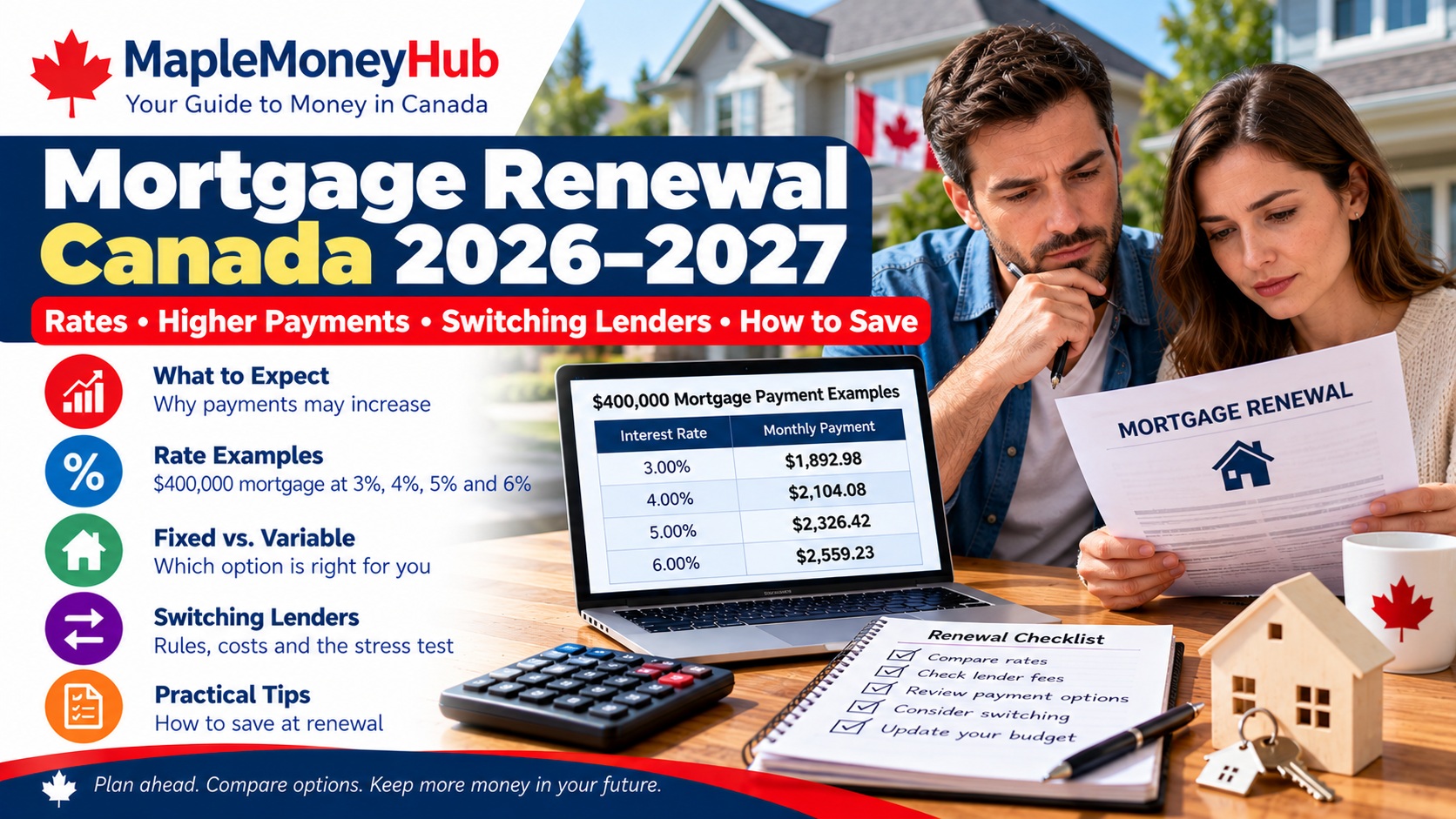
4. $400,000 Mortgage Payment Comparison: 3%, 4%, 5% and 6%
Consider a homeowner renewing a mortgage with a remaining principal balance of $400,000 and 25 years of remaining amortization.
For this example, assume a fixed annual mortgage rate compounded semi-annually, with monthly payments calculated using the equivalent monthly rate. This is a common Canadian fixed-rate mortgage calculation convention.
| Illustrative Rate | Monthly Payment | Annual Payments | Difference vs. 3% |
|---|---|---|---|
| 3.00% | $1,892.98 | $22,715.76 | — |
| 4.00% | $2,104.08 | $25,248.96 | +$211.10/month |
| 5.00% | $2,326.42 | $27,917.04 | +$433.44/month |
| 6.00% | $2,559.23 | $30,710.76 | +$666.25/month |
Calculated examples rounded to the nearest cent. Annual payments equal the displayed monthly payment multiplied by 12. Actual lender payments can differ due to calculation conventions, payment dates, rounding and contract terms.
What happens if the rate changes from 3% to 5%?
At 3%, the illustrated monthly payment is $1,892.98.
At 5%, it increases to $2,326.42.
Monthly increase: $433.44
Over 12 months, that is approximately $5,201.28 more in mortgage payments, assuming the same $400,000 starting balance and 25-year amortization for both scenarios.
This comparison isolates the effect of the interest rate. It does not compare a real mortgage’s original payment with its renewal payment after years of principal repayment.
For a more personalized estimate, use the MapleMoneyHub mortgage calculator.
Calculate Your Mortgage Payment5. Fixed vs. Variable Mortgage at Renewal
One of the biggest decisions at renewal is whether to select a fixed or variable interest rate.
Fixed-Rate Mortgage
A fixed-rate mortgage maintains the same contractual interest rate throughout the chosen term.
This can make budgeting easier because your scheduled principal-and-interest payment is generally predictable.
However, a fixed rate may become less attractive if market rates decline significantly during your term. Breaking the mortgage early may also trigger a substantial penalty.
Variable-Rate Mortgage
A variable mortgage rate can move with the lender’s reference rate.
Depending on the product, your payments may change when interest rates move, or your payment may remain fixed while the amount allocated to principal and interest changes.
FCAC warns that fixed-payment variable mortgages can face additional risks when interest rates rise, including situations where principal repayment slows or stops.
| Feature | Fixed Rate | Variable Rate |
|---|---|---|
| Interest rate | Stays fixed during the term. | May rise or fall. |
| Payment predictability | Generally predictable. | Depends on the variable mortgage structure. |
| Benefit if market rates fall | Usually no automatic reduction. | May benefit, depending on the contract. |
| Risk if rates rise | Limited during the fixed term. | Interest costs may rise. |
| Early-exit costs | May involve significant penalties. | Contract-specific penalties and conditions. |
There is no universally best choice. Consider your budget, risk tolerance, plans to move and ability to manage higher payments.
6. Can You Negotiate Your Mortgage Renewal Rate?
Yes. FCAC explicitly encourages borrowers to negotiate with their existing lender.
The renewal offer is not necessarily the lowest rate your lender is willing to provide.
Before contacting your lender, gather comparable written quotes showing:
- The interest rate.
- The mortgage term.
- Fixed or variable rate type.
- Prepayment privileges.
- Portability and early-break conditions.
- Applicable fees and restrictions.
Ask your lender whether it can match or improve the competing offer.
Do not compare only the advertised interest rate. A mortgage with a slightly lower rate but restrictive prepayment terms or expensive penalties may not be the better overall choice.
7. How Much Can a Small Rate Reduction Save?
Even a small interest-rate difference can affect your payment.
Consider a hypothetical $400,000 balance with 25 years remaining.
Using the same Canadian fixed-rate calculation method:
| Rate | Monthly Payment |
|---|---|
| 5.00% | $2,326.42 |
| 4.75% | Approximately $2,270 |
| Difference | Approximately $56/month |
A reduction of 0.25 percentage points could therefore save roughly $670 in payments over the first year under this example.
The actual interest savings and mortgage balance at the end of the term depend on the amortization schedule and payment timing.
8. Can You Switch Mortgage Lenders at Renewal?
Yes. You are not required to renew with your existing lender.
You may apply to move your mortgage to another lender that offers more suitable terms.
However, the new lender must approve the application. Switching may involve a review of income, debts, credit history, property value and the existing mortgage.
FCAC identifies potential switching expenses such as:
- Mortgage discharge or transfer fees.
- Registration or assignment fees.
- Property appraisal fees.
- Legal or notary costs.
- Other lender administration charges.
Ask the new lender whether it will cover any of these expenses.
9. Do You Need to Pass the Mortgage Stress Test Again?
The answer depends on the type of mortgage transaction and lender.
Renewing with your existing lender without increasing the mortgage or changing important terms is generally different from applying for a new mortgage.
For a new uninsured mortgage at a federally regulated lender, OSFI’s minimum qualifying rate framework generally requires qualification at the greater of the contractual mortgage rate plus two percentage points or the prescribed floor, subject to applicable rules.
However, there is an important exception for eligible uninsured mortgage switches.
OSFI’s Uninsured Straight-Switch Rule
Effective November 21, 2024, OSFI stopped prescribing its minimum qualifying rate for an eligible uninsured straight switch from one federally regulated institution to another.
The exemption applies when:
- The existing mortgage is a stand-alone uninsured mortgage.
- The borrower moves it between federally regulated institutions.
- The loan amount does not increase.
- The remaining contractual amortization does not increase.
OSFI still expects the receiving lender to assess the borrower’s capacity to repay and apply sound underwriting practices.
This is not guaranteed approval. A lender can still decline an application based on its own risk assessment.
10. What About Insured Mortgages?
Mortgage loan insurance protects the lender against borrower default. It is different from optional mortgage life or disability insurance.
Insured mortgages have their own rules, and the applicable qualification requirements depend on the transaction and lender.
FCAC notes that borrowers who already have mortgage loan insurance may be able to preserve that coverage when switching lenders, but changes such as increasing the loan or extending amortization may lead to additional insurance requirements or premiums.
Before switching, ask your existing lender for the mortgage insurance certificate information and confirm the new lender’s requirements.
11. Should You Extend Your Amortization at Renewal?
Extending the amortization may reduce your monthly payment because the remaining mortgage is repaid over a longer period.
However, this generally increases total interest costs and can extend the time until you own your home mortgage-free.
Consider a simplified $400,000 mortgage at a fixed 5% rate.
| Remaining Amortization | Approximate Monthly Payment | Main Trade-Off |
|---|---|---|
| 20 years | About $2,630 | Higher payment, faster repayment. |
| 25 years | $2,326 | Lower payment, longer repayment. |
| 30 years | About $2,135 | Lowest payment here, greater long-term interest exposure. |
These are illustrative payment estimates, not confirmation that every borrower is eligible for every amortization period.
Extending amortization may involve new underwriting, mortgage insurance implications or additional costs.
Before agreeing, ask for the estimated total interest over the remaining life of the mortgage, not just the new monthly payment.
12. Mortgage Renewal vs. Refinancing: What’s the Difference?
Renewal generally means arranging new terms for the existing outstanding mortgage balance when the current term ends.
Refinancing usually involves replacing or changing the mortgage to borrow more, alter important loan conditions or access home equity.
| Feature | Renewal | Refinancing |
|---|---|---|
| Primary purpose | Continue the remaining mortgage. | Change financing or borrowing amount. |
| Additional borrowing | Not normally part of a straightforward renewal. | May be included. |
| Qualification | Depends on lender and transaction. | Typically involves new underwriting. |
| Potential costs | May include switching costs. | May include appraisal, legal and other fees. |
If you want to consolidate debt or fund renovations, compare the total cost of refinancing with alternatives. Turning short-term debt into long-term mortgage debt can increase total interest even if the monthly payment falls.
13. What If Your Mortgage Renewal Is Denied?
A mortgage lender may decide not to renew a contract, although the outcome depends on the lender and your circumstances.
Federally regulated lenders must notify borrowers at least 21 days before the term ends if they will not renew.
Possible reasons for difficulty include payment problems, changes in creditworthiness or lender-specific lending policies.
If you are concerned about renewal:
- Contact your lender before the term expires.
- Ask what options are available and whether additional documents are needed.
- Review your income, debts and credit information.
- Consider speaking with a qualified mortgage broker.
- Seek independent financial or legal advice if you may be unable to repay the balance at maturity.
Do not ignore notices or assume a mortgage will automatically renew on acceptable terms.
14. How to Prepare Your Household Budget for Higher Payments
A higher mortgage payment can affect spending on groceries, utilities, transportation, insurance and savings.
Suppose your current payment is $1,900 per month and the projected renewal payment is $2,330.
The difference is $430 monthly, or $5,160 annually.
One practical approach is to begin testing the higher payment before renewal by transferring the difference into savings each month, if your budget allows.
This can help you determine whether the new payment is manageable while building a financial buffer.
You can also review recurring household costs and other debt obligations.
MapleMoneyHub’s budget, savings and mortgage calculators can help organize these figures.
15. Common Mortgage Renewal Mistakes to Avoid
- Accepting the first renewal offer: Compare other lenders and negotiate.
- Waiting until the final week: Switching lenders may require documentation and processing time.
- Comparing only interest rates: Review fees, penalties, privileges and restrictions.
- Ignoring remaining amortization: A lower payment may come from extending the repayment period.
- Assuming every switch avoids a stress test: OSFI’s exemption applies only to qualifying uninsured straight switches.
- Overlooking prepayment penalties: Breaking a mortgage before maturity can be expensive.
- Not reviewing household cash flow: Calculate the effect of higher payments before signing.
- Assuming approval is automatic: A new lender may assess income, debts and credit.
16. Mortgage Renewal Checklist for 2026–2027
- Confirm your mortgage maturity date.
- Check the outstanding principal balance.
- Verify your remaining amortization.
- Request comparable fixed and variable quotes.
- Ask your lender to negotiate its renewal offer.
- Compare the monthly payment and total interest.
- Check prepayment privileges and penalties.
- Ask about fees to switch lenders.
- Confirm any stress-test or underwriting requirements.
- Review your emergency savings and monthly budget.
- Read the final mortgage contract carefully.
Frequently Asked Questions
How early can I renew my mortgage in Canada?
Some lenders allow early renewal, but the timing and conditions vary. FCAC recommends beginning to compare mortgage options several months before the term ends.
Can I negotiate my mortgage renewal rate?
Yes. Ask your current lender for a better offer and provide comparable quotes from other lenders or brokers.
Will mortgage rates go down in 2027?
Future mortgage rates cannot be predicted with certainty. They depend on economic conditions, funding costs, lender competition and the type of mortgage. Compare actual offers near your renewal date rather than relying on a forecast.
Do I need a new mortgage stress test at renewal?
Not necessarily. Requirements depend on the lender and transaction. Eligible uninsured straight switches between federally regulated lenders are exempt from OSFI’s prescribed minimum qualifying rate, but lender underwriting still applies.
Can I switch lenders without paying a penalty?
Switching at the scheduled maturity date may avoid an early-prepayment penalty, but transfer, discharge, registration, appraisal or legal fees may still apply.
What happens if I do nothing at mortgage renewal?
Some lenders may automatically renew your mortgage according to the terms described in their renewal notice. This may not provide the most competitive rate or suitable conditions.
Should I choose a two-year or five-year mortgage term?
The choice depends on your need for payment certainty, future plans, rate expectations and potential early-exit costs. Compare the total terms rather than selecting solely by the advertised rate.
Related MapleMoneyHub Resources
- Free Canadian Mortgage and Budget Calculators — estimate payments and household expenses.
- Electricity Bill Too High in Canada? — identify opportunities to reduce household utility costs.
- Car Insurance Deductible in Canada — understand another major household expense.
- Financial Disclaimer — understand the scope of MapleMoneyHub’s educational content.
TL;DR: Mortgage Renewal in Canada 2026–2027
Mortgage renewal is an opportunity to review your interest rate, monthly payment, lender and repayment strategy.
- Start comparing offers several months before renewal.
- Do not automatically accept the first renewal rate.
- A $400,000 mortgage over 25 years costs approximately $1,893 per month at 3% versus $2,559 at 6% under the stated assumptions.
- Compare fixed and variable mortgage risks.
- Check whether switching lenders will involve fees or new qualification requirements.
- Remember that OSFI’s uninsured straight-switch exemption has specific conditions.
- Budget for higher payments before signing.
Recommended first action: Find your mortgage maturity date and remaining balance, then request competing quotes well before the renewal deadline.
Official Canadian Sources
- FCAC — Renewing Your Mortgage
- FCAC — Mortgage Consumer Rights
- FCAC — Interest on Mortgages
- FCAC — Mortgage Terms and Amortization
- OSFI — Uninsured Straight-Switch Exemption
- OSFI — Annual Risk Outlook 2026–2027
- Bank of Canada — Mortgage Payments at Renewal
Last reviewed: October 27, 2026. MapleMoneyHub.com is an independent financial information website. This article is educational and does not provide personalized mortgage, financial or legal advice. Mortgage terms and eligibility depend on your lender, contract and circumstances.