MAPLEMONEYHUB | INSURANCE
Car Insurance Deductible in Canada: How It Works & What You Pay
Updated October 27, 2026 | Canadian Auto Insurance Guide
A car insurance deductible is the portion of an eligible insurance claim that you pay yourself before your insurer covers the remaining approved loss.
For example, if covered vehicle repairs cost $4,000 and your deductible is $500, your share is generally $500 and the insurer pays $3,500, subject to policy limits and other conditions.
A higher deductible may lower your insurance premium, but it increases the amount you must pay when a covered claim occurs.
Important: Deductibles vary by coverage, insurer, province and accident circumstances. A deductible may be reduced, waived or treated differently for certain claims.
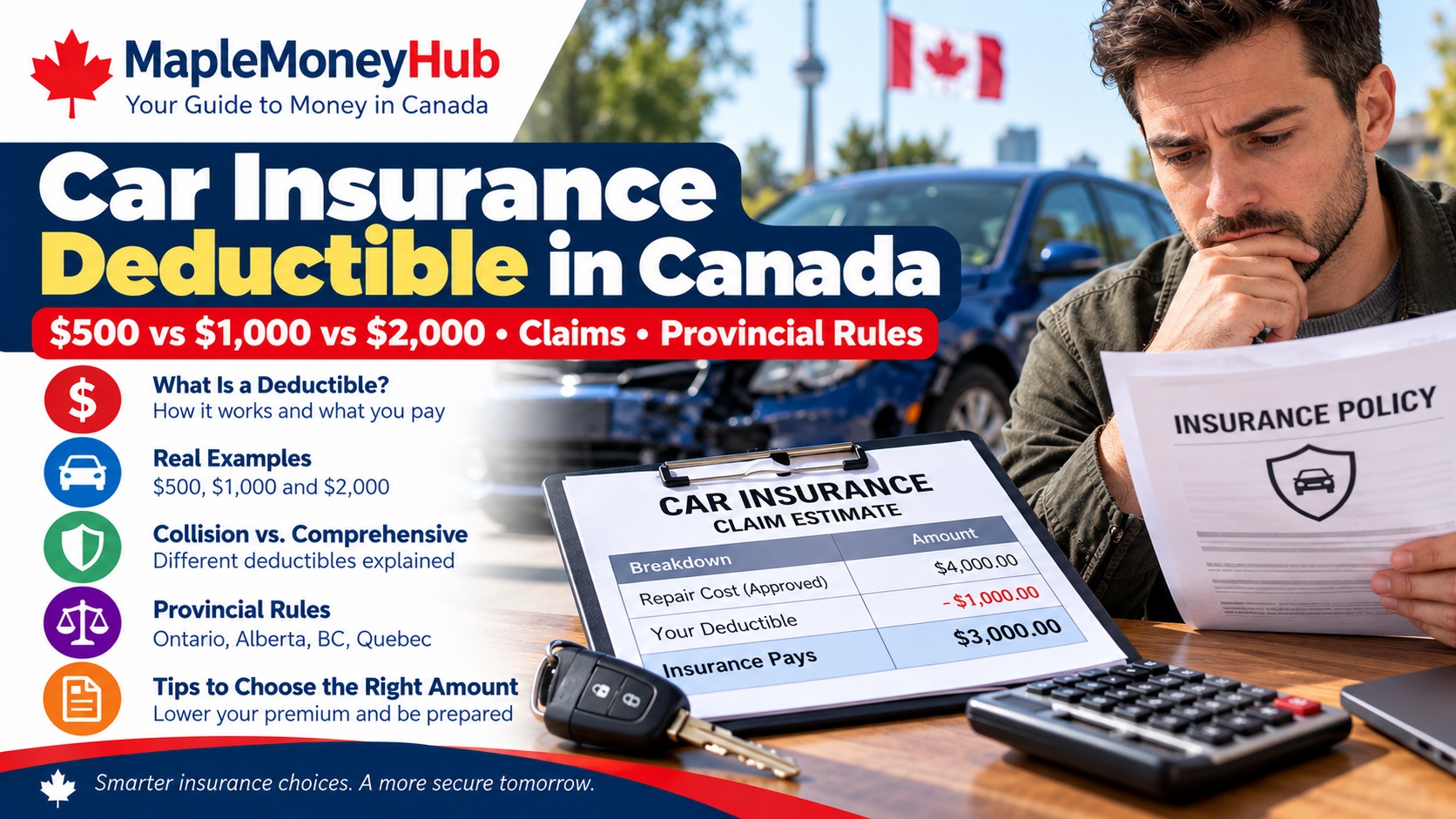
Imagine your car is damaged in an accident. The repair shop estimates $4,000 in damage, but your insurance policy lists a $1,000 deductible.
Does that mean you must pay $1,000? Will your insurer cover the remaining $3,000? What happens if another driver caused the accident?
These are common questions for Canadian drivers, especially when buying insurance for the first time or comparing renewal quotes.
Understanding deductibles helps you estimate the financial impact of an accident and choose coverage that fits your budget.
This guide explains how car insurance deductibles work across Canada, compares common deductible amounts and provides practical examples based on official provincial insurance guidance.
1. How Does a Car Insurance Deductible Work?
A deductible is your financial contribution toward an insured loss. It is usually applied to an approved claim payment rather than paid as a separate annual fee.
The basic calculation is:
Insurer Payment = Covered Loss − Applicable Deductible
Example:
- Approved repair cost: $3,500
- Applicable deductible: $500
- Your share: $500
- Insurer’s share: $3,000
This simplified formula assumes the loss is fully covered, the deductible applies in full, and no other limits or adjustments affect the settlement.
In practice, the insurer may pay the repair facility directly and you pay your deductible to the shop. Alternatively, the deductible may be subtracted from a settlement paid to you.
Alberta’s government specifically describes these different claim-payment arrangements in its official automobile collision guidance.
2. $500 vs. $1,000 vs. $2,000 Car Insurance Deductible
Canadian auto insurance policies may offer several deductible choices. The available amounts depend on the insurer and coverage.
Let’s compare three hypothetical policies covering the same type of insured collision loss.
| Covered Repair Cost | $500 Deductible | $1,000 Deductible | $2,000 Deductible |
|---|---|---|---|
| $800 | Insurer pays $300 | Insurer pays $0 | Insurer pays $0 |
| $2,500 | Insurer pays $2,000 | Insurer pays $1,500 | Insurer pays $500 |
| $4,000 | Insurer pays $3,500 | Insurer pays $3,000 | Insurer pays $2,000 |
| $8,000 | Insurer pays $7,500 | Insurer pays $7,000 | Insurer pays $6,000 |
These calculations show how much an insurer would pay for a fully covered loss under the stated assumptions.
For the $800 repair example, the insurer would not pay anything under a $1,000 or $2,000 deductible because the repair cost is lower than the deductible.
However, the deductible does not mean the driver must pay the entire deductible when the repair costs less. If a repair costs $800, the out-of-pocket repair cost is $800, not $1,000 or $2,000.
3. Does a Higher Deductible Lower Your Car Insurance Premium?
Generally, yes. When you agree to pay more toward a covered loss, your insurer takes on less of that financial risk.
Ontario’s Financial Services Regulatory Authority and Quebec’s Autorité des marchés financiers both explain that higher deductibles can reduce premiums.
However, the savings are not fixed. They depend on the insurer, vehicle, driving history, location and coverage selected.
Illustrative Premium Comparison
| Deductible | Hypothetical Annual Premium | Annual Savings |
|---|---|---|
| $500 | $2,100 | Baseline |
| $1,000 | $1,950 | $150 |
| $2,000 | $1,780 | $320 |
Illustrative quotes only. These figures are not current insurer prices or guaranteed discounts.
Under this example, increasing the deductible from $500 to $1,000 saves $150 annually but adds up to $500 of additional out-of-pocket exposure on a covered claim.
It would take approximately 3.3 claim-free years for the $150 annual savings to equal that $500 difference.
This is a simple break-even comparison, not a prediction of future accidents or premiums.
4. Collision vs. Comprehensive Deductible: What’s the Difference?
Your insurance policy may have separate deductibles for different types of vehicle damage.
Collision Coverage
Collision coverage generally applies to insured damage caused by your vehicle colliding with another vehicle or object, or by an upset such as a rollover.
For example, if you accidentally hit a parking-garage pillar and your car requires $3,200 in covered repairs, the collision deductible may apply.
Comprehensive Coverage
Comprehensive coverage generally applies to specified non-collision events, such as theft, vandalism, fire, certain weather damage and some glass losses.
For example, if a storm damages your parked vehicle, your comprehensive deductible may apply if the event is covered by your policy.
| Situation | Coverage Often Relevant | Deductible Consideration |
|---|---|---|
| Hit a roadside barrier | Collision | Collision deductible may apply. |
| Vehicle stolen | Comprehensive or all perils | Applicable deductible may apply. |
| Hail damages vehicle | Comprehensive | Check policy and applicable deductible. |
| Vandalism | Comprehensive | Check exclusions and deductible. |
| At-fault collision | Collision | Collision deductible usually applies. |
| Not-at-fault collision | Province-specific property damage coverage | Deductible may be waived or reduced, depending on circumstances. |
Do not assume every comprehensive policy covers every type of damage. Read your policy’s exclusions and endorsements.
5. Do You Pay a Deductible If the Accident Was Not Your Fault?
Not always. The answer depends on your province, the applicable coverage and the insurer’s determination of responsibility.
In some circumstances, your insurer may cover eligible vehicle damage without requiring a deductible. In other situations, a deductible may apply or may be reimbursed later.
Ontario has Direct Compensation–Property Damage coverage, commonly called DC-PD. Where the applicable conditions are met, this coverage allows eligible drivers to recover certain losses through their own insurer when another driver is responsible.
Ontario’s regulator explains that some policies have no DC-PD deductible, while others may include one.
British Columbia’s ICBC also explains that deductibles can sometimes be waived or partly reimbursed depending on responsibility and coverage.
6. How Deductibles Work in Ontario
Ontario’s insurance system includes mandatory and optional automobile coverages. Deductibles can differ among collision, comprehensive, all perils and Direct Compensation–Property Damage coverage.
For example, a driver might choose a $1,000 collision deductible and a $500 comprehensive deductible.
If the driver causes a covered collision, the collision deductible may apply. If the vehicle is stolen and the loss is covered, the comprehensive deductible may apply instead.
Ontario’s insurance regulator also notes that some drivers may choose a deductible for DC-PD coverage in exchange for lower premiums.
2026 policy consideration: Ontario introduced changes to its accident-benefits framework for policies issued or renewed from July 1, 2026. These changes concern accident benefits and should not be confused with the deductible on a collision repair claim.
Always review your policy’s effective date and coverage schedule.
Official resource: FSRA — Standard Auto Insurance Policy.
7. How Deductibles Work in Alberta
Alberta requires basic automobile insurance, including third-party liability and accident benefits. Collision and comprehensive coverage are optional.
If you purchase collision or comprehensive protection, your policy may specify separate deductibles.
Alberta also uses a Direct Compensation for Property Damage framework for qualifying accidents. Deductible options can depend on the coverage and insurer.
When your vehicle is repaired after an insured accident, Alberta’s government explains that the deductible may be paid directly to the repair shop or deducted from the insurer’s settlement.
Example: A driver with a $1,000 collision deductible has $5,500 in approved collision repairs. Assuming the deductible applies in full and there are no other adjustments, the driver’s share is $1,000 and the insurer covers $4,500.
Official resource: Alberta — Automobile Collisions and Insurance.
8. How Deductibles Work in British Columbia
British Columbia uses an auto insurance system centred on ICBC’s mandatory Basic Autoplan coverage, with optional products such as Collision and Comprehensive coverage.
When purchasing optional collision or comprehensive coverage, drivers select from available deductible amounts.
ICBC’s published Autoplan guidance explains that standard deductible choices for these optional coverages generally range from $300 to $2,500, with higher options for certain high-value vehicles.
ICBC also notes that deductible reimbursement or waiver may depend on the other driver’s responsibility and insurance arrangements.
When repairs are completed through an ICBC repair-network facility, the customer may pay the applicable deductible directly to the repair shop.
Official resource: ICBC — Collision Claims.
9. How Deductibles Work in Quebec
Quebec has a distinct automobile insurance structure.
The public automobile insurance plan administered by the Société de l’assurance automobile du Québec covers qualifying bodily injuries. Private insurers provide civil liability and optional vehicle-damage coverage.
Quebec’s Autorité des marchés financiers explains that private automobile insurance contracts include different sections for civil liability and damage to the insured vehicle.
For example, collision and comprehensive protection may be purchased under the applicable private insurance policy.
The AMF provides a straightforward deductible example: with $2,000 in covered damage and a $500 deductible, the insurer pays $1,500.
Quebec’s Direct Compensation Agreement can also affect how vehicle damage is compensated when multiple vehicles are involved.
Official resource: AMF — Automobile Insurance Costs.
10. Provincial Comparison: Car Insurance Deductibles in Canada
| Province | Insurance Structure | Deductible Considerations |
|---|---|---|
| Ontario | Private insurers under provincial regulation. | Collision, comprehensive and some DC-PD coverage may have different deductibles. |
| Alberta | Private insurers; mandatory basic coverage. | Optional collision and comprehensive deductibles; DCPD arrangements also matter. |
| British Columbia | ICBC Basic coverage with optional insurance choices. | Optional collision and comprehensive deductibles; responsibility may affect payment. |
| Quebec | Public bodily injury plan and private vehicle-damage insurance. | Deductibles depend on private policy coverage and applicable compensation rules. |
These differences are why an insurance example from another province may not apply directly to your claim.
11. What Happens If Repair Costs Are Less Than Your Deductible?
If your repair costs are below the applicable deductible, there may be no insurance payment.
Suppose a driver has a $1,000 collision deductible and receives a $650 repair estimate for a covered incident.
Because the loss is less than the deductible, the insurer would generally pay nothing under the simplified calculation.
The driver would pay the $650 repair cost if they proceed with the repairs.
This is one reason some drivers choose to pay for minor repairs themselves.
However, there may still be reasons to notify your insurer, including policy reporting requirements, hidden damage, injury or another party’s involvement.
Do not assume that paying privately removes a legal duty to report an accident.
12. Should You Pay for Repairs Yourself or File a Claim?
The decision depends on more than the deductible.
Consider the size of the loss, whether another driver was involved, potential injuries, hidden damage, your policy’s reporting requirements and whether the claim could affect future premiums.
| Situation | What to Consider |
|---|---|
| $400 repair; $1,000 deductible | Insurance may pay nothing, but reporting obligations still matter. |
| $1,300 repair; $1,000 deductible | Potential insurer payment is only $300 before other conditions. |
| $6,000 repair; $1,000 deductible | Potential insurer payment is $5,000 for a fully covered loss. |
| Accident involving another driver | Fault, legal reporting duties and liability exposure may matter. |
| Possible injury or hidden damage | Seek appropriate assistance and contact your insurer promptly. |
For larger losses, insurance protection may be particularly valuable. For smaller incidents, it may be worth discussing the consequences of a claim with your insurer or broker before deciding how to proceed.
13. Can You Change Your Deductible During Your Policy?
Many insurers permit policyholders to request changes to coverage or deductibles, although approval, effective dates and premium adjustments depend on the insurer.
Contact your broker or insurance company to request an updated quote.
Do not assume a new deductible can be applied retroactively to damage that has already occurred.
Before changing the amount, ask:
- When will the new deductible take effect?
- How much will the annual premium change?
- Does the change affect collision, comprehensive or both?
- Are there restrictions based on the vehicle or financing agreement?
- Will the change affect existing claims?
14. Which Deductible Should You Choose?
The best deductible is not necessarily the lowest or highest option.
A lower deductible can reduce the financial shock of a covered accident, but it may result in a higher insurance premium.
A higher deductible may reduce premiums, but it requires you to absorb more of the repair cost when a claim occurs.
| Deductible | Potential Advantage | Main Trade-Off |
|---|---|---|
| $500 | Lower out-of-pocket expense on covered claims. | Premium may be higher. |
| $1,000 | Middle-ground option for some drivers. | Requires more cash if a claim occurs. |
| $2,000 | May provide greater premium savings. | Substantial out-of-pocket exposure. |
For example, a driver who has $700 available for emergencies may struggle with a $2,000 deductible after an accident.
Another driver with a well-funded emergency account may prefer a higher deductible if the premium savings are worthwhile.
Use MapleMoneyHub’s free financial calculators to review your monthly budget and savings goals before making the decision.
15. How Much Should You Keep in Savings for a Deductible?
A practical approach is to keep enough readily accessible money to cover your largest likely deductible, alongside other essential emergency expenses.
If your collision deductible is $1,000 and comprehensive deductible is $500, you should understand that a covered collision could require $1,000 from your own funds.
For a household already dealing with high rent, debt payments or utility bills, the ability to pay the deductible may matter more than a modest premium discount.
Consider the deductible as part of your broader emergency-fund planning rather than as an isolated insurance choice.
16. Common Car Insurance Deductible Mistakes
- Assuming every claim has the same deductible: Collision and comprehensive amounts may differ.
- Choosing the highest deductible without checking savings: Lower premiums do not eliminate future repair expenses.
- Assuming not-at-fault always means no deductible: Provincial rules and coverage conditions matter.
- Ignoring the policy declarations page: This is where important coverage and deductible details are usually recorded.
- Confusing a deductible with a premium: The premium is the cost of insurance; the deductible is your share of an eligible claim.
- Assuming a completed repair will always be reimbursed: Obtain insurer guidance before authorizing major repairs.
- Comparing insurance quotes with different coverages: A cheaper policy may offer less protection or a higher deductible.
17. Questions to Ask Before Buying Car Insurance
- What is my collision deductible?
- What is my comprehensive deductible?
- Does a different deductible apply to glass or theft claims?
- When can my deductible be waived or reimbursed?
- What is the annual premium for $500, $1,000 and $2,000 options?
- Are there special conditions for leased or financed vehicles?
- What happens if repair costs are below my deductible?
- How do I report a claim and arrange repairs?
Frequently Asked Questions
Is a $500 car insurance deductible good in Canada?
A $500 deductible may suit drivers who prefer lower out-of-pocket costs when making covered claims. Whether it is worthwhile depends on the premium difference, available savings and coverage terms.
Is a $1,000 deductible too high?
Not necessarily. It may be reasonable if you can comfortably pay $1,000 after an accident and the premium savings justify the additional risk.
Do I pay my deductible if someone hits my parked car?
It depends on the province, coverage, identification of the other driver and responsibility determination. Ask your insurer how the claim will be handled.
Do you pay the deductible before repairs?
Payment arrangements vary. Some insurers pay repair facilities directly and require you to pay the deductible to the shop. Others deduct it from the settlement.
Does a deductible apply if my car is stolen?
A deductible may apply if theft is covered under comprehensive, all-perils or another applicable coverage. Review your policy for exceptions.
Does increasing my deductible always reduce my premium?
A higher deductible generally reduces premiums, but the amount of savings varies. Request a quote from your insurer before making changes.
Related MapleMoneyHub Guides
- Free Canadian Financial Calculators — plan your monthly budget and savings.
- Electricity Bill Too High in Canada? — understand household costs.
- Interac e-Transfer Pending in Canada? — troubleshoot banking transfers.
- Financial Disclaimer — learn about the limits of our financial information.
Final Takeaway: Which Deductible Is Best?
A car insurance deductible in Canada is the amount you contribute toward an eligible insured loss.
A $500 deductible generally means less out-of-pocket expense after a covered claim than a $1,000 or $2,000 deductible. However, choosing a higher deductible may reduce your annual insurance premium.
The right choice depends on your budget, emergency savings, vehicle value, coverage and province.
Before renewing: Compare quotes using the same coverage limits, ask about deductible exceptions and choose an amount you could realistically pay after an accident.
Official Canadian Insurance Sources
- Ontario FSRA — What Determines Your Auto Insurance Rate?
- Ontario FSRA — Understanding the Claims Process
- Ontario FSRA — Optional Insurance Coverage
- Government of Alberta — Automobile Insurance
- Government of Alberta — Automobile Collisions and Insurance
- ICBC — Collision Claims
- ICBC — Shared or Undetermined Responsibility
- Quebec AMF — How Automobile Insurance Costs Are Determined
- Quebec AMF — Automobile Insurance Framework
Editorial review: October 27, 2026. MapleMoneyHub.com is an independent Canadian financial-information website and is not affiliated with any insurance provider or provincial regulator. This guide is educational, not personalized insurance or legal advice. Your policy wording and applicable provincial rules govern actual claims.
1 thought on “Car Insurance Deductible in Canada: Costs & Examples”