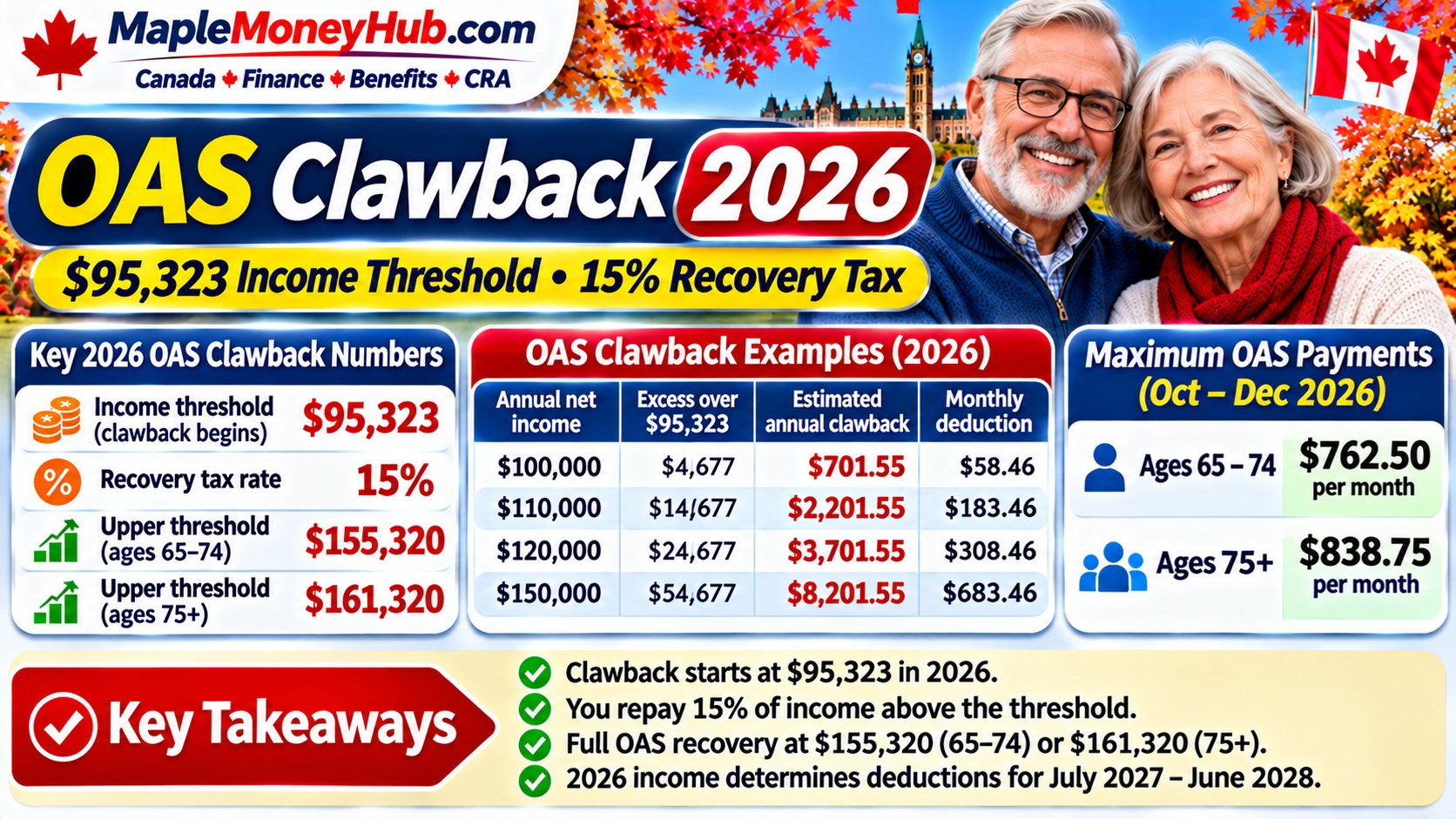
Understanding the Old Age Security clawback is particularly important for Canadian retirees who receive workplace pensions, Canada Pension Plan benefits, RRIF withdrawals or employment income.
Even if you qualify for the maximum Old Age Security pension, your income may reduce the amount you ultimately receive.
Last reviewed: November 24, 2026.
What Is the OAS Clawback?
The Old Age Security clawback, officially known as the OAS recovery tax, requires higher-income seniors to repay some or all of their OAS pension.
Unlike the Canada Pension Plan, which is primarily based on contributions and retirement age, OAS pension payments are subject to an income-related recovery mechanism.
The recovery tax is calculated using individual income rather than total household income.
For every additional dollar of applicable income above the annual threshold, approximately 15 cents of OAS may be recovered until the applicable pension has been fully repaid.
OAS Clawback Thresholds 2026 and 2027
One of the most confusing aspects of the OAS recovery tax is the difference between the income year and the monthly recovery period.
| Income year | Clawback begins | Upper threshold age 65–74 | Upper threshold age 75+ | Monthly recovery period |
|---|---|---|---|---|
| 2024 | $90,997 | $148,451 | $154,196 | July 2025–June 2026 |
| 2025 | $93,454 | $152,062 | $157,923 | July 2026–June 2027 |
| 2026 | $95,323 | $155,320 | $161,320 | July 2027–June 2028 |
Source: Government of Canada OAS Recovery Tax Thresholds.
The upper thresholds reflect standard maximum pension amounts. Seniors receiving partial or deferred OAS pensions may have different effective full-recovery income levels.
How Much Has the OAS Clawback Threshold Increased?
| Tax year | Income threshold | Annual increase |
|---|---|---|
| 2022 | $81,761 | — |
| 2023 | $86,912 | $5,151 |
| 2024 | $90,997 | $4,085 |
| 2025 | $93,454 | $2,457 |
| 2026 | $95,323 | $1,869 |
The 2026 threshold is approximately 2% higher than the 2025 threshold.
For a senior whose income remains above both thresholds, this increase could reduce the preliminary annual recovery tax by up to $280.35, assuming the pension repayment cap does not affect the calculation.
How to Calculate the OAS Clawback in 2026
For a straightforward Canadian resident calculation, subtract the applicable threshold from your eligible net income and multiply any positive difference by 15%.
Estimated recovery tax = (Applicable net income − $95,323) × 15%
If the result is negative, the estimated recovery tax is zero. The actual repayment cannot exceed the applicable recoverable OAS benefits.
Example 1: Annual income of $100,000
Applicable net income: $100,000
2026 threshold: $95,323
Excess income: $4,677
Estimated annual clawback: $701.55
Equivalent monthly deduction: approximately $58.46.
Example 2: Annual income of $120,000
Applicable net income: $120,000
Excess income: $24,677
Estimated annual clawback: $3,701.55
Equivalent monthly deduction: approximately $308.46.
Example 3: Annual income of $150,000
Applicable net income: $150,000
Excess income: $54,677
Preliminary annual clawback: $8,201.55
Equivalent monthly deduction: approximately $683.46 before applying the actual pension cap.
OAS Clawback Chart 2026 by Income
The following calculations illustrate how additional retirement income increases the preliminary recovery tax.
| Applicable annual net income | Annual recovery tax before cap | Monthly equivalent |
|---|---|---|
| $80,000 | $0 | $0 |
| $90,000 | $0 | $0 |
| $95,323 | $0 | $0 |
| $100,000 | $701.55 | $58.46 |
| $105,000 | $1,451.55 | $120.96 |
| $110,000 | $2,201.55 | $183.46 |
| $115,000 | $2,951.55 | $245.96 |
| $120,000 | $3,701.55 | $308.46 |
| $125,000 | $4,451.55 | $370.96 |
| $130,000 | $5,201.55 | $433.46 |
| $140,000 | $6,701.55 | $558.46 |
| $150,000 | $8,201.55 | $683.46 |
| $160,000 | Subject to pension cap | Up to full pension |
These estimates assume standard resident recovery tax treatment. Your final repayment depends on actual benefits, applicable income adjustments and tax circumstances.
Maximum OAS Payments in November and December 2026
The government increased OAS pension rates for the October to December 2026 quarter based on inflation adjustments.
| Age group | Maximum monthly OAS | Annualized equivalent |
|---|---|---|
| 65 to 74 | $762.50 | $9,150.00 |
| 75 and older | $838.75 | $10,065.00 |
The annualized amounts are monthly rates multiplied by 12, not actual total OAS payments for the entire 2026 calendar year.
Actual annual benefits vary because OAS rates are reviewed quarterly and recipients may become eligible or change age groups during the year.
Source: Official OAS Payment Amounts.
What Income Counts Towards the OAS Clawback?
The recovery tax is not calculated using employment income alone. Several sources of retirement and investment income can contribute to the calculation.
| Income source | Generally affects OAS clawback? |
|---|---|
| Employment income | Yes |
| CPP retirement pension | Yes |
| OAS pension | Yes |
| Workplace pension | Yes |
| RRSP withdrawals | Yes |
| RRIF withdrawals | Yes |
| Taxable investment interest | Yes |
| Canadian taxable dividends | Yes, including applicable gross-up |
| Taxable capital gains | Yes |
| Net rental income | Yes |
| Taxable foreign income | Generally yes |
| Ordinary TFSA withdrawals | No |
| Ordinary TFSA investment earnings | No |
For Canadian residents, line 23400 of the federal income tax return is generally the starting point for determining the relevant income. Specific adjustments may apply under the CRA recovery tax worksheet.
Does OAS Clawback Use Gross or Net Income?
The calculation is based on applicable net income before certain adjustments, rather than simply your gross salary or after-tax take-home income.
This means that eligible deductions may influence whether your income exceeds the recovery threshold.
However, tax credits that reduce your income tax bill do not necessarily reduce your income for OAS recovery purposes.
Use the CRA Federal Worksheet when completing your income tax return rather than relying exclusively on gross income calculations.
How RRIF Withdrawals Can Trigger an OAS Clawback
Mandatory RRIF withdrawals are an important consideration for seniors who receive Old Age Security.
A retiree whose pension income is below the OAS threshold may suddenly exceed it after adding required RRIF withdrawals.
Example: Retirement income plus a RRIF withdrawal
Assume a Canadian retiree has the following annual income:
| Income source | Annual amount |
|---|---|
| Workplace pension | $60,000 |
| CPP pension | $15,000 |
| OAS pension | $8,900 |
| RRIF withdrawal | $20,000 |
| Total assumed net income | $103,900 |
Assuming no further deductions or adjustments:
Excess income: $103,900 − $95,323 = $8,577.
Estimated annual OAS recovery tax: $1,286.55.
Monthly equivalent: approximately $107.21.
This illustrates why retirement withdrawals should be planned alongside pension income and other taxable earnings.
Read our RRIF Payment Schedule and Minimum Withdrawal Guide for age-based withdrawal rates and calculations.
Does the OAS Clawback Apply to Couples?
OAS recovery tax is generally calculated separately for each individual receiving the pension.
A married couple with a combined income of $160,000 does not automatically face a clawback simply because their combined income exceeds $95,323.
| Income distribution | Person A recovery tax | Person B recovery tax |
|---|---|---|
| $80,000 each | $0 | $0 |
| $100,000 and $60,000 | $701.55 | $0 |
| $120,000 and $40,000 | $3,701.55 | $0 |
These examples demonstrate how the distribution of individual retirement income can influence total household OAS recovery taxes.
Eligible pension income splitting may help some couples manage this difference, but the effect on both spouses’ taxes and benefits must be considered.
7 Ways to Manage Your OAS Clawback Legally
1. Use a Tax-Free Savings Account
Ordinary TFSA withdrawals do not count as taxable income. Using available TFSA savings for occasional expenses may help avoid unnecessary increases in taxable retirement income.
2. Consider Eligible Pension Income Splitting
Canadian couples who qualify may jointly elect to allocate up to 50% of eligible pension income to the other spouse or common-law partner.
This can reduce one partner’s income while increasing the other’s. The overall result depends on both individuals’ circumstances.
3. Plan RRSP and RRIF Withdrawals
Consider spreading discretionary registered account withdrawals across multiple years rather than taking a large lump sum.
Mandatory RRIF minimum withdrawals must still be completed as required.
4. Review Available RRSP Deductions
Eligible RRSP deductions may reduce applicable net income if you have contribution room and meet the relevant age and account requirements.
Older retirees may also have eligible spousal RRSP contribution options, subject to specific rules.
5. Manage the Timing of Taxable Investment Sales
Selling investments with substantial taxable gains can increase income in the year of sale.
Where appropriate, planning disposals across different tax years may reduce concentrated income increases. Investment decisions should also consider market risk and financial needs.
6. Understand the Dividend Gross-Up
Taxable Canadian dividends can affect OAS recovery calculations because the taxable dividend amount may exceed the cash dividend received.
The dividend tax credit may reduce income tax but does not necessarily remove the associated OAS recovery effect.
7. Review OAS Deferral Before Starting Payments
People who have not yet started OAS may choose to defer their pension until a later age, up to age 70.
Deferral increases the eventual monthly pension, but recipients give up payments during the deferral period and may face other benefit restrictions.
Deferral does not guarantee that future OAS clawbacks will be avoided.
How the OAS Clawback Appears on Your Tax Return
Canadian residents receiving OAS generally receive a T4A(OAS) tax slip.
| Tax slip box or return line | Purpose |
|---|---|
| T4A(OAS), Box 18 | OAS pension received |
| T4A(OAS), Box 22 | Income tax deducted, including applicable recovery withholding |
| Line 11300 | OAS pension income |
| Line 23400 | Net income before adjustments |
| Line 23500 | Social benefits repayment deduction |
| Line 42200 | Social benefits repayment |
| Line 43700 | Total income tax deducted |
Follow the applicable tax-year instructions. Amounts already withheld from monthly pension payments are taken into account when calculating the final tax balance.
See the CRA social benefits repayment instructions.
What If Your Income Drops in 2026?
Suppose you earned a high salary in 2025 but retired during 2026. Your monthly OAS recovery deductions may initially reflect your higher previous-year income.
If your expected income has decreased substantially, you can ask the CRA to reduce the amount withheld from your OAS payments.
The relevant form is T1213(OAS), Request to Reduce Old Age Security Recovery Tax at Source.
- Estimate your applicable income for the current year.
- Obtain the current T1213(OAS) form.
- Complete the income and pension information.
- Submit the request to the CRA as directed.
- Wait for the CRA’s decision.
Approval is not automatic. Reducing withholding also does not eliminate any recovery tax ultimately payable based on your actual annual income.
OAS Clawback vs Guaranteed Income Supplement
| Feature | OAS recovery tax | GIS income test |
|---|---|---|
| Purpose | Recovers OAS from higher-income recipients | Determines eligibility for low-income senior support |
| Income basis | Generally individual income | Individual or combined couple income, depending on status |
| Reduction rules | 15% above the applicable threshold | Separate income-based benefit formulas |
| Tax treatment | OAS is generally taxable | GIS is generally non-taxable |
The OAS recovery threshold must not be confused with the considerably lower income limits used to determine GIS eligibility.
Frequently Asked Questions
What is the OAS clawback threshold for 2026?
The threshold for income earned in 2026 is $95,323. The standard recovery tax rate above this threshold is 15%.
At what income is OAS completely clawed back in 2026?
The published upper thresholds for the 2026 income year are $155,320 for ages 65 to 74 and $161,320 for ages 75 and older. Actual full repayment levels can differ according to individual pension entitlement.
Is the 2026 OAS clawback based on 2025 income?
Monthly recovery deductions from July 2026 to June 2027 are generally based on 2025 income. The 2026 tax-year calculation itself uses 2026 income.
Does CPP income count towards the OAS clawback?
Yes. CPP retirement pension income generally forms part of the income used to calculate OAS recovery tax.
Do TFSA withdrawals affect OAS payments?
Ordinary tax-free TFSA withdrawals do not increase taxable income and generally do not trigger the OAS clawback.
Does the OAS clawback apply to household income?
No. OAS recovery tax is generally calculated using each recipient’s individual applicable income.
Is OAS itself included in the clawback income calculation?
Yes. OAS pension income generally contributes to the applicable income calculation.
Can I recover OAS deductions if my income decreases?
Your final tax return reconciles actual tax liability and applicable withholding. You may also request reduced future withholding from the CRA if your expected income falls.
Can I receive CPP if my OAS is fully clawed back?
Yes. CPP retirement benefits are separate from OAS and are not subject to the OAS recovery tax.
Does turning 75 eliminate the OAS clawback?
No. Seniors aged 75 and older receive a higher standard OAS pension, which generally increases the income level at which the pension is fully recovered. The initial income threshold remains the same.
What is the OAS clawback threshold for the 2027 tax year?
Check the officially published 2027 income-year threshold before planning withdrawals. The $95,323 threshold relates to 2026 income, even though it is used for monthly recovery deductions beginning in July 2027.
Related MapleMoneyHub Guides
Official Government Sources
TL;DR: OAS Clawback 2026
- 2026 income threshold: $95,323.
- Recovery tax rate: 15% of applicable excess income.
- Standard upper threshold for ages 65–74: $155,320.
- Standard upper threshold for ages 75+: $161,320.
- July 2026 to June 2027 deductions generally use 2025 income.
- July 2027 to June 2028 deductions generally use 2026 income.
- RRIF withdrawals, CPP and taxable investment income can affect the calculation.
- Ordinary TFSA withdrawals do not increase clawback income.
- Eligible retirees may request reduced withholding if their income falls substantially.
Editorial and financial disclaimer: Reviewed November 24, 2026, using published Government of Canada and CRA information. Calculations are illustrative and assume standard Canadian resident tax circumstances. Different rules may apply to non-residents, partial pensions and deferred OAS benefits. MapleMoneyHub.com is an independent educational website and is not affiliated with the Government of Canada. Consult the CRA or a qualified Canadian tax professional for individual retirement planning.