Are you wondering when your Registered Retirement Income Fund payment will arrive in 2026 or how much you must withdraw in 2027? Unlike government pensions such as CPP and Old Age Security, RRIF payments follow a schedule arranged with your bank, brokerage or other financial institution.
Understanding your RRIF payment schedule is important for managing retirement income, meeting mandatory withdrawal requirements and avoiding unexpected income tax bills.
Last reviewed: November 19, 2026. The 2027 examples use currently published RRIF withdrawal rules and are subject to future legislative changes.
What Is a RRIF Payment?
A Registered Retirement Income Fund is a registered Canadian retirement account designed to provide income from accumulated retirement savings.
Many Canadians establish a RRIF by transferring money from a Registered Retirement Savings Plan when approaching retirement.
The investments within the RRIF can continue growing on a tax-deferred basis. Withdrawals are generally included in taxable income for the year they are received.
A RRIF is not a government-funded monthly pension. Its payments come from your own retirement assets.
Learn more through the official CRA RRIF guide.
RRIF Payment Schedule 2026–2027
Most financial institutions offer several payment-frequency options. The exact arrangements depend on the account provider.
| Payment frequency | Payments per year | How it works |
|---|---|---|
| Monthly | 12 | Regular retirement income throughout the year |
| Quarterly | 4 | One payment approximately every three months |
| Semi-annual | 2 | Two larger payments during the year |
| Annual | 1 | One payment covering the annual withdrawal amount |
| Additional withdrawals | As arranged | Extra withdrawals when required, subject to account terms |
Your bank may allow you to select a specific payment day, while other providers use predetermined processing dates.
If a scheduled date falls on a weekend or statutory holiday, the financial institution may adjust the processing date according to its own procedures.
Important RRIF Withdrawal Deadlines
| Date | What happens |
|---|---|
| January 1, 2026 | Reference date for calculating the 2026 annual minimum |
| December 31, 2026 | Deadline to complete required 2026 withdrawals |
| January 1, 2027 | Reference date for calculating the 2027 annual minimum |
| December 31, 2027 | Deadline to complete required 2027 withdrawals |
RRIF Minimum Withdrawal Rates by Age 2026–2027
The CRA publishes prescribed factors used to determine mandatory annual RRIF withdrawals.
The following table applies to ordinary modern RRIF accounts. Certain older qualifying RRIF arrangements may use different factors.
| Age at beginning of year | Minimum withdrawal rate | Annual withdrawal on $100,000 |
|---|---|---|
| 60 | 3.3333% | $3,333.33 |
| 65 | 4.00% | $4,000 |
| 66 | 4.1667% | $4,166.67 |
| 67 | 4.3478% | $4,347.83 |
| 68 | 4.5455% | $4,545.45 |
| 69 | 4.7619% | $4,761.90 |
| 70 | 5.00% | $5,000 |
| 71 | 5.28% | $5,280 |
| 72 | 5.40% | $5,400 |
| 73 | 5.53% | $5,530 |
| 74 | 5.67% | $5,670 |
| 75 | 5.82% | $5,820 |
| 76 | 5.98% | $5,980 |
| 77 | 6.17% | $6,170 |
| 78 | 6.36% | $6,360 |
| 79 | 6.58% | $6,580 |
| 80 | 6.82% | $6,820 |
| 81 | 7.08% | $7,080 |
| 82 | 7.38% | $7,380 |
| 83 | 7.71% | $7,710 |
| 84 | 8.08% | $8,080 |
| 85 | 8.51% | $8,510 |
| 86 | 8.99% | $8,990 |
| 87 | 9.55% | $9,550 |
| 88 | 10.21% | $10,210 |
| 89 | 10.99% | $10,990 |
| 90 | 11.92% | $11,920 |
| 91 | 13.06% | $13,060 |
| 92 | 14.49% | $14,490 |
| 93 | 16.34% | $16,340 |
| 94 | 18.79% | $18,790 |
| 95 and older | 20.00% | $20,000 |
Source: CRA Chart of Prescribed RRIF Factors. Percentages for ages below 71 are displayed approximately; example amounts use the underlying formula.
How to Calculate Your Minimum RRIF Payment
For most ordinary RRIF investment accounts, the calculation is based on the account’s fair market value at the beginning of the calendar year and the applicable withdrawal factor.
Annual minimum = January 1 RRIF value × applicable withdrawal percentage.
Monthly payment = Annual withdrawal amount ÷ 12.
For individuals aged 70 or younger, the standard withdrawal factor is calculated using this formula:
Withdrawal factor = 1 ÷ (90 − age)
For individuals aged 71 and older, the prescribed percentage table generally applies.
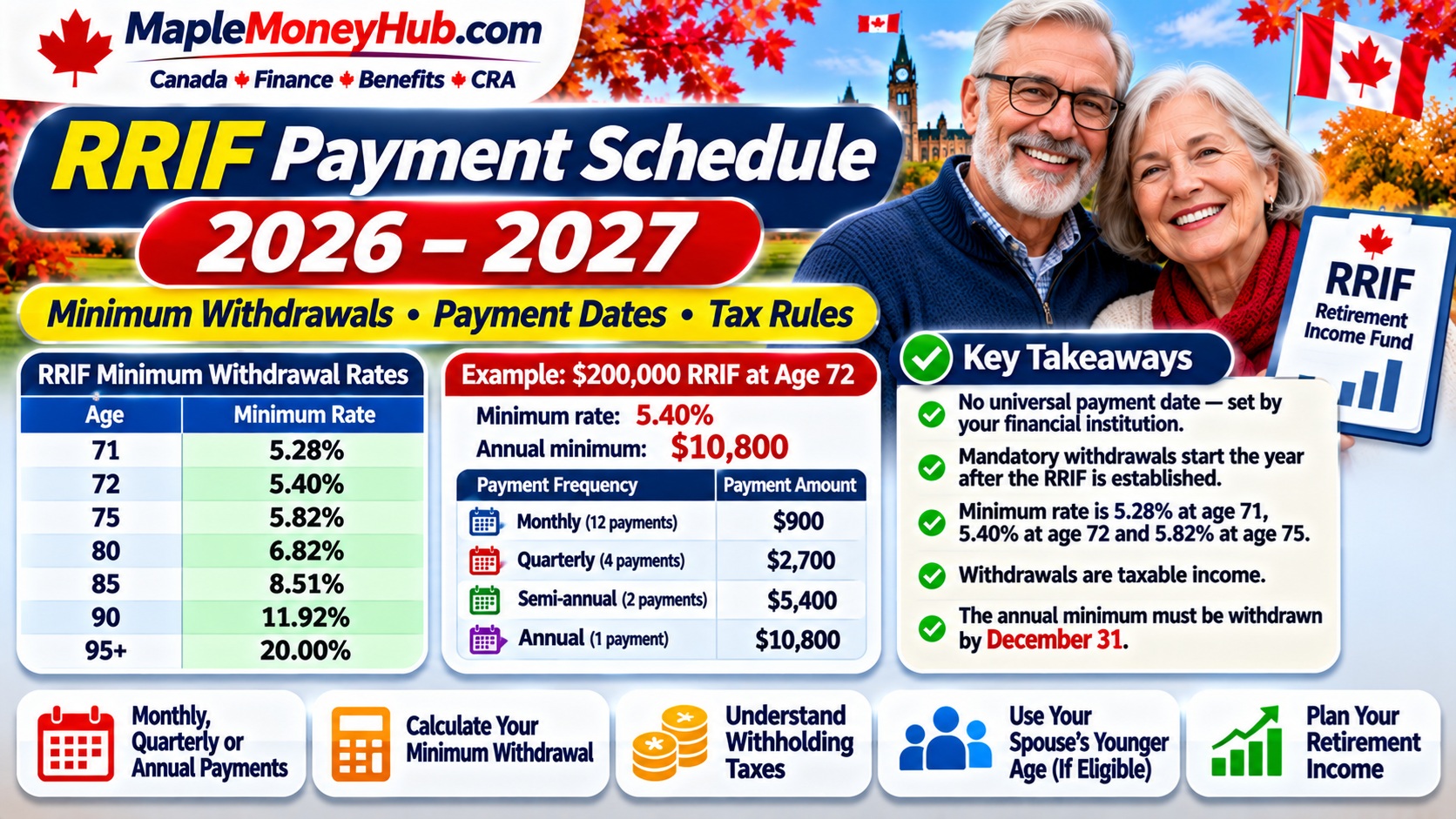
Example 1: $200,000 RRIF at age 72
Suppose you are 72 at the beginning of 2027 and your existing RRIF is valued at $200,000.
Minimum withdrawal rate: 5.40%
Annual minimum: $200,000 × 5.40% = $10,800
| Payment frequency | Gross payment |
|---|---|
| Monthly | $900 |
| Quarterly | $2,700 |
| Semi-annual | $5,400 |
| Annual | $10,800 |
These amounts represent the same annual minimum distributed at different intervals, before any applicable tax withholding or other adjustments.
Example 2: $300,000 RRIF at age 75
January 1 account value: $300,000.
Applicable minimum withdrawal rate: 5.82%.
Annual minimum: $17,460.
Monthly equivalent: $1,455.
The account holder could arrange monthly payments of $1,455 or select another payment frequency supported by the provider.
RRIF Payment Schedule by Account Balance
The following table compares estimated monthly minimum withdrawals across different ages and opening-year account values.
| Age | $100,000 RRIF | $250,000 RRIF | $500,000 RRIF |
|---|---|---|---|
| 65 | $333.33 | $833.33 | $1,666.67 |
| 70 | $416.67 | $1,041.67 | $2,083.33 |
| 71 | $440.00 | $1,100.00 | $2,200.00 |
| 72 | $450.00 | $1,125.00 | $2,250.00 |
| 75 | $485.00 | $1,212.50 | $2,425.00 |
| 80 | $568.33 | $1,420.83 | $2,841.67 |
| 85 | $709.17 | $1,772.92 | $3,545.83 |
| 90 | $993.33 | $2,483.33 | $4,966.67 |
| 95+ | $1,666.67 | $4,166.67 | $8,333.33 |
These are illustrative gross monthly amounts, assuming the account is already subject to mandatory withdrawals. Your financial institution determines the actual minimum.
When Do Mandatory RRIF Payments Begin?
Canadian taxpayers generally must mature their RRSPs by the end of the calendar year in which they turn 71.
Available options include transferring eligible assets directly to a RRIF, purchasing a qualifying annuity or withdrawing the RRSP balance.
A RRIF does not require a minimum withdrawal during the calendar year it is established.
| RRIF established | First mandatory withdrawal year |
|---|---|
| 2024 | 2025 |
| 2025 | 2026 |
| 2026 | 2027 |
| 2027 | 2028 |
Voluntary withdrawals can be made in the establishment year, but because the minimum is zero, those withdrawals are generally subject to withholding tax.
Can You Use Your Younger Spouse’s Age?
When establishing a RRIF, Canadian rules permit an election to calculate the minimum payment using an eligible spouse’s or common-law partner’s age.
Using a younger spouse’s age can reduce the mandatory withdrawal amount, potentially leaving more money invested inside the registered account.
Example: RRIF owner aged 72, spouse aged 65
Assume the opening-year RRIF balance is $250,000.
Using the owner’s age of 72:
$250,000 × 5.40% = $13,500 annually.
Using the spouse’s age of 65:
$250,000 × 4% = $10,000 annually.
Difference in mandatory withdrawals: $3,500 per year.
This election must be made when setting up the RRIF before payments begin. It generally cannot be changed for that existing fund.
RRIF Withdrawal Tax Rates in Canada
There is an important distinction between withholding tax and the final income tax owed.
Minimum RRIF withdrawals are generally not subject to mandatory withholding tax for Canadian residents. However, the amount received remains taxable income.
Amounts withdrawn above the annual minimum are generally subject to withholding tax.
| Amount withdrawn above minimum | Standard withholding outside Quebec |
|---|---|
| $5,000 or less | 10% |
| Over $5,000 up to $15,000 | 20% |
| Over $15,000 | 30% |
Quebec applies different federal withholding rates alongside applicable provincial withholding requirements. Non-residents may also be subject to different rules.
Where regular instalments form part of a single annual withdrawal request, the withholding rate on the excess may be determined using the total requested excess rather than each instalment separately.
Example: Withdrawing more than your minimum
Suppose your annual RRIF minimum is $10,800, but you request a total annual withdrawal of $18,000.
Excess withdrawal: $18,000 − $10,800 = $7,200.
Assuming the standard 20% withholding rate applies outside Quebec:
Withholding tax: $7,200 × 20% = $1,440.
Amount received after withholding: $16,560.
The full $18,000 would generally be included in annual taxable income. The $1,440 withheld is credited toward your final tax liability.
Monthly vs Annual RRIF Withdrawals
The best withdrawal frequency depends on your retirement expenses, investment strategy and other income sources.
| Frequency | Potential advantages | Considerations |
|---|---|---|
| Monthly | Predictable household income | May require regular investment sales |
| Quarterly | Useful for periodic expenses | Requires budgeting between deposits |
| Annual, early in year | Immediate access to cash | Less money remains invested inside the RRIF |
| Annual, late in year | Assets remain invested longer | Year-end processing and market risks |
Changing payment frequency does not, by itself, change the total annual minimum withdrawal requirement.
RRIF Payment Schedule vs CPP and OAS
Some retirees mistakenly expect their RRIF deposit to arrive on the same day as their government pension.
| Income source | Payment schedule | Who administers it? |
|---|---|---|
| RRIF | Individual account arrangement | Bank, brokerage or other carrier |
| CPP | Published government schedule | Service Canada |
| OAS | Published government schedule | Service Canada |
| GIS | Regular government benefit schedule | Service Canada |
For government pension dates, check the official Canadian benefit payment calendar.
Can RRIF Withdrawals Affect OAS and GIS?
Yes. RRIF withdrawals generally increase taxable income and may affect eligibility for income-tested government benefits.
Higher retirement income could increase the Old Age Security recovery tax or reduce Guaranteed Income Supplement entitlement, depending on the applicable income rules and thresholds.
Retirees receiving income-tested benefits should consider the combined effect of RRIF withdrawals, CPP, workplace pensions and other taxable income before requesting substantial additional payments.
Eligible RRIF income may also qualify for the pension income tax credit and pension income splitting, subject to the relevant requirements.
A qualified Canadian tax professional can help assess the effect of additional withdrawals on overall retirement income.
What Happens If Your RRIF Investments Lose Value?
The ordinary annual RRIF minimum is established using the beginning-of-year account value.
If the investment balance falls during the year, the original annual minimum generally does not automatically decrease.
Example: Investment market decline
A retiree aged 72 starts the year with a $200,000 RRIF.
The required minimum is $10,800.
If the account value later falls to $170,000, the previously calculated annual minimum generally remains $10,800.
The next year’s minimum will normally be recalculated using the new beginning-of-year account value and applicable age-based factor.
Some retirees maintain a cash allocation inside their RRIF to help cover upcoming withdrawals without needing to sell investments during unfavourable market conditions.
Why Didn’t My RRIF Payment Arrive?
If a scheduled RRIF deposit is missing, contact the financial institution managing your account rather than the CRA or Service Canada.
Check the following:
- Confirm your selected RRIF payment frequency.
- Check the scheduled payment date.
- Verify the destination bank account.
- Review recent changes to your withdrawal instructions.
- Check whether investment sale proceeds are available.
- Allow for applicable processing and settlement times.
- Contact your RRIF provider about the missing payment.
Unlike government pension delays, there is no single nationwide waiting period for reporting a missing RRIF payment.
How to Change Your RRIF Payment Schedule
Most providers allow account holders to request changes to their recurring withdrawals.
- Sign in to your financial institution’s secure website or contact its retirement account department.
- Locate your RRIF payment instructions.
- Request the preferred payment frequency and amount.
- Confirm the receiving bank account.
- Review any applicable withholding tax.
- Ensure total calendar-year payments meet the mandatory minimum.
- Obtain confirmation of the revised schedule.
Processing times and available options vary by financial institution.
RRIF Year-End Checklist for Canadian Retirees
- Confirm your required 2026 minimum withdrawal.
- Review the total amount already withdrawn.
- Calculate any outstanding minimum payment.
- Check your provider’s December processing deadline.
- Review expected taxable income for the year.
- Consider the effect of additional withdrawals on OAS and GIS.
- Confirm your preferred payment schedule for 2027.
- Retain your RRIF statements and T4RIF tax slip.
Frequently Asked Questions
What is the RRIF payment schedule for 2027?
There is no universal Canadian RRIF payment calendar. Your payment dates depend on the instructions arranged with your financial institution.
What is the minimum RRIF withdrawal at age 71?
The prescribed minimum rate for a standard modern RRIF is 5.28%, provided the account is already subject to annual minimum withdrawals and age 71 is the applicable beginning-of-year age.
What is the RRIF withdrawal rate at age 72?
The standard prescribed factor is 5.40% of the applicable beginning-of-year account value.
Can I receive RRIF payments every month?
Yes. Monthly payments are commonly available, subject to your financial institution’s account options.
Do I have to withdraw money in the year I open a RRIF?
No mandatory minimum applies during the establishment year. Required withdrawals normally start the following calendar year.
Is the minimum RRIF withdrawal tax-free?
No. It generally counts as taxable income, even though mandatory withholding tax does not normally apply to the minimum amount for Canadian residents.
Can I withdraw my entire RRIF?
An ordinary RRIF generally does not have a maximum annual withdrawal limit. However, withdrawing the entire balance could produce substantial taxable income.
What is the deadline for RRIF withdrawals in 2026?
Required annual withdrawals must be completed by December 31, 2026. Your financial institution may impose an earlier processing deadline.
Can I skip my annual minimum payment?
Generally, no. The required annual amount must be paid out unless a specific legislated exception applies.
Does the RRIF minimum increase every year?
The prescribed percentage generally rises with age until reaching 20% at age 95. However, the actual dollar amount can increase or decrease depending on the account balance.
Can RRIF withdrawals reduce my GIS?
Yes. Taxable RRIF income can affect income-tested benefits, including the Guaranteed Income Supplement.
Will I receive a tax slip for RRIF payments?
Your financial institution generally issues a T4RIF slip reporting applicable retirement income fund payments and tax deducted.
Related MapleMoneyHub Retirement Guides
Official CRA Sources
TL;DR: RRIF Payment Schedule 2026–2027
- RRIF payment dates are arranged with your financial institution.
- Monthly, quarterly and annual payment options are commonly available.
- Mandatory withdrawals begin the year after establishment.
- The standard minimum rate at age 71 is 5.28%.
- The standard minimum rate at age 72 is 5.40%.
- Withdrawals generally count as taxable income.
- Withholding tax normally applies to amounts exceeding the minimum.
- Required annual withdrawals must be completed by December 31.
- Review your 2027 payment arrangements with your RRIF provider.
Editorial note: Prepared for MapleMoneyHub.com and reviewed November 19, 2026, using published CRA retirement account guidance. All financial examples are illustrative and assume ordinary modern RRIF arrangements. Special rules may apply to older accounts, locked-in retirement funds, annuity contracts and non-residents. This article provides general educational information rather than personalized investment or tax advice. MapleMoneyHub is not affiliated with the Canada Revenue Agency.
1 thought on “RRIF Payment Schedule 2026–2027: Minimum Withdrawals, Dates and Tax Rules”