MAPLEMONEYHUB | BILLS & UTILITIES
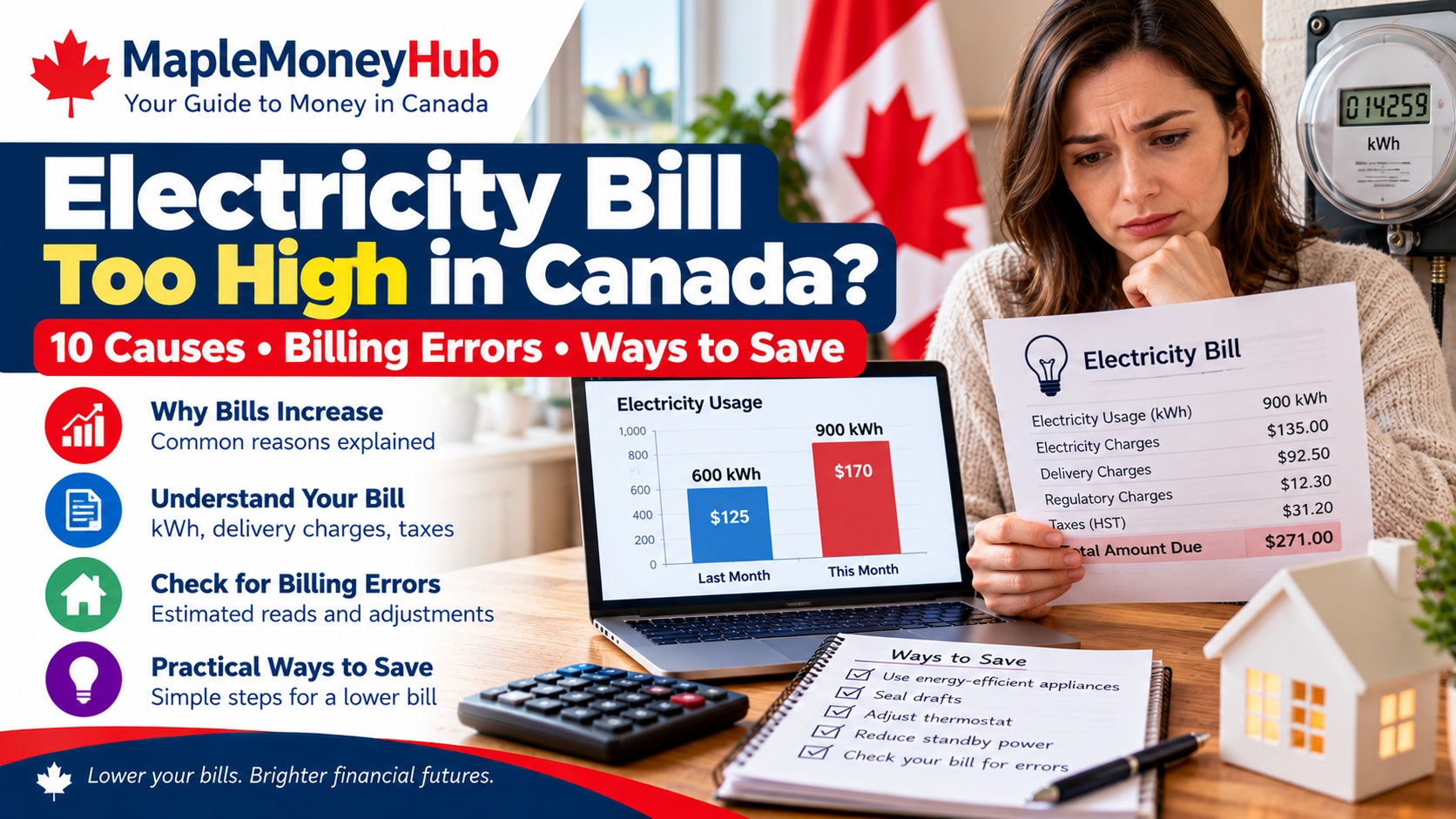
Electricity Bill Too High in Canada? 10 Reasons and Ways to Lower It
Updated October 27, 2026 | Canadian Household Energy Guide
An unusually high electricity bill in Canada can result from increased heating or cooling, longer billing periods, higher electricity rates, delivery charges, estimated meter readings, inefficient appliances or a billing adjustment.
Start by comparing your electricity use in kilowatt-hours (kWh), not just the dollar amount. Check the billing dates, meter readings, rate plan and fixed charges. If consumption has not increased but the amount due has, examine changes to rates, fees, taxes, credits and previous balances.
If you cannot explain the increase, ask your electricity provider to review the bill before assuming your meter is faulty.
Opening a Canadian electricity bill that is $80, $150 or even $250 higher than expected can be stressful. Perhaps your household routine has barely changed, yet the amount owing has increased dramatically.
Many Canadians call their electricity bill a hydro bill, although the term varies by province and utility. Whatever name appears on your statement, the first step is to understand what you are actually paying for.
Your bill is influenced by electricity consumption, the price plan, utility delivery costs, taxes, adjustments and sometimes government assistance. The combination differs across Canada, which means an Ontario bill should not be interpreted using the same rules as one from Quebec, Alberta or British Columbia.
This guide explains ten common causes, provides original calculations and shows how to investigate a suspicious charge without guessing.
1. Your Household Used More Electricity
The simplest reason for a higher bill is that the home consumed more electricity during the billing period.
Electricity consumption is measured in kilowatt-hours (kWh). One kWh represents using one kilowatt of power for one hour.
For example, a 1,500-watt portable heater operating for four hours consumes:
1,500 watts ÷ 1,000 = 1.5 kilowatts
1.5 kW × 4 hours = 6 kWh
At an illustrative energy price of $0.15 per kWh, the electricity component costs:
6 × $0.15 = $0.90 per day
Over 30 days, that is $27 in electricity charges before applicable delivery costs, taxes and other adjustments.
A single heater may not explain a large bill increase, but several heaters, longer operating hours or additional electric appliances can make a noticeable difference.
2. Electric Heating or Air Conditioning Increased
Canadian weather creates major seasonal changes in household energy needs.
During winter, electric baseboard heaters, heat pumps, portable heaters and electric furnaces may operate more frequently. During summer, air conditioners and dehumidifiers can raise electricity consumption.
The effect depends on your home’s heating fuel. A house heated primarily with natural gas may have a different electricity pattern from one relying on electric resistance heating.
What to check
- Compare kWh used during the same season last year.
- Review thermostat schedules and actual indoor temperatures.
- Check whether portable heaters were used more frequently.
- Look for clogged HVAC filters or blocked airflow.
- Inspect drafty windows and doors.
Natural Resources Canada recommends better insulation, air sealing, efficient heating and cooling practices, and appropriate thermostat controls to reduce wasted energy.
3. Your Billing Period Was Longer Than Usual
Electricity statements do not always cover the same number of days. A bill for 35 days may be higher than one for 28 days even if daily consumption remains unchanged.
Suppose a household uses an average of 24 kWh daily:
| Billing Period | Average Daily Use | Total Electricity |
|---|---|---|
| 28 days | 24 kWh | 672 kWh |
| 30 days | 24 kWh | 720 kWh |
| 35 days | 24 kWh | 840 kWh |
The difference between the shortest and longest period is 168 kWh, even though the household’s daily usage did not change.
When comparing bills, calculate kWh per day instead of looking only at the total.
4. Your Electricity Rate or Price Plan Changed
Electricity pricing is not uniform across Canada. Provinces have different market structures, regulated rates, utility providers and rate schedules.
In Ontario, eligible residential customers purchasing electricity through their utility can choose among Time-of-Use, Ultra-Low Overnight and Tiered pricing.
Under time-sensitive plans, the hour when electricity is consumed can affect the price. Under tiered pricing, the price can increase after consumption crosses a threshold.
In other provinces, utilities may apply different blocks, seasonal rules or rate structures.
5. Delivery Charges Increased
One of the most common questions is: Why is my electricity bill high when I used very little electricity?
The answer may involve delivery and other non-energy charges.
For example, the Ontario Energy Board explains that delivery charges cover moving electricity through transmission and distribution infrastructure. Some charges are fixed, while others depend on consumption.
| Bill Component | What It Generally Covers |
|---|---|
| Electricity or energy | The electricity consumed, measured in kWh. |
| Distribution or delivery | Local wires, equipment, maintenance and electricity delivery. |
| Transmission | Movement of electricity over larger power networks. |
| Customer or account charge | Billing, metering and account services, where applicable. |
| Regulatory or system charges | Additional electricity-system costs, depending on the province. |
| Taxes and adjustments | Applicable taxes, credits, rebates or previous balances. |
Not every Canadian electricity bill uses these exact labels. Your local utility’s bill explanation is the authoritative guide.
6. The Utility Used an Estimated Meter Reading
Some billing situations involve estimated rather than actual meter readings. If an earlier estimate was too low, a later bill based on actual consumption may include a catch-up adjustment.
That can make one statement unusually large without indicating that all the electricity was consumed during the latest month.
How to investigate
- Find the meter-reading section on your bill.
- Check whether the reading is identified as actual or estimated.
- Compare the previous and current meter readings.
- Check the number of days in the billing period.
- Contact the utility if the readings or dates do not make sense.
Hydro-Québec’s official bill guide illustrates how meter readings and billing-period information are used to calculate electricity consumption.
For smart-meter customers, the utility’s online portal may provide more detailed usage history.
7. An Appliance Is Using More Electricity Than Expected
Older or malfunctioning appliances can consume more electricity than homeowners realize.
Potential contributors include an aging refrigerator, a malfunctioning freezer, an electric water heater, a dehumidifier or a portable heater running for long periods.
A hot-water leak can also increase the energy required to heat replacement water if your home uses an electric water heater.
| Appliance | Illustrative Usage | Monthly kWh |
|---|---|---|
| 1,500 W space heater | 4 hours daily for 30 days | 180 kWh |
| 1,000 W dehumidifier | 5 hours daily for 30 days | 150 kWh |
| 100 W lighting load | 6 hours daily for 30 days | 18 kWh |
| 2,000 W electric heater | 3 hours daily for 30 days | 180 kWh |
Illustrative examples based on the stated wattages and operating hours. Real appliances cycle on and off, so actual consumption may be lower or higher.
To investigate, review the appliance’s wattage, estimated operating hours and, where safe and appropriate, use a suitable plug-in energy monitor.
Do not attempt electrical panel repairs or meter modifications yourself.
8. Standby Power Is Adding to Your Usage
Televisions, gaming systems, computers, printers and entertainment equipment can consume electricity while apparently switched off.
Natural Resources Canada notes that standby power can account for a meaningful share of household electricity use and recommends smart power bars and disconnecting devices that are rarely used.
Simple changes include:
- Switching off unused electronics where practical.
- Using smart power bars for compatible equipment.
- Choosing efficient replacement appliances.
- Turning off unnecessary lighting.
- Reviewing devices that run continuously.
Do not unplug essential equipment such as medical devices, refrigerators, security systems or other appliances that must remain powered.
9. Your Bill Includes a Previous Balance or Adjustment
A high amount due is not always caused by high electricity consumption.
Your statement may include a previous unpaid balance, late-payment charges, an adjustment, a returned-payment fee or a change in a credit or rebate.
Look for separate figures labelled:
- Previous balance
- Payments received
- Current charges
- Adjustments
- Credits or rebates
- Total amount due
For example, a household with $125 in current charges and a $95 unpaid balance may see a total amount due of $220 before any other fees or adjustments.
That does not mean electricity consumption suddenly doubled.
10. Your Meter or Bill May Need Investigation
Meter errors are possible, but they should not be the first assumption when a bill increases.
Before requesting a meter test, check consumption history, billing dates, rate changes, heating equipment and previous balances.
If the numbers remain unexplained, ask the utility to review the account and explain its meter-verification process.
Some utilities may charge for certain meter tests if the equipment is found to be accurate. Ask about potential fees before authorizing a test.
Electricity Bill Example: 600 kWh vs. 900 kWh
To understand how increased consumption affects your bill, consider a simplified household example.
Assume the electricity energy price is $0.15 per kWh, with a fixed monthly charge of $35.
| Calculation | 600 kWh | 900 kWh |
|---|---|---|
| Electricity use | 600 kWh | 900 kWh |
| Illustrative energy price | $0.15/kWh | $0.15/kWh |
| Energy cost | $90.00 | $135.00 |
| Illustrative fixed charge | $35.00 | $35.00 |
| Subtotal | $125.00 | $170.00 |
| Increase | — | $45.00 |
Electricity consumption increased by 50%, from 600 to 900 kWh. In this simplified model, the subtotal increased by 36%, because the fixed charge remained unchanged.
The model excludes taxes, variable delivery fees, tiered pricing, time-of-use differences and rebates. It is not a quotation for any Canadian utility.
Use MapleMoneyHub’s free electricity cost calculator to explore your own appliance consumption and estimated costs.
How Electricity Bills Differ Across Canadian Provinces
Canada does not have a single nationwide residential electricity tariff. Understanding the local rate structure is essential when evaluating a high bill.
| Province | Billing Consideration | Official Source |
|---|---|---|
| Ontario | Eligible utility customers may choose Time-of-Use, Ultra-Low Overnight or Tiered pricing. Delivery and regulatory charges also matter. | Ontario Energy Board |
| Quebec | Hydro-Québec bills depend on the applicable rate, consumption, billing period and other charges. | Hydro-Québec |
| British Columbia | Check the utility, residential rate schedule and whether billing involves energy blocks or other charges. | BC Hydro |
| Alberta | Energy supply, distribution and transmission charges can be important. Retail arrangements differ from some regulated provincial systems. | Utilities Consumer Advocate |
| Manitoba | Review Manitoba Hydro’s current residential rate and bill explanation. | Manitoba Hydro |
| Saskatchewan | Check the residential tariff, service charges and usage details. | SaskPower |
| Nova Scotia | Review the applicable residential rate and any fuel or other approved adjustments. | Nova Scotia Power |
Other provinces and territories have their own providers and regulations. Rates may also vary by customer class, location and contract.
Comparison tip: Rather than comparing only cents per kWh, compare the total bill for the same consumption level, including delivery, fixed charges, taxes and rebates.
How to Dispute an Electricity Bill in Canada
If your electricity bill appears incorrect, begin by contacting the utility directly. A clear, documented explanation makes the review process easier.
Step 1: Gather Your Bills
Collect the current statement and at least three earlier bills. If possible, compare the same season in the previous year.
Step 2: Compare the Key Numbers
Check the kWh used, billing days, meter readings, rate plan, fixed charges, adjustments and previous balance.
Step 3: Contact Customer Service
Ask which specific factor caused the increase. If the bill includes an estimated reading or catch-up adjustment, request an explanation of the calculation.
Step 4: Request a Formal Review
If the explanation does not resolve the issue, ask about the utility’s billing dispute procedure and meter-verification process.
Step 5: Escalate When Appropriate
Where available, follow the applicable provincial regulator’s complaint or dispute process. The correct escalation route depends on your province and electricity provider.
Keep copies of statements, emails, reference numbers and the dates of your conversations.
- Was my meter reading actual or estimated?
- Did my billing period contain more days than usual?
- Did my electricity rate or price plan change?
- Which delivery charges increased?
- Is there a previous balance or billing adjustment?
- Can you provide daily or hourly usage information?
- What is the process for reviewing or disputing this bill?
10 Practical Ways to Lower Your Electricity Bill
Once you’ve confirmed that your bill is accurate, focus on the household activities responsible for the most energy use.
- Review heating settings: Avoid heating unused rooms unnecessarily while maintaining safe temperatures.
- Seal drafts: Weather-stripping and air sealing can reduce heating and cooling demand.
- Maintain HVAC equipment: Follow manufacturer guidance for cleaning filters and servicing equipment.
- Switch to efficient lighting: Replace older bulbs with suitable LEDs.
- Check electric water heating: Repair leaks and consider safe, efficient hot-water practices.
- Reduce unnecessary standby power: Use appropriate smart power bars and disconnect unused devices.
- Use efficient appliances: Consider ENERGY STAR models when replacement is necessary.
- Review your electricity price plan: If eligible, compare plans using your actual usage pattern.
- Monitor consumption: Use your utility’s online usage tools to identify unusual days.
- Explore energy assistance: Check for current provincial, utility or income-based programs.
Natural Resources Canada recommends many of these actions in its official household energy-efficiency guidance.
Are Electricity Bill Rebates Available in Canada?
Depending on where you live and your circumstances, you may qualify for utility bill assistance, a rate reduction, energy-efficiency upgrades or another support program.
Programs are not identical across provinces and may change over time. Some provide bill credits, while others help households reduce future energy consumption through insulation, air sealing or heating upgrades.
For example, the federal government announced expansion of the Canada Greener Homes Affordability Program in June 2026 to additional provinces, including Quebec, British Columbia, Nova Scotia and Prince Edward Island. Delivery, timing and eligibility depend on the applicable jurisdiction.
Check current programs through your utility, provincial government or the official Natural Resources Canada home-efficiency resources.
Do not assume that a program announced nationally is already accepting applications in your community.
Frequently Asked Questions
Why did my hydro bill double in one month?
A sudden increase may result from heating or cooling, a longer billing period, a corrected estimated meter reading, higher rates or an unpaid previous balance. Compare kWh and daily consumption before assuming the meter is wrong.
Why is my electricity bill high when I’m away from home?
Refrigerators, freezers, water heaters, heating systems and other equipment may continue using electricity while the property is unoccupied. Fixed utility charges may also remain payable.
Can I dispute a high electricity bill?
Yes. Contact the utility and request an explanation or billing review. If the issue remains unresolved, ask about the relevant provincial complaint process.
Does using electricity at night save money?
It depends on your rate plan. Some time-of-use plans charge different rates by hour, while flat or tiered structures may not provide a nighttime price advantage.
What uses the most electricity in a Canadian home?
The answer depends on the home and its energy sources. Electric space heating, water heating, cooling and major appliances can be significant contributors. Review your household equipment and utility consumption data.
Related MapleMoneyHub Guides
- Free Canadian Financial Calculators — including an electricity cost calculator.
- Interac e-Transfer Pending in Canada? — troubleshoot payment delays.
- CRA Notice of Assessment 2026 — understand tax assessment information.
- Financial Disclaimer — important information about our guides.
Final Takeaway: What Should You Do First?
If your electricity bill is unexpectedly high, begin with three numbers: total kWh, billing days and total current charges.
Compare these against previous bills. If usage increased, investigate heating, cooling and appliances. If usage stayed similar, check rate changes, delivery fees, adjustments and previous balances.
When the numbers still do not make sense, contact your utility and request a detailed review. Small efficiency improvements can help, but correcting a billing problem should come first.
Official Sources
- Ontario Energy Board — Understanding Your Electricity Bill
- Ontario Energy Board — Electricity Rates and Plans
- Hydro-Québec — Reading Your Bill
- Natural Resources Canada — Home Energy Efficiency
- Natural Resources Canada — 10 Energy-Saving Actions
- Government of Canada — June 2026 Energy Affordability Announcement
Last reviewed: October 27, 2026. MapleMoneyHub.com is an independent information website and is not affiliated with any electricity provider or government department. Electricity rates, rebates and program eligibility vary by location and may change.