MAPLEMONEYHUB | CRA EMPLOYMENT NEWS
CRA 735 Workforce Adjustment Notices 2026: Who Is Affected, Layoff Risks & Employee Rights
Updated October 30, 2026 | Canada Revenue Agency Workforce Update
No. The 735 figure refers to employees affected by a workforce adjustment exercise, not 735 confirmed layoffs.
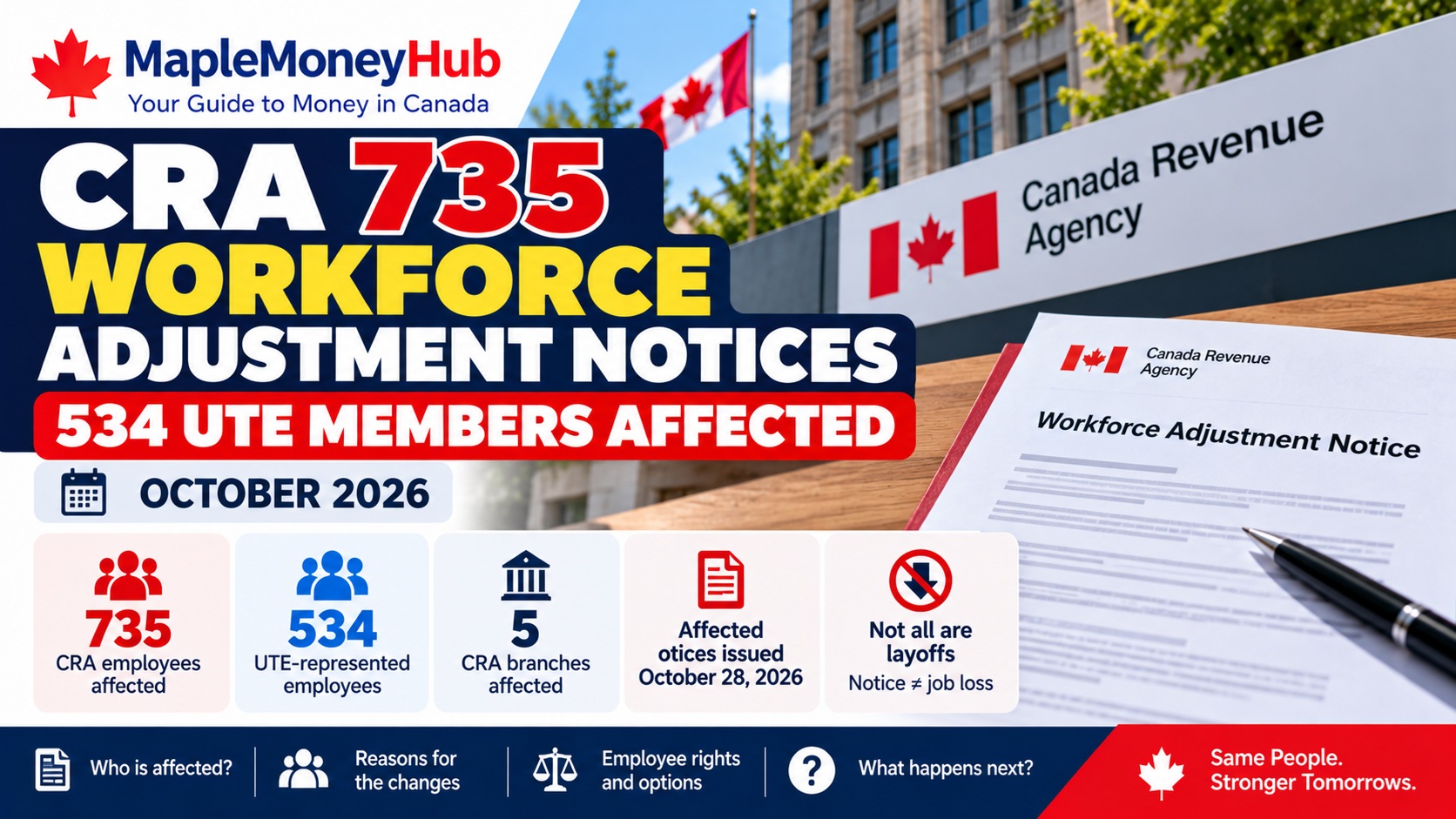
On October 28, 2026, the Union of Taxation Employees (UTE) announced that the Canada Revenue Agency was undertaking a workforce adjustment involving 735 employees, including 534 UTE-represented workers.
Employees across Canada are affected. The five branches involved are Appeals; Assessment, Benefit, and Service; Commissioner’s Office; Human Resources; and Compliance Programs.
An affected notice means an employee’s position may no longer be required. It does not automatically mean employment has ended.
What affected employees should do: Read the notice, identify any deadlines, contact their union representative and human resources, and review the applicable Workforce Adjustment Appendix before choosing an option.
Source: UTE’s October 28 announcement.
The Canada Revenue Agency’s latest workforce adjustment announcement has raised questions among federal employees about job security, possible layoffs, reassignment and the future of tax services.
For many workers, the most immediate concern is what receiving an affected notice means. Others want to know whether the announcement represents a final job-loss decision or the beginning of a longer process.
The distinction matters. Under the workforce adjustment framework, employees may receive several different types of notices, and each stage can carry different rights, responsibilities and timelines.
This MapleMoneyHub guide explains the October 2026 CRA announcement, the branches involved, the reasons cited for the changes, the rights of affected employees and the possible implications for Canadian taxpayers.
1. What Happened at CRA on October 28, 2026?
On October 28, the Union of Taxation Employees announced that CRA was undertaking a workforce adjustment exercise affecting 735 employees.
Of that total, 534 employees were represented by UTE, which is a component of the Public Service Alliance of Canada (PSAC).
The union said affected notices were scheduled to be delivered that day and that employees in all regions of Canada were included.
PSAC followed with an October 29 statement criticizing the reductions and warning about possible consequences for public services.
The announcement forms part of broader federal efforts to adjust staffing, organizational structures and spending.
However, the October announcement does not establish that all affected positions will be eliminated or that all notified employees will lose their jobs.
2. Which CRA Branches Are Affected?
UTE identified five CRA branches involved in the October workforce adjustment exercise.
| CRA Branch | General Area of Responsibility |
|---|---|
| Appeals Branch | Tax objections, appeals and dispute-resolution functions. |
| Assessment, Benefit, and Service Branch | Assessment, benefit administration and taxpayer service activities. |
| Commissioner’s Office | Agency leadership and related corporate functions. |
| Human Resources Branch | Workforce planning, staffing and employee-support functions. |
| Compliance Programs Branch | Tax compliance and related program activities. |
The announcement does not provide a verified branch-by-branch count of all 735 affected employees.
Therefore, it would be misleading to claim that a specific number of employees in the Appeals Branch, Compliance Programs Branch or another branch will be laid off without additional official information.
UTE also confirmed that employees in all regions are affected, but it did not publish a complete city-by-city breakdown in the October 28 notice.
3. Why Is CRA Issuing Workforce Adjustment Notices?
According to the UTE announcement, the reasons identified by CRA vary depending on the branch and organizational circumstances.
They include:
- The end of pandemic-related funding and workloads.
- Expenditure reductions and budget pressures.
- Agency alignment and organizational streamlining.
- Changes in workload and operational priorities.
- Centralization of certain functions.
- Harmonization of work processes.
- Expanded digital or self-service delivery.
- Regional and organizational restructuring.
These reasons do not necessarily apply equally to every affected employee.
For example, one work unit may be affected because a temporary program has ended, while another may be reviewed because its work is being reorganized or centralized.
Employees should consult their individual notice and employer representatives to understand the reason applicable to their own position.
4. Does an Affected Notice Mean You Are Laid Off?
No. This is the most important distinction in the October 2026 announcement.
An affected notice informs an employee that their position may no longer be required and that the employer is undertaking further analysis or workforce adjustment procedures.
The process may eventually result in a position being retained, a different position being offered, voluntary departure, surplus status or layoff.
Those outcomes are not interchangeable.
| Term | What It Generally Means |
|---|---|
| Affected | The employee’s position may no longer be required. A final outcome has not necessarily been determined. |
| Surplus | The position is being eliminated, and the employee enters a process governed by applicable employment protections. |
| Guarantee of a Reasonable Job Offer | The employer provides a guarantee under the applicable workforce adjustment rules, subject to the conditions of that framework. |
| Opting employee | An eligible employee without a guaranteed reasonable job offer who must select among available workforce adjustment options. |
| Layoff | Employment ends following the applicable legal and contractual process. |
The correct classification depends on the employee’s letter and the rules governing their position.
5. What Rights Do Affected CRA Employees Have?
PSAC’s CRA-specific workforce adjustment guidance explains that the applicable collective agreement includes a Workforce Adjustment Appendix.
The appendix establishes responsibilities and protections intended to support affected employees and preserve employment opportunities where possible.
Depending on the employee’s circumstances, the process can involve:
- Written notification of workforce adjustment status.
- Consultation with the bargaining agent.
- Efforts to identify alternative employment opportunities.
- Consideration of retraining opportunities.
- Voluntary departure procedures where applicable.
- Selection procedures for retention or layoff.
- Salary protection and other contractual provisions where applicable.
- Access to information about available options and deadlines.
Employees should review the actual provisions in their collective agreement rather than assuming every federal department follows exactly the same rules.
CRA is a separate agency, and the general federal workforce adjustment guidance for the core public administration does not automatically govern every CRA employee.
The PSAC CRA-specific FAQ is particularly useful for UTE members.
Read PSAC’s CRA Workforce Adjustment FAQ.
6. What Should You Do After Receiving a CRA Affected Notice?
Receiving a workforce adjustment notice can create uncertainty, especially when it is unclear whether the position will eventually be eliminated.
UTE recommends reading the letter carefully and contacting union representatives before making decisions.
Step 1: Read the Entire Notice
Identify the status described in the letter, the date it takes effect, the next procedural steps and any instructions requiring a response.
Do not assume that another employee’s notice contains identical terms.
Step 2: Record Every Deadline
Some later workforce adjustment stages involve formal deadlines for selecting options or responding to the employer.
Missing a deadline could affect the options available to you.
Record the dates from your own documents and ask for clarification if anything is unclear.
Step 3: Contact Your UTE Representative
Union representatives can help explain the collective agreement, available protections and how the process applies to your circumstances.
UTE has specifically encouraged affected members to contact their local representatives.
Step 4: Speak With Human Resources
Ask which stage of the workforce adjustment process applies to you and what information will be provided next.
Find out whether employee information sessions, counselling or alternative employment discussions are planned.
Step 5: Review Available Employment Opportunities
Where appropriate, keep your résumé current and review internal opportunities that match your qualifications.
Employees should also understand any rules concerning retraining, priority appointments or reasonable job offers.
Step 6: Avoid Rushed Decisions
Do not accept a voluntary departure arrangement, resign or make pension decisions without understanding the financial and employment consequences.
For complex situations, seek guidance from the union, human resources and a qualified professional where appropriate.
7. Could Some CRA Employees Keep Their Jobs?
Yes. The workforce adjustment process can produce different outcomes.
Depending on the circumstances, an employee may remain in their position, move to another role or participate in a process to determine which employees are retained.
Other employees may receive guarantees of reasonable job offers or access to options described in their collective agreement.
Not every affected notice will necessarily lead to an individual layoff.
The eventual number of job losses cannot be calculated simply by treating all 735 affected employees as dismissed.
8. What Is a Voluntary Departure Program?
A voluntary departure program may be established when the relevant workforce adjustment conditions are met.
Such a program allows eligible employees to consider leaving employment voluntarily under specified terms rather than waiting for a selection process.
However, eligibility and available choices depend on the applicable workforce adjustment provisions.
Employees should not assume that every affected person automatically qualifies for the same voluntary departure package.
PSAC’s CRA-specific guidance explains the employer’s responsibilities and the options available at different stages.
Before making a decision, employees should understand potential effects on pension eligibility, benefits, taxes, future employment and any available transition payments.
9. Will CRA Employees Receive Severance or Transition Payments?
Some employees may qualify for severance or transition-related payments, depending on their employment status, the applicable collective agreement and the eventual outcome.
However, an affected notice alone does not establish that a specific severance amount is payable.
For example, the calculation may depend on years of service, salary, employment category and the option selected.
PSAC’s CRA workforce adjustment FAQ discusses severance provisions and transition options for qualifying employees.
Employees should request an individualized explanation of any proposed payment before signing documents or making a final election.
10. Is This the Same as the March 2026 CRA Workforce Adjustment?
No. The October announcement is a separate workforce adjustment exercise.
Earlier in 2026, CRA employees were also affected by workforce changes connected in part to the winding down of certain federal programs and operational adjustments.
The October exercise involves 735 employees across five identified branches.
These figures should not be combined casually because different announcements may involve different employees, employment statuses and reporting periods.
Similarly, cumulative union totals are not the same as a count of completed layoffs.
11. How Does This Relate to PSAC-UTE Bargaining?
The workforce adjustment announcement arrives during an active round of collective bargaining between PSAC-UTE and CRA.
The next mediation meetings were scheduled for November 24 and 25, 2026.
Collective bargaining and workforce adjustment are related employment issues, but they are not the same process.
Bargaining concerns the terms of a collective agreement, while workforce adjustment concerns organizational decisions affecting positions and the protections that apply to employees.
Employees should follow both developments because changes to staffing and job security may be relevant to their broader workplace concerns.
For bargaining updates, consult the official UTE bargaining page.
12. Could the 735 Notices Affect CRA Tax Refunds?
The notices raise reasonable questions about the agency’s ability to maintain services, but they do not establish that a specific tax refund will be delayed.
PSAC has warned that reducing CRA staffing could contribute to longer waits and difficulty accessing assistance.
That is the union’s stated concern, not confirmation of a new nationwide tax-refund delay.
CRA has described its organizational changes as part of efforts to align services, staffing and operational priorities.
For taxpayers, the practical approach is to monitor official CRA service announcements and check individual refund status rather than assume a disruption has occurred.
Related guide: CRA Tax Refund Delayed in 2026?
13. Will Canada Child Benefit, CPP or OAS Payments Be Delayed?
There is no confirmed blanket suspension of federal benefits resulting from the October workforce adjustment notices.
The Canada Child Benefit and certain other tax credits are administered through the CRA.
CPP and OAS are administered through Service Canada, which is a different federal organization.
Consequently, the CRA workforce adjustment announcement should not be presented as evidence that CPP or OAS payments have been cancelled or delayed.
Recipients should continue checking the official payment calendars for their particular benefits.
Read our Canada Benefit Payment Dates October 2026 guide for program-specific dates.
14. What Happens Next After the October Notices?
UTE said CRA would hold information sessions in the coming weeks and that PSAC would provide further resources to affected members.
Further developments may include:
- Employee information sessions and individual discussions.
- Clarification of affected positions and organizational changes.
- Identification of alternative employment opportunities.
- Voluntary departure procedures where applicable.
- Retention or layoff selection processes where required.
- Additional notices specifying individual employment status.
- Union updates about the application of workforce adjustment protections.
These are possible stages of the process, not a prediction that each will occur for every employee.
No universal final layoff date for all 735 affected employees was established in the UTE announcement.
15. Frequently Asked Questions
How many CRA employees received workforce adjustment notices?
The October 2026 exercise affects 735 employees, including 534 represented by UTE.
Were 735 CRA employees laid off?
No. The figure refers to employees affected by the workforce adjustment exercise. The final number of layoffs has not been established by that announcement.
When were the notices issued?
UTE said the notices were scheduled for delivery on October 28, 2026.
Which CRA branches are affected?
The five identified branches are Appeals; Assessment, Benefit, and Service; Commissioner’s Office; Human Resources; and Compliance Programs.
Are CRA employees across Canada affected?
Yes. UTE stated that employees in all regions are affected.
Does an affected employee have to resign?
No. An affected notice does not automatically require resignation. Employees should review their individual status, rights and options before making decisions.
Can an affected employee be reassigned?
Potentially. Alternative employment opportunities are among the protections and procedures that may apply under the relevant workforce adjustment framework.
Will every affected employee receive severance?
No such conclusion can be drawn from the notice alone. Entitlement depends on the employee’s circumstances and the applicable provisions.
Will CRA tax services be interrupted?
The union has warned about possible service consequences, but the October notice does not itself confirm a specific nationwide service interruption.
Where can affected employees get help?
UTE members should contact their local union representative and consult PSAC’s CRA-specific workforce adjustment guidance. Employees can also seek clarification from CRA human resources.
16. Related MapleMoneyHub Articles
- CRA Tax Refund Delayed in 2026?
- CRA Account Locked After Too Many Attempts?
- CRA Notice of Assessment 2026
- Canada Benefit Payment Dates October 2026
- PSAC UTE CRA Mediation Dates 2026
17. TL;DR: CRA 735 Workforce Adjustment Notices
- CRA’s October 2026 workforce adjustment exercise affects 735 employees.
- 534 employees are represented by the Union of Taxation Employees.
- UTE announced the exercise on October 28, 2026.
- Employees in all Canadian regions are affected.
- Five CRA branches are involved.
- An affected notice is not confirmation of a layoff.
- Employment outcomes may include retention, reassignment, voluntary departure or layoff, depending on the applicable process.
- Employees should review their notices, track deadlines and contact union representatives.
- No specific nationwide tax-refund or benefit-payment interruption has been established by the notices.
Bottom line: The October announcement begins or advances workforce adjustment procedures for affected employees. It does not mean 735 CRA workers have already lost their jobs.
Official Sources and References
- Union of Taxation Employees — October 28, 2026 Announcement
New Workforce Adjustment: 534 Members Affected - Public Service Alliance of Canada — October 29 Statement
PSAC response to CRA workforce reductions - PSAC — CRA Workforce Adjustment FAQ
Employee rights, definitions and available options - Government of Canada — Workforce Adjustment
General federal workforce adjustment information - Union of Taxation Employees — Bargaining Updates
Current CRA collective bargaining information
Last reviewed October 30, 2026. MapleMoneyHub is an independent Canadian information website and is not affiliated with CRA, PSAC or UTE. Employment rights, options and deadlines depend on the employee’s specific notice and applicable collective agreement. General federal workforce adjustment guidance may differ from CRA-specific provisions. This article is informational and is not legal or employment advice.