MAPLEMONEYHUB | CANADIAN EMPLOYMENT & BARGAINING
PSAC UTE CRA Mediation Dates 2026: November 24–25 Bargaining Update
Updated October 29, 2026 | Canada Revenue Agency Collective Bargaining
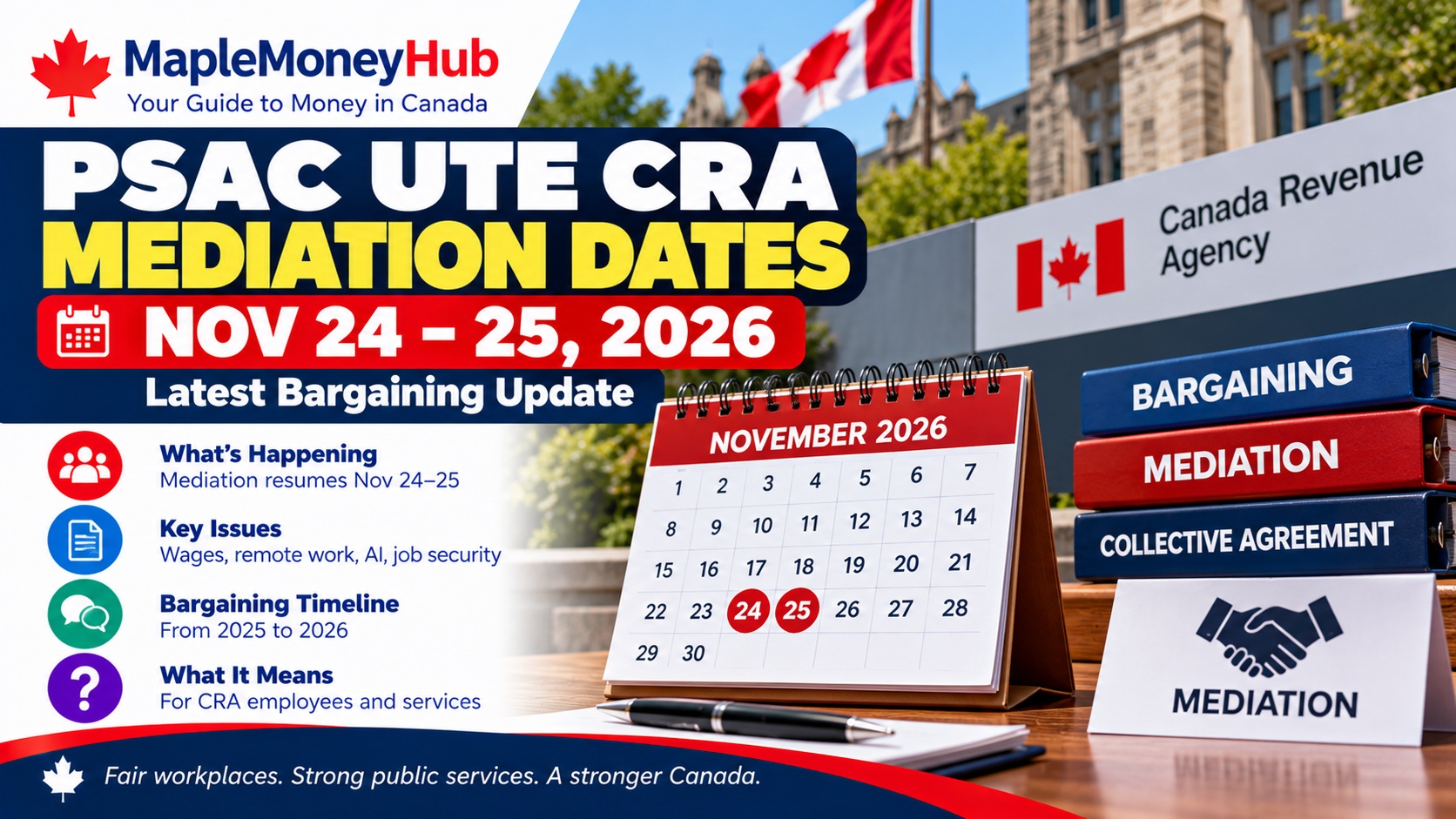
The next mediation meetings between the Public Service Alliance of Canada–Union of Taxation Employees (PSAC-UTE) and the Canada Revenue Agency (CRA) are scheduled for November 24 and 25, 2026.
PSAC announced the dates on October 21, 2026. The meetings will involve a third-party mediator following unsuccessful mediation in May and a federal labour board decision to bypass the Public Interest Commission process.
- Next mediation: November 24–25, 2026.
- Union: PSAC–Union of Taxation Employees.
- Employer: Canada Revenue Agency.
- Previous mediation: May 5–7, 2026.
- Key issues: Wages, remote work, artificial intelligence and job security.
- Agreement reached? No new agreement was announced in the October 21 update.
- Strike announced? The mediation announcement did not announce a strike.
Thousands of Canada Revenue Agency employees are watching the next stage of collective bargaining after a difficult year of negotiations.
The announcement of new mediation dates gives workers a specific point on the calendar, but it does not guarantee that the union and CRA will reach a settlement during those two days.
For employees, the outcome could influence future salary increases, workplace arrangements, job-security protections and the terms of a renewed collective agreement.
For taxpayers, the discussions may also raise questions about whether CRA services could be affected if negotiations remain unresolved.
This guide explains the confirmed mediation dates, what happened earlier in 2026, the major disagreements, and what employees should monitor next.
1. Latest PSAC UTE CRA Mediation Status
CURRENT STATUS — LAST CHECKED OCTOBER 29, 2026
November 24–25, 2026Status: Mediation scheduled.
Participants: PSAC-UTE bargaining team and CRA representatives.
Process: Third-party mediation following the labour board’s decision not to establish a Public Interest Commission at this stage.
Outcome: Not yet known. The scheduled meetings are in the future.
PSAC published the new dates on October 21, 2026, and the Union of Taxation Employees included the announcement in its official bargaining updates.
The announcement follows months of disagreements over compensation, workplace policies and employee protections.
There is no confirmed settlement date. November 24 and 25 are dates for discussions, not guaranteed dates for a signed collective agreement.
2. PSAC UTE CRA Bargaining Timeline: 2025–2026
The current negotiations did not begin in October 2026. They follow an earlier bargaining process that started in 2025.
| Date | Bargaining Development |
|---|---|
| May 2025 | UTE sought bargaining proposals from members. |
| July 2025 | UTE served notice to bargain with CRA. |
| September 2025 | The new round of negotiations began. |
| October 31, 2025 | The previous collective agreement reached its stated expiry date. |
| February 6, 2026 | PSAC-UTE declared an impasse in negotiations. |
| March 2026 | The federal labour board arranged mediation. |
| May 5–7, 2026 | Mediation sessions took place without a settlement. |
| June 8, 2026 | The labour board decided not to establish a Public Interest Commission at that stage. |
| October 21, 2026 | PSAC announced new mediation dates. |
| November 24–25, 2026 | Next scheduled mediation meetings. |
The timeline helps explain why members may see older articles referring to mediation in May. Those sessions already occurred and did not produce a new agreement.
The November meetings are a separate opportunity to resume mediated discussions.
3. Why Did PSAC-UTE Declare an Impasse?
In February 2026, PSAC-UTE declared that bargaining had reached an impasse.
An impasse means the parties have been unable to make sufficient progress through their direct negotiations.
It does not automatically terminate negotiations, create a new contract or begin a strike.
The union said it was dissatisfied with the employer’s responses to its priorities, including wages, artificial intelligence protections and remote work.
CRA disputed aspects of the union’s characterization of the negotiations and said there were numerous outstanding proposals that still required discussion.
These are different positions from the two bargaining parties, not findings that one side has been proven correct.
4. What Happened During May 2026 Mediation?
Earlier mediation meetings were scheduled for May 5–7, 2026.
The sessions involved mediators intended to help the parties make progress toward a negotiated agreement.
However, the mediation did not result in a settlement.
PSAC-UTE’s Position
The union reported that the employer had not meaningfully addressed important member priorities, particularly wage increases, remote work and safeguards related to artificial intelligence.
CRA’s Position
CRA said limited progress had been achieved and criticized the union’s approach to discussing outstanding proposals.
The agency also said the union’s proposals had substantial financial implications and that it was not ready to table an economic proposal under those circumstances.
CRA stated that it remained committed to negotiating a fair agreement that was responsible to employees and Canadians.
Because the parties disagreed about the reasons for the unsuccessful sessions, readers should consult both official bargaining updates rather than relying on a single interpretation.
5. What Does Bypassing the Public Interest Commission Mean?
A Public Interest Commission, or PIC, is part of the federal collective bargaining dispute-resolution framework.
Its role can include examining outstanding issues and making recommendations to assist the parties.
After the unsuccessful May mediation, the Federal Public Sector Labour Relations and Employment Board decided not to establish a PIC at that stage of the CRA negotiations.
The board concluded that a PIC was unlikely to assist the parties in reaching a resolution given the outstanding issues and limited progress.
PSAC-UTE supported bypassing the PIC process because it considered that process lengthy and unlikely to resolve the dispute.
CRA expressed disappointment with the decision and argued that a PIC could provide a useful structured forum.
6. What Are the Main CRA Bargaining Issues?
Several issues have remained prominent throughout this bargaining round.
| Issue | Why It Matters to Employees |
|---|---|
| Wage increases | Future salary adjustments affect household budgets, purchasing power and long-term earnings. |
| Remote work | Work-location rules can affect commuting costs, caregiving and work-life balance. |
| Artificial intelligence | Employees want clarity about how automation may affect duties, positions and workplace protections. |
| Job security | Negotiated protections can affect how workforce changes are handled. |
| Hours of work | Scheduling rules affect working conditions and predictability. |
Not every bargaining proposal will necessarily appear in a final agreement. Negotiations often involve compromises, revised language and issues that remain unresolved until late in the process.
7. Will CRA Employees Receive a Pay Raise in 2026?
A new wage increase cannot be confirmed simply because mediation dates have been announced.
The amount and effective dates of any future wage adjustments would depend on the terms of a negotiated agreement or another lawful resolution.
If a new agreement includes retroactive salary increases, the agreement and subsequent payroll implementation instructions would determine how those amounts are calculated and paid.
Employees should therefore be cautious about social media claims announcing a specific wage increase or retroactive payment before the terms have been officially confirmed.
Why Retroactive Pay Matters
When collective agreements are finalized after an earlier agreement expires, a new agreement may establish wage rates effective from an earlier date.
If so, eligible employees may be owed the difference between amounts already paid and the newly negotiated rates for the applicable period.
However, retroactive pay is not guaranteed merely because a contract has expired. It depends on the eventual agreement.
8. Is the Previous CRA Collective Agreement Still in Effect?
The CRA identifies October 31, 2025 as the expiry date of the previous PSAC-UTE collective agreement.
That does not mean employees immediately lose all previously negotiated terms and conditions.
PSAC’s bargaining FAQ explains that existing agreement terms generally continue to apply while negotiations are underway, subject to the relevant labour-law framework.
Employees should continue following applicable workplace policies and official instructions unless informed of a lawful change.
For a specific pay, leave, scheduling or grievance question, consult the current collective agreement, your union representative or the appropriate workplace authority.
9. Does November Mediation Mean a CRA Strike Is Coming?
No strike was announced in PSAC’s October 21 mediation update.
Mediation is a process intended to help the parties resolve disagreements.
If the parties remain unable to reach an agreement, further bargaining and other steps under the federal labour-relations framework may follow.
Any lawful strike action would be subject to applicable requirements, including union procedures and statutory conditions.
Employees should not interpret a scheduled mediation meeting as a strike date.
Similarly, taxpayers should not assume CRA offices or online services will close because mediation is taking place.
10. Could CRA Mediation Affect Tax Refunds or Benefits?
The mediation meetings themselves do not establish that CRA tax refunds, benefit payments or online services will be interrupted.
The CRA continues to administer programs such as income tax assessments, the Canada Child Benefit and other federal credits.
If a labour disruption is formally announced in the future, the agency would need to communicate any relevant service impacts.
Until then, Canadians should use official CRA service updates rather than assuming that bargaining automatically delays payments.
Related reading: CRA Tax Refund Delayed in 2026?
11. What Could Happen on November 24 and 25?
There are several possible outcomes when the parties meet with a mediator.
Outcome 1: Progress on Selected Issues
The parties may narrow their differences on some proposals without resolving the entire collective agreement.
Outcome 2: More Negotiations Are Scheduled
If progress is made but major issues remain, further meetings could be arranged.
Outcome 3: A Tentative Agreement
The parties could reach a tentative agreement, but this outcome is not guaranteed.
Any tentative agreement would still be subject to the applicable approval and ratification processes.
Outcome 4: No Agreement
The meetings may conclude without a settlement, leaving the parties to consider their next lawful steps.
Readers should wait for an official announcement before treating any of these scenarios as confirmed.
12. Where Can CRA Employees Find Official Bargaining Updates?
For current information, employees should prioritize three sources.
- PSAC: Union-wide announcements, bargaining updates and frequently asked questions.
- UTE: CRA-specific bargaining bulletins and member information.
- CRA: Employer bargaining updates and its explanation of the negotiation process.
Comparing the union’s and employer’s statements is especially useful when the parties disagree about the reasons for limited progress.
View Official UTE Bargaining Updates13. Frequently Asked Questions
When is the next PSAC UTE CRA mediation?
November 24 and 25, 2026, according to PSAC’s October 21 announcement.
Are the November mediation dates confirmed?
Yes. PSAC officially announced the scheduled dates. They remain subject to any later scheduling changes.
Did PSAC-UTE and CRA reach an agreement in May 2026?
No. The May mediation sessions did not produce a new collective agreement.
What happened to the Public Interest Commission?
The federal labour board decided not to establish a PIC at that stage of the negotiations, determining it was unlikely to help the parties reach a resolution.
Is CRA going on strike in November 2026?
The October 21 announcement scheduled mediation; it did not announce a strike. Future developments must be confirmed through official sources.
Will CRA employees receive retroactive pay?
That depends on the eventual agreement, including its wage provisions and effective dates. No specific retroactive amount can be confirmed from the mediation announcement.
What are the major bargaining demands?
PSAC-UTE has highlighted wage increases, remote work, artificial intelligence protections and job security.
Will CRA tax services stop during mediation?
Mediation itself does not mean CRA services will stop. Any actual service disruption would require a separate confirmed development.
14. Related MapleMoneyHub Guides
- CRA Account Locked After Too Many Attempts?
- CRA Tax Refund Delayed in 2026?
- Canada Benefit Payment Dates October 2026
- CRA Notice of Assessment 2026
15. TL;DR: PSAC UTE CRA Mediation Dates
- The next CRA bargaining mediation sessions are scheduled for November 24–25, 2026.
- PSAC announced the dates on October 21, 2026.
- Previous mediation in May ended without an agreement.
- The federal labour board decided not to establish a Public Interest Commission at that stage.
- Major outstanding issues include wages, remote work, AI protections and job security.
- No new collective agreement or wage increase was confirmed in the October 21 announcement.
- The announcement did not establish a strike date.
- Employees should monitor PSAC, UTE and CRA for the outcome of the November meetings.
Next expected milestone: November 24–25, 2026 mediation meetings.
Official Sources
- PSAC — New Mediation Dates Set (October 21, 2026)
Official November 24–25 announcement - PSAC — CRA Bargaining FAQ
Bargaining status, process and employee questions - UTE — Bargaining Updates
Official UTE bargaining bulletins - UTE — PIC Bypass Decision
June 2026 union update - Canada Revenue Agency — Collective Bargaining
CRA employer statements and negotiation history
Last reviewed October 29, 2026. MapleMoneyHub is an independent information website and is not affiliated with PSAC, UTE or the Canada Revenue Agency. Mediation dates and bargaining developments may change. This article provides general information, not legal or labour-relations advice.