MAPLEMONEYHUB | GOVERNMENT BENEFITS
Disability Tax Credit Application for Canada Disability Benefit 2026: Complete Guide
Updated October 30, 2026 | CRA and Service Canada Application Guide
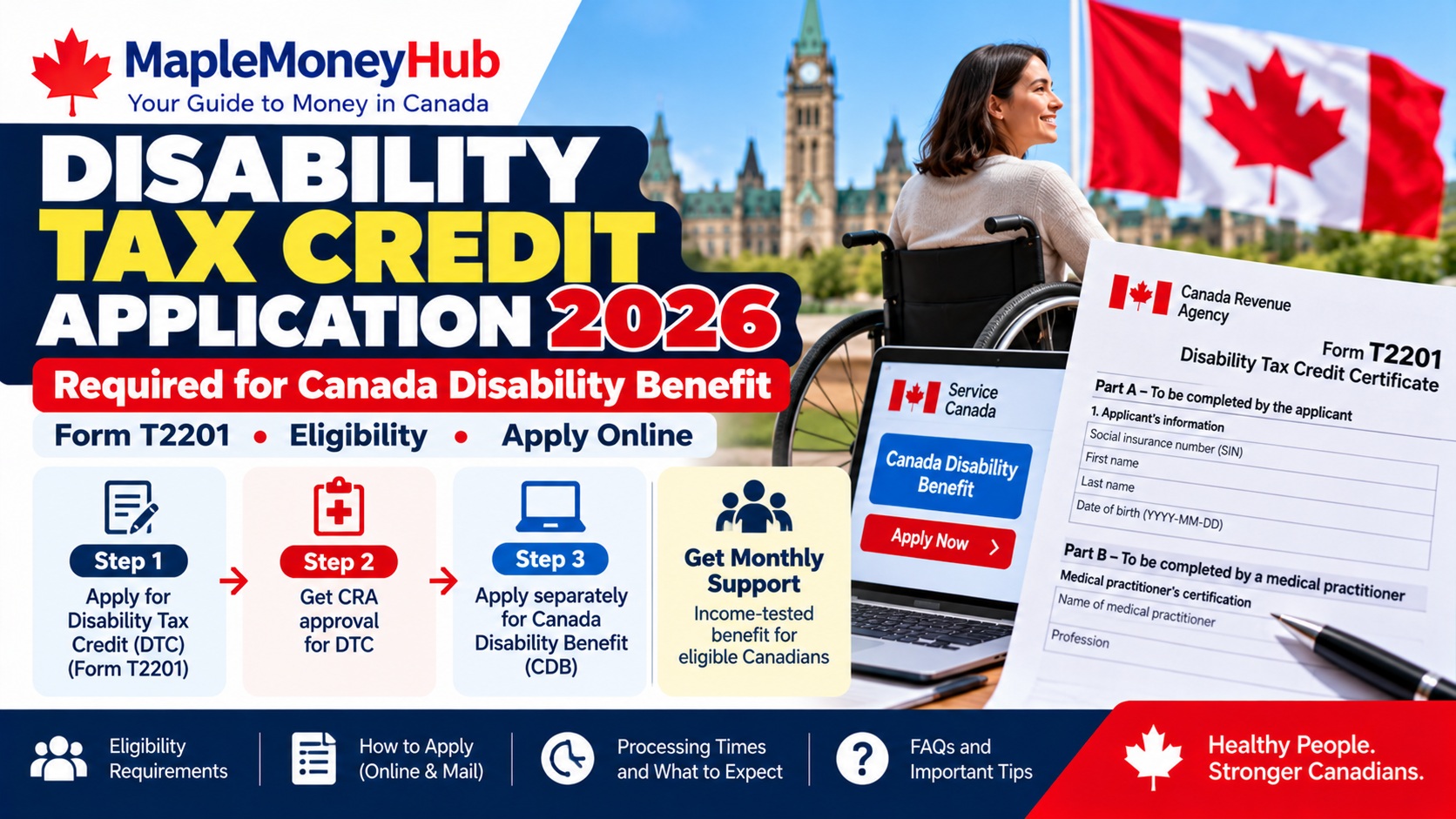
To qualify for the Canada Disability Benefit (CDB), you must first be approved for the Disability Tax Credit (DTC) by the Canada Revenue Agency.
Apply for the DTC using the CRA’s digital application or Form T2201, Disability Tax Credit Certificate. You complete Part A, and an authorized medical practitioner completes Part B describing the effects of your impairment.
After CRA approves your DTC application, you must submit a separate Canada Disability Benefit application through Service Canada. DTC approval does not automatically start monthly CDB payments.
For the 2026–2027 CDB payment period, you and your spouse or common-law partner, if applicable, must have filed your 2025 federal income tax returns.
Apply for the Disability Tax CreditAlready DTC-approved? Apply for the Canada Disability Benefit.
The Canada Disability Benefit provides income support to eligible working-age Canadians with disabilities.
However, the application process can be confusing because two different federal organizations are involved.
The Canada Revenue Agency determines whether someone qualifies for the Disability Tax Credit. Service Canada administers the Canada Disability Benefit application and payments.
Understanding this distinction is essential. Applying for the DTC is not the same as applying for the CDB, and receiving DTC approval does not guarantee that you meet every requirement for monthly benefit payments.
This guide explains the complete process, including eligibility, medical certification, Form T2201, online applications, CRA processing, Service Canada applications and what to do if your DTC request is denied.
1. Is the Disability Tax Credit Required for the Canada Disability Benefit?
Yes. DTC approval is a mandatory eligibility requirement for the Canada Disability Benefit.
The DTC is a non-refundable income tax credit administered by the CRA.
The CDB is a separate income-tested monthly benefit administered by Service Canada.
| Feature | Disability Tax Credit | Canada Disability Benefit |
|---|---|---|
| Administered by | CRA | Service Canada |
| Purpose | Reduce eligible income tax | Provide monthly financial support |
| Application | Digital DTC form or T2201 | Separate CDB application |
| Medical certification | Required for initial approval | Uses CRA DTC approval |
| Income requirement | No general income ceiling for DTC eligibility | Benefit amount is income-tested |
| Automatic enrolment | Not applicable | No; application required |
Someone may qualify for the DTC but receive no CDB payment because they do not meet the CDB’s age, residency, tax-filing, immigration-status or income-related requirements.
2. Who Qualifies for the Disability Tax Credit?
CRA evaluates the effects of an impairment on a person’s ability to perform certain everyday activities.
A diagnosis alone does not establish eligibility.
The medical practitioner must certify that the person meets the applicable criteria.
There are three principal eligibility pathways:
- A marked restriction in one eligible category.
- The cumulative effect of significant limitations in two or more eligible categories.
- Qualifying life-sustaining therapy.
What Is a Marked Restriction?
A marked restriction generally means that a person is unable to perform an eligible activity, or takes at least three times as long as someone of a similar age without the impairment, even with appropriate treatment, medication or assistive devices.
The restriction must be present all or substantially all of the time, generally at least 90%, and must have lasted or be expected to last for a continuous period of at least 12 months.
Different rules apply to certain vision impairments and life-sustaining therapy.
3. Which Disabilities and Impairments May Qualify?
CRA considers the effects of impairments in the following categories:
| Category | What CRA Evaluates |
|---|---|
| Walking | Ability to walk independently or with appropriate aids. |
| Mental functions | Functions necessary for everyday life, including memory, judgment and adaptive functioning. |
| Dressing | Ability to dress oneself. |
| Feeding | Ability to feed oneself, including preparing food for immediate consumption under applicable rules. |
| Eliminating | Bowel or bladder functions. |
| Hearing | Ability to hear under the applicable criteria. |
| Speaking | Ability to communicate through speech. |
| Vision | Visual acuity or field-of-vision limitations. |
| Life-sustaining therapy | Qualifying therapy required to support a vital function. |
| Cumulative limitations | Combined effects of significant limitations in eligible categories. |
Conditions involving physical disability, mental health, developmental disability or chronic illness may qualify when the specific CRA criteria are met.
The important factor is how the impairment affects the person, not simply the name of the medical condition.
4. How to Apply for the Disability Tax Credit Online in 2026
The CRA provides a digital application process that allows the applicant and medical practitioner to complete their respective sections electronically.
Step 1: Sign In to CRA My Account
Visit the official CRA DTC application page.
Sign in to your CRA account and choose your Individual account.
Step 2: Select Benefits and Credits
Find the Benefits and credits section and select the option labelled “Apply for DTC.”
Step 3: Complete Part A
Enter the required information about the person with the impairment.
If a supporting family member may claim a transferred disability amount, provide the relevant information where requested.
Complete the consent questions carefully.
Step 4: Save Your Reference Number
After submitting Part A, CRA provides a reference number.
This reference number is valid for up to 12 months and can be used once by the medical practitioner to submit Part B digitally.
Step 5: Give the Number to Your Medical Practitioner
The medical practitioner enters the reference number and matching identifying information to access Part B.
Only an authorized medical practitioner can complete the medical certification.
Step 6: Medical Practitioner Submits Part B
The practitioner describes the impairment and its effects according to CRA requirements.
Once Part B is completed and submitted digitally using the reference number, the complete application is sent automatically to CRA.
Step 7: Track Your Application
Use CRA My Account to review the application status and monitor any requests for additional information.
The CRA will issue a notice of determination when it makes a decision.
5. How to Apply Using Form T2201 by Mail
Applicants who prefer paper forms can use Form T2201, Disability Tax Credit Certificate.
- Download the current Form T2201 from Canada.ca.
- Complete Part A with the required personal information and consent.
- Sign the authorization section.
- Ask an eligible medical practitioner to complete and sign Part B.
- Check that every required field and signature is present.
- Mail the complete form to an appropriate CRA tax centre.
- Keep a copy for your records.
CRA requires both parts of the paper application to be submitted together.
Do not submit Part A digitally and Part B on paper as separate parts of one application.
Download Official Form T22016. Important 2026 Change: Do Not Upload a New T2201 Through Submit Documents
CRA introduced a significant procedural change on July 14, 2026.
New DTC applications must be submitted using the dedicated digital DTC application or by mailing a completed paper form.
The general “Submit documents” feature in CRA My Account is no longer the correct channel for submitting a new DTC application.
If CRA requests additional documents during an existing application review, follow the instructions and reference number provided in its letter.
This distinction is important because using the wrong submission method can delay the process.
7. Which Medical Practitioners Can Complete Form T2201?
The professional authorized to certify an impairment depends on the category being assessed.
| Medical Practitioner | Eligible Certification Categories |
|---|---|
| Medical doctor | All impairment categories |
| Nurse practitioner | All impairment categories |
| Optometrist | Vision |
| Audiologist | Hearing |
| Occupational therapist | Walking, feeding and dressing |
| Physiotherapist | Walking |
| Psychologist | Mental functions |
| Speech-language pathologist | Speaking |
Applicants should choose a practitioner familiar with their medical history and functional limitations.
Medical practitioners must use their professional judgment when certifying the effects of the impairment.
8. Does the Doctor Need to Describe the Diagnosis or Daily Limitations?
Both may be relevant, but CRA’s eligibility decision focuses on the effects of the impairment under the DTC criteria.
The medical practitioner should explain how the person’s condition affects the eligible activities and how frequently those limitations occur.
Useful information may include:
- How long the impairment has existed.
- Whether it is expected to last at least 12 months.
- Which everyday activities are affected.
- How long the activities take.
- Whether limitations remain despite treatment or assistive devices.
- Whether two or more limitations have a cumulative effect.
- Details of qualifying life-sustaining therapy, where applicable.
Applicants should provide accurate information about their actual circumstances and avoid exaggerating symptoms or limitations.
9. How Long Does CRA Take to Approve the Disability Tax Credit?
CRA reviews the completed application and may contact the medical practitioner for additional information.
Processing time depends on the completeness of the application and whether further medical details are required.
CRA provides a processing-time tool and application progress tracker.
Rather than relying on an outdated fixed estimate, check the current processing time through the official CRA website.
If you submit the DTC application at the same time as your income tax return, CRA may review the DTC application before assessing the return, potentially delaying the tax assessment.
10. What Happens After CRA Approves Your DTC?
CRA sends a notice of determination explaining its decision.
If approved, the notice identifies the tax years for which you qualify.
Approval may allow you to claim the disability amount on your tax return, transfer an unused portion to an eligible supporting family member or access other disability-related programs.
For people seeking the Canada Disability Benefit, the next step is to apply through Service Canada.
You do not generally need to submit a new DTC application every year unless CRA requires it or your approval expires.
11. How to Apply for the Canada Disability Benefit After DTC Approval
Once your DTC is approved, check that you meet the remaining CDB eligibility requirements.
You can apply for the CDB online, by phone, at a Service Canada office or using a paper application.
Step 1: Open the Official CDB Application
Visit the Service Canada application page.
Apply for Canada Disability BenefitStep 2: Gather Your Information
Have your Social Insurance Number, mailing address and legal status in Canada ready.
If you received a Service Canada invitation letter, it may include a unique six-digit application code.
You can apply even if you did not receive an invitation letter, provided you meet the eligibility requirements.
Step 3: Enter the Requested Details
Complete the application using accurate personal information.
You may provide direct deposit information to receive payments electronically.
Step 4: Submit Your Application
Review the details before submitting.
Keep any confirmation information for future reference.
Step 5: Wait for the CDB Decision
Service Canada will assess the application using the program’s eligibility rules.
If approved, your first payment will generally be made on the third Thursday of the month following approval and may include eligible back payments.
12. Canada Disability Benefit Eligibility in 2026
To qualify for the CDB, applicants must meet all applicable conditions.
| Requirement | 2026 Rule |
|---|---|
| Age | Generally 18 to 64 years old |
| Disability Tax Credit | CRA DTC approval required |
| Tax filing | 2025 federal tax return filed by applicant and spouse or partner, if applicable |
| Residency | Canadian resident for income tax purposes |
| Immigration or legal status | Must fall within an eligible category under CDB rules |
| Income | Payment amount determined using adjusted family net income and applicable rules |
Eligible legal-status categories include Canadian citizens, permanent residents, protected persons, individuals registered or entitled to registration under the Indian Act, and certain temporary residents who have lived in Canada throughout the previous 18 months.
Applicants under 18 may apply up to six months before their 18th birthday, but their application is not processed until they turn 18.
People aged 65 or older may qualify for certain back payments for earlier eligible months before turning 65.
13. How Much Is the Canada Disability Benefit?
The CDB provides income-tested support with a maximum base amount of $2,400 per year, equivalent to $200 per month.
The actual amount depends on adjusted family net income and other program rules.
Not everyone approved for the DTC will receive the maximum CDB payment.
Service Canada also provides information about a supplemental payment intended to help with costs associated with obtaining the DTC.
Check the official CDB benefit calculation page for the current income thresholds, reductions and supplemental-payment rules.
Read our related Canada Disability Benefit Payment Dates 2026 guide.
14. Can You Receive CDB Back Payments?
Yes, in qualifying circumstances.
Service Canada states that eligible applicants may receive back payments for up to 24 months from the date their application is received, but not for any month before June 2025.
Back payments depend on whether all eligibility requirements were met during the relevant months.
For example, a person who receives DTC approval in late 2026 may still qualify for CDB payments relating to earlier eligible months.
However, DTC approval alone does not guarantee back payments for every month.
Apply for the CDB promptly after receiving DTC approval to avoid unnecessary delays.
15. What if CRA Denies Your Disability Tax Credit Application?
If CRA denies your application, read the notice of determination carefully.
The decision should explain why the medical information did not establish eligibility.
You may:
- Contact CRA to discuss the decision.
- Review Form T2201 for missing or unclear information.
- Request a review and provide additional medical evidence.
- Ask your medical practitioner to clarify the functional limitations.
- File a formal objection within the applicable deadline if you disagree.
CRA states that an income tax objection may be filed within 90 days of the notice of determination.
Submitting a new diagnosis without explaining the actual limitations may not resolve the issue.
Additional information should address the reasons given for the denial.
16. Can You Apply for DTC Without Paying an Application Company?
Yes.
There is no CRA fee to submit a Disability Tax Credit application.
However, your medical practitioner may charge a fee for completing the medical certification.
That fee may be eligible as a medical expense on your tax return, subject to CRA rules.
Third-party application companies are not required.
Applicants should be cautious about services charging a large percentage of a potential tax refund simply to complete the application.
The official CRA application process is available directly through Canada.ca.
17. Is the Disability Tax Credit Refundable?
No. The DTC is a non-refundable tax credit.
It can reduce the federal income tax you owe but does not automatically create a cash payment when you have no tax liability.
In certain circumstances, an unused disability amount can be transferred to an eligible supporting family member.
That is different from the Canada Disability Benefit, which is a direct monthly financial benefit for eligible applicants.
18. Can You Claim the DTC for Previous Tax Years?
Yes, potentially.
If CRA approves your eligibility for earlier years, you may be able to claim the disability amount for up to 10 previous tax years.
The notice of determination identifies the years covered by your approval.
You can request adjustments to previous tax returns where appropriate.
When completing the DTC application, you can authorize CRA to automatically adjust eligible prior-year returns.
Otherwise, you may request changes through CRA My Account or by mail.
Any resulting tax refund depends on your previous tax situation and eligibility.
19. Who Do You Contact About DTC or CDB?
| Question | Responsible Agency | Contact |
|---|---|---|
| DTC application, medical certification or determination | CRA | 1-800-959-8281 |
| Start DTC Part A through automated telephone service | CRA | 1-800-463-4421 |
| CDB application, eligibility or payments | Service Canada | 1-833-486-3007 |
| CDB TTY service | Service Canada | 1-833-467-2700 |
The CDB contact centre’s published hours are Monday to Friday, 8:30 a.m. to 4:30 p.m. local time, excluding statutory holidays.
Check the official CRA and Service Canada contact pages for current hours and accessibility options.
20. Common Disability Tax Credit Application Mistakes
- Assuming a diagnosis automatically qualifies for DTC approval.
- Submitting Form T2201 without the medical practitioner’s certification.
- Using a pre-2023 paper form in late 2026.
- Uploading a new DTC application through the wrong CRA document-submission channel.
- Submitting digital Part A and paper Part B separately.
- Forgetting to give the digital reference number to the practitioner.
- Providing insufficient information about the duration and frequency of limitations.
- Assuming DTC approval automatically creates a CDB application.
- Failing to file the required income tax returns.
- Ignoring a CRA request for additional information.
Carefully checking these details can reduce avoidable delays.
21. Frequently Asked Questions
Do I need the Disability Tax Credit to receive the Canada Disability Benefit?
Yes. CRA approval for the DTC is a mandatory CDB eligibility requirement.
Can I apply for the DTC online in 2026?
Yes. Use the dedicated digital application through CRA My Account. The applicant completes Part A and an authorized medical practitioner completes Part B.
What is Form T2201?
Form T2201 is the Disability Tax Credit Certificate used to apply for DTC approval.
Can I submit Form T2201 through CRA Submit Documents?
Not as a new application. Since July 14, 2026, use the dedicated digital DTC application or mail the completed paper form.
Does a doctor have to complete the application?
A qualified medical practitioner must complete Part B. Depending on the impairment, the practitioner may be a doctor, nurse practitioner or another authorized professional.
Can someone with a mental health condition qualify?
Potentially. Eligibility depends on whether the impairment meets CRA’s criteria for mental functions necessary for everyday life or another qualifying pathway.
Does DTC approval automatically start CDB payments?
No. You must apply separately to Service Canada for the Canada Disability Benefit.
Can I receive CDB back payments?
Eligible applicants may receive up to 24 months of back payments, subject to program rules, with no payments for months before June 2025.
Can I apply for DTC if I have no taxable income?
Yes. DTC eligibility is not limited to people who owe income tax. Approval may also help establish eligibility for other programs, including the CDB.
What happens if my DTC is denied?
You can request clarification, submit additional medical evidence, ask for a review or file an objection within the applicable deadline.
22. Related MapleMoneyHub Articles
- Canada Disability Benefit Payment Dates 2026
- CRA Notice of Assessment 2026
- CRA Account Locked? How to Recover Access
- Canada Benefit Payment Dates October 2026
- CRA Phone Service Targets 2026
23. TL;DR: Disability Tax Credit Application for CDB
- You must be approved for the DTC to qualify for the Canada Disability Benefit.
- The CRA determines DTC eligibility.
- Service Canada administers CDB applications and payments.
- Apply for the DTC using the digital application or Form T2201.
- The applicant completes Part A; an authorized medical practitioner completes Part B.
- New DTC applications cannot be uploaded through the general CRA Submit documents feature.
- Pre-2023 versions of T2201 are no longer accepted as of September 8, 2026.
- DTC approval does not automatically enrol you in CDB.
- For the 2026–2027 CDB period, required 2025 tax returns must be filed.
- Eligible CDB applicants may qualify for back payments under program rules.
Bottom line: Apply for DTC approval first, then submit a separate CDB application once you meet the requirements. Completing both steps correctly is essential to receiving the benefit.
Start Your DTC ApplicationOfficial Government Sources
- CRA — How to Apply for the Disability Tax Credit
- CRA — Disability Tax Credit Eligibility
- CRA — Form T2201
- CRA — 2026 DTC Application Changes
- Service Canada — Canada Disability Benefit Eligibility
- Service Canada — Apply for the Canada Disability Benefit
- Service Canada — CDB Contact Information
Last reviewed October 30, 2026. MapleMoneyHub is an independent Canadian information website and is not affiliated with the CRA or Service Canada. Eligibility depends on individual medical circumstances, tax filing and applicable benefit rules. This guide is informational and does not replace professional medical, tax or legal advice.