MAPLEMONEYHUB | BANKING & PAYMENTS
Payments Canada Real-Time Rail Launch Status 2026: When Will Instant Payments Start?
Updated November 1, 2026 | Canadian Banking and Payments
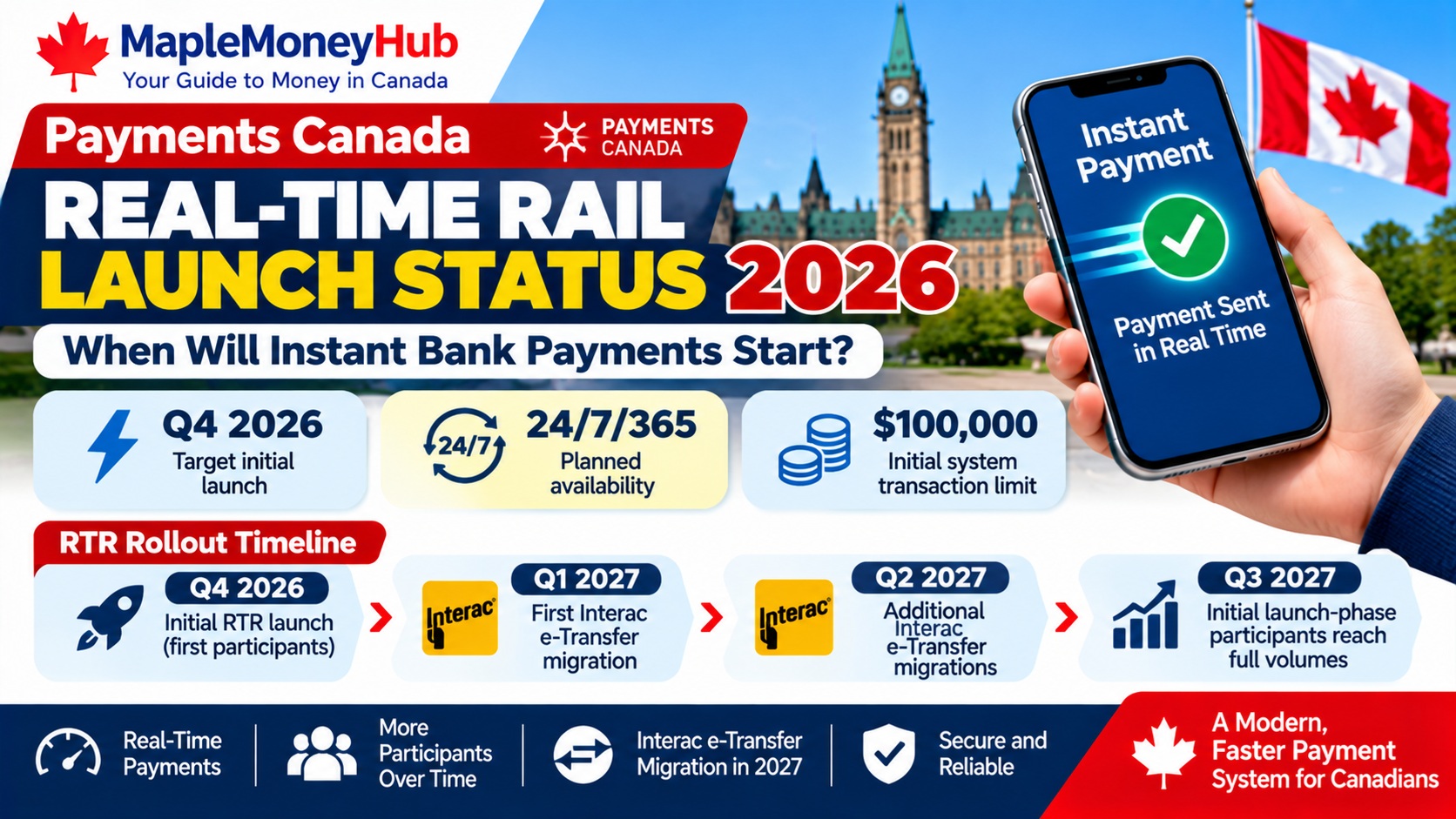
Not yet, based on Payments Canada’s published launch updates available as of November 1, 2026. Canada’s Real-Time Rail (RTR) is scheduled for an initial launch in the fourth quarter of 2026, following successful testing and regulatory assurance.
The rollout will be phased. Initial direct-to-Exchange participants are targeted for Q4 2026. The first Interac e-Transfer clearing and settlement migrations are planned for Q1 2027, followed by additional migrations in Q2 2027.
The system is designed to support real-time payments and settlement, 24 hours a day, seven days a week, including weekends and holidays.
However, this does not mean every Canadian bank customer will immediately have access to a new instant-payment service when the initial infrastructure launches.
Check Official RTR Launch StatusCanada is preparing for one of its most significant payment infrastructure upgrades in years.
The Real-Time Rail is intended to enable financial institutions and payment service providers to move money between participating institutions in real time, with final clearing and settlement happening continuously.
For Canadian consumers, this could eventually mean more convenient payments, faster transfers and new banking products.
For businesses, it could improve cash flow, reduce delays in receiving payments and make it easier to operate outside traditional banking hours.
But the launch has also generated questions: Is RTR already live? Which banks will participate? Will it replace Interac e-Transfer? Can Canadians send $100,000 instantly?
This guide explains the confirmed launch timeline, the difference between RTR and existing payment services, and what Canadians should realistically expect in 2026 and 2027.
1. What Is Payments Canada’s Real-Time Rail?
The Real-Time Rail is a new national payment system being developed by Payments Canada.
Payments Canada operates important parts of Canada’s payment infrastructure and establishes rules governing the exchange, clearing and settlement of payments among participating institutions.
The RTR will allow eligible participants to send, receive, clear and settle payments in real time.
Unlike some existing payment methods, the RTR is designed to provide continuous settlement rather than relying on a later batch-processing cycle.
The system will also support ISO 20022 messaging, which allows richer payment information to accompany transactions.
That additional information could help businesses automate payment reconciliation and develop more sophisticated financial services.
2. What Is the Latest RTR Launch Status in November 2026?
The most recent published roadmap describes a deliberately sequenced introduction.
Rather than activating every participating bank and payment service simultaneously, Payments Canada plans to introduce participants and transaction volumes gradually.
This approach is intended to protect the stability of a system that will become part of Canada’s critical financial infrastructure.
The official schedule remains subject to changes if testing identifies issues requiring additional work.
3. Payments Canada Real-Time Rail Launch Timeline
| Period | Planned Milestone | What It Means |
|---|---|---|
| Q4 2026 | Initial RTR launch | First direct-to-Exchange participants begin operating on the system. |
| Q1 2027 | First Interac migration phase | Initial participants migrate Interac e-Transfer clearing and settlement volumes. |
| Q2 2027 | Additional Interac migration | More participating institutions migrate eligible volumes. |
| Q3 2027 | Full volumes for initial phases | Participants in the initial launch phases target full transaction volumes. |
| After initial phases | Continued onboarding | Additional eligible participants join as they meet readiness requirements. |
These are target milestones, not guaranteed launch dates for individual banks or consumer payment products.
Source: Payments Canada — Testing and Launch.
4. Why Is the Real-Time Rail Launch Taking So Long?
RTR is not simply another banking app or website.
It is a national payment system that must safely process financial transactions among participating institutions.
The infrastructure requires coordination between payment-system operators, financial institutions, regulators, technology providers and fraud-prevention services.
Testing includes:
- System integration testing.
- User acceptance testing.
- Industry solution assurance testing.
- Operational readiness testing.
- Security testing.
- Performance and resilience testing.
These checks are intended to establish that the system can process transactions reliably, respond to security threats and continue operating during periods of high demand.
Payments Canada has stated that testing will continue until it and its partners have sufficient assurance that the infrastructure is ready.
5. What Progress Was Made During 2026?
Several important milestones occurred during 2026.
Industry Testing Began
Payments Canada’s July 2026 quarterly update confirmed that the project had entered the industry solution assurance testing phase.
This meant participating institutions were connecting to the system and testing their own workflows and payment interactions.
Earlier testing had focused on internal technical components.
Fraud Services Were Tested
Participants also began validating the system’s centralized fraud services.
These services are designed to evaluate payment risks as transactions move through the infrastructure.
Legal Framework Was Finalized
Payments Canada announced on June 30, 2026 that the RTR by-law and rules had received the necessary approvals.
They came into force on August 24, 2026, establishing an important legal foundation for the system.
These milestones show progress, but they should not be confused with a completed consumer launch.
6. How Will Real-Time Rail Payments Work?
The RTR is designed to support payment exchange, clearing and settlement within a real-time environment.
In simplified terms:
- A customer or business initiates a payment using a service offered by a participating financial institution or payment provider.
- The provider performs applicable account, authorization and fraud checks.
- The payment instruction moves through the RTR infrastructure.
- Participating institutions exchange the required payment information.
- The system clears and settles the payment in real time.
- The receiving provider makes the payment available according to its product design and applicable rules.
The exact customer experience will depend on the financial institution and payment product involved.
RTR is the underlying infrastructure; banks and payment providers will decide how to present their services to customers.
7. Will Real-Time Rail Work on Weekends and Holidays?
Yes. Continuous availability is one of the system’s defining features.
The RTR is designed to operate 24 hours a day, seven days a week, 365 days a year.
That includes weekends and public holidays.
This could reduce dependence on traditional banking business days for payment services built on the RTR.
However, individual providers may still impose their own security reviews, transaction restrictions or product-specific conditions.
Therefore, continuous system availability does not mean every payment will always be completed without delay.
8. Will RTR Replace Interac e-Transfer?
Not immediately.
Interac e-Transfer is already a widely used payment service in Canada.
The RTR is a separate underlying payment infrastructure that will support new services and changes to how certain existing payments are cleared and settled.
Payments Canada’s roadmap specifically includes migrating Interac e-Transfer clearing and settlement volumes onto the RTR during 2027.
This is not the same as announcing that the familiar Interac e-Transfer customer experience will disappear.
| Feature | Interac e-Transfer Today | Real-Time Rail |
|---|---|---|
| Primary role | Consumer and business transfer service | National payment infrastructure |
| Payment speed | Often fast; delays can occur | Designed for real-time exchange and settlement |
| Availability | Transfers can be initiated outside banking hours | 24/7/365 system operation |
| Clearing and settlement | Uses existing arrangements | Real-time clearing and settlement |
| 2026 status | Established service | Initial launch targeted for Q4 |
| 2027 changes | Planned clearing and settlement migration | Gradual increase in participants and volumes |
If you are experiencing an Interac payment delay today, do not assume the RTR rollout is responsible.
See our related guide: Interac e-Transfer Pending in Canada.
9. Which Canadian Banks Will Support RTR?
Payments Canada has not published a complete confirmed list of institutions participating in the first launch phase.
It says participant names will be shared once the system is live and institutions have successfully completed onboarding.
As a result, it would be misleading to publish a definitive list claiming that RBC, TD, Scotiabank, BMO, CIBC or National Bank will all offer consumer RTR transfers on launch day.
Financial institutions must satisfy technical, operational, security and certification requirements before going live.
Payments Canada says access to RTR is expected to become available to more than nine in ten Canadians within the first year after launch.
This is a rollout expectation, not confirmation that all customers will receive identical services at the same time.
10. Will Canada’s Big Six Banks Join in 2026?
Industry reporting in October 2026 raised questions about whether Canada’s six largest banks would participate in the first launch phase.
BetaKit reported, citing unnamed industry sources, that the initial rollout was unlikely to include the Big Six banks.
Payments Canada did not confirm individual phase-one participants in that report.
The Department of Finance indicated that it would work toward participation by major financial institutions by summer 2027.
Readers should treat this as reporting about expected participation, not an official announcement that a particular bank has been excluded.
The safest way to confirm availability will be to check Payments Canada’s participant announcements and your financial institution’s own notices.
11. What Is the RTR Transaction Limit?
Payments Canada states that the Real-Time Rail will have an initial $100,000 system transaction limit.
This limit is intended to align with relevant financial and fraud-risk controls.
However, individual participants may establish lower transaction limits for their customers.
Example: System Limit vs. Bank Limit
Suppose the RTR system permits transactions up to $100,000.
Your bank could still offer an RTR-based service with a lower limit, such as $5,000 or $25,000, depending on its policies.
These lower amounts are illustrative examples, not confirmed limits at any particular Canadian bank.
Always check the actual limits published by your financial institution.
12. Will RTR Make Payroll and Salary Deposits Faster?
Potentially, yes.
RTR could support new payment products that help businesses send funds outside traditional banking hours.
Possible uses include:
- Faster payroll-related payments.
- Urgent supplier payments.
- Insurance claim disbursements.
- Marketplace seller payouts.
- Business-to-business transfers.
- Refunds and other customer payments.
However, the launch of RTR does not automatically convert every payroll system, government benefit deposit or bill-payment service into an instant payment.
Employers, banks and payment providers must choose to implement compatible products and workflows.
Existing payroll schedules and payment-processing arrangements may continue unless the provider changes them.
13. Will Government Benefits Be Paid Instantly?
The RTR could eventually support faster government disbursements if appropriate services are developed.
However, there is no confirmed general change requiring CPP, OAS, Employment Insurance, Canada Child Benefit or other federal benefit payments to move onto RTR at launch.
Canadians should continue using the payment dates officially published by the relevant government agency.
Do not assume a scheduled benefit will arrive earlier simply because the Real-Time Rail launches.
For existing schedules, see our CPP Payment Dates 2026 and EI Payment Dates 2026 guides.
14. Will RTR Reduce Bank Transfer Fees?
Possibly, but lower customer fees are not guaranteed.
RTR may encourage competition by giving eligible payment service providers more ways to develop payment products.
However, Payments Canada does not set the retail price of every banking service that participants may offer.
Banks and fintech companies will determine pricing for their products, subject to applicable requirements.
Some services could be offered without a separate transfer fee, while others may have transaction or subscription charges.
Consumers should compare actual published prices rather than assume every RTR transfer will be free.
15. Is Real-Time Rail Safe?
Payments Canada has made security and operational resilience central requirements of the launch.
RTR participants must meet mandatory standards before joining.
The system is also being designed with centralized fraud services that evaluate transactions in real time.
These measures are intended to supplement, not replace, each participant’s own fraud controls.
Nevertheless, instant payments can create risks if money is sent to a scammer or the wrong recipient.
Consumers should continue to:
- Verify recipient details before sending money.
- Use trusted banking apps and websites.
- Be suspicious of urgent payment requests.
- Never share one-time security codes.
- Contact their bank immediately if fraud is suspected.
Faster settlement should not be confused with guaranteed payment reversibility.
16. What Is ISO 20022 and Why Does It Matter?
ISO 20022 is an international standard for financial messaging.
It enables more structured and detailed information to accompany payment instructions.
For businesses, this could improve automated matching between incoming payments and invoices.
For example, a business might receive a payment together with a structured invoice reference, making it easier to identify what the payment relates to.
Better payment data can reduce manual reconciliation work and support new accounting integrations.
However, these benefits depend on how participating institutions and software providers implement the standard.
17. How Will RTR Affect Canadian Fintech Companies?
RTR may create opportunities for eligible fintech companies and payment service providers to develop new payment services.
Historically, some firms have relied on partnerships with banks to access payment infrastructure.
Expanded Payments Canada membership eligibility and RTR participation models could support greater competition.
However, membership does not automatically grant access to RTR.
Each participant must meet the applicable requirements and complete certification.
The practical effect on consumers will depend on which providers join, what services they launch and how those services are priced.
18. Can I Sign Up for Real-Time Rail Now?
RTR is not a single consumer application that everyone can download.
It is payment infrastructure used by participating financial institutions and payment providers.
Consumers will generally access RTR-powered services through banks, credit unions or other eligible providers after those services become available.
As of November 1, 2026, there is no general requirement for Canadians to register for RTR or change their bank accounts.
Be cautious of websites claiming you must pay a registration fee to activate Real-Time Rail access.
Use your bank’s official website and Payments Canada’s published information to verify any announcement.
19. What Should Canadian Bank Customers Do Before Launch?
For most consumers, no immediate action is necessary.
Still, it is useful to understand what the rollout will and will not change.
- Continue using existing bank transfers and Interac e-Transfer normally.
- Watch for official announcements from your financial institution.
- Check whether your bank supports any new RTR-powered payment product.
- Review transaction limits and fees when a service launches.
- Verify how mistaken or fraudulent payments are handled.
- Keep existing bill-payment and payroll arrangements unchanged unless your provider instructs otherwise.
- Check Payments Canada’s launch updates for changes to the rollout schedule.
Businesses should also speak with their banking and payment-processing providers about potential integration timelines.
20. Frequently Asked Questions
Has Canada’s Real-Time Rail launched in 2026?
As of November 1, 2026, Payments Canada’s official schedule still targets a Q4 2026 initial launch. A completed nationwide launch has not been confirmed in the published updates reviewed for this article.
What is the expected RTR launch date?
Payments Canada targets Q4 2026 but has not published a guaranteed calendar day for general consumer availability.
Will RTR work 24 hours a day?
Yes. The infrastructure is designed for continuous 24/7/365 operation.
Will Interac e-Transfer disappear?
No immediate discontinuation has been announced. Interac e-Transfer clearing and settlement volumes are scheduled to migrate in phases during 2027.
Will all Canadian banks participate on day one?
No. The launch is deliberately phased, and individual participants must meet readiness and certification requirements.
Can I send $100,000 instantly?
The initial RTR system transaction limit is $100,000, but financial institutions can impose lower customer limits. Availability also depends on participating providers and their services.
Will RTR speed up direct deposits?
It could enable faster payment products, but existing direct-deposit arrangements will not automatically change at launch.
Will government benefits arrive earlier?
No general change to government benefit schedules has been confirmed as a result of RTR.
Is RTR the same as Interac?
No. RTR is national payment infrastructure, while Interac e-Transfer is a customer-facing transfer service with its own network and arrangements.
Do I need to register for RTR?
No general consumer registration is required. Eligible services will be offered by participating financial institutions and payment providers.
21. Related MapleMoneyHub Articles
- Interac e-Transfer Pending in Canada: Causes and Fixes
- CRA Payroll Calculator 2026: CPP, EI and Take-Home Pay
- CPP Payment Dates 2026
- EI Payment Dates 2026
- How Credit Scores Work in Canada
22. TL;DR: Payments Canada Real-Time Rail Launch Status
- Payments Canada targets an initial Real-Time Rail launch in Q4 2026.
- The system remains subject to successful testing and readiness assessments.
- The first direct-to-Exchange participants are scheduled for Q4 2026.
- Interac e-Transfer clearing and settlement migration is planned for Q1 and Q2 2027.
- Participants in the initial phases are targeted to reach full volumes by Q3 2027.
- RTR will support real-time payment exchange, clearing and settlement.
- The infrastructure is designed to operate 24/7/365.
- The initial system transaction limit is $100,000, but providers may impose lower limits.
- Not every Canadian bank will necessarily offer RTR services at initial launch.
- Existing government benefit, payroll and bill-payment schedules will not automatically change.
Bottom line: Canada’s Real-Time Rail is moving toward a phased launch, not an immediate nationwide switch to instant payments. Canadians should watch for official participant announcements and bank-specific service availability.
View Latest Official RTR StatusOfficial Sources and Further Reading
- Payments Canada — Testing and Launch
Official RTR launch schedule and testing phases - Payments Canada — Real-Time Rail FAQ
System availability, transaction limits and participation - Payments Canada — July 2026 Quarterly Update
Industry solution assurance testing and rollout strategy - Payments Canada — RTR Rules Approved
June 2026 announcement and August 2026 effective date - BetaKit — October 2026 Banking Industry Report
Reporting on initial bank participation and rollout questions
Last reviewed November 1, 2026. MapleMoneyHub is an independent Canadian financial information website and is not affiliated with Payments Canada, Interac or any financial institution. Launch timelines, participating institutions and product availability may change.